
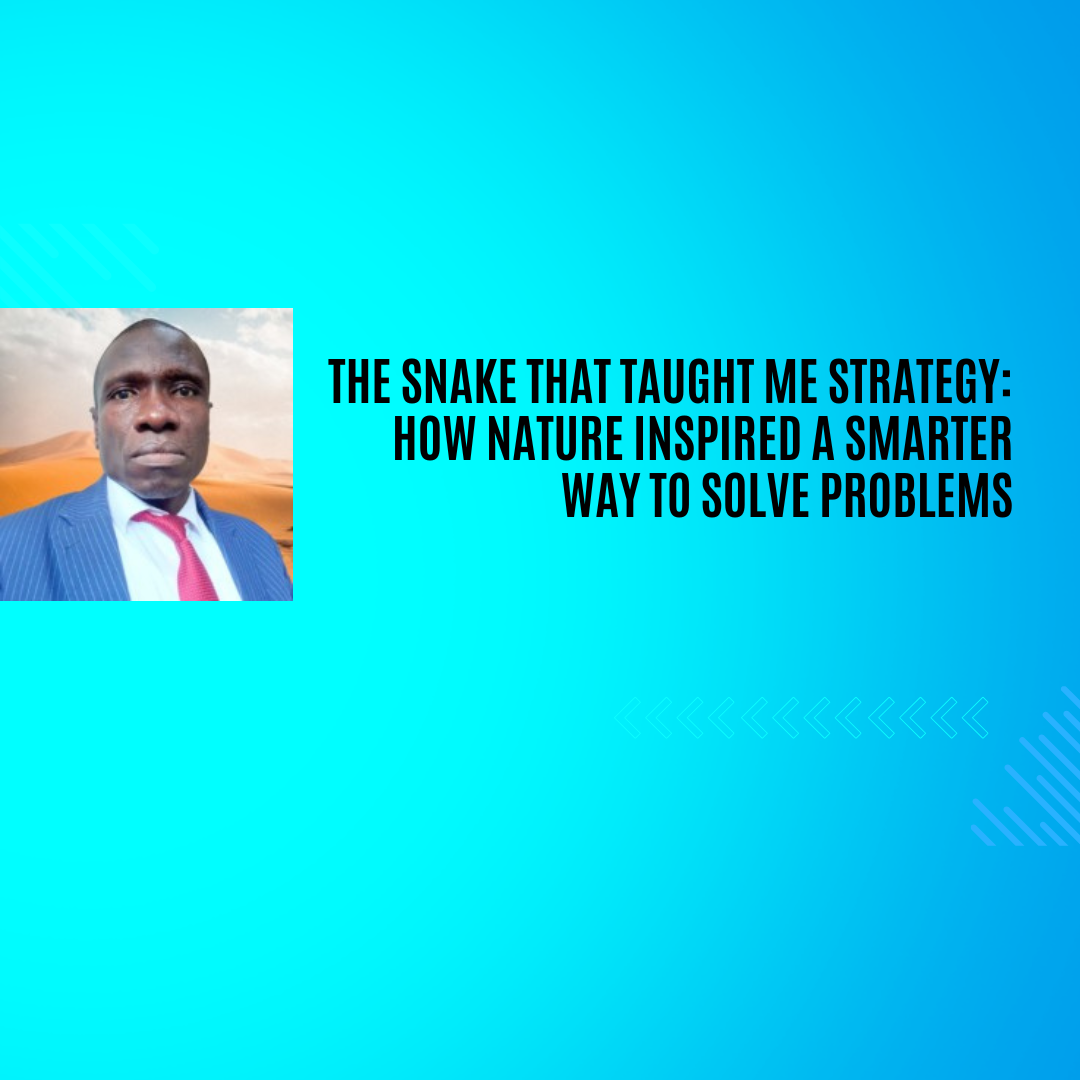
By Hezron Ochiel
I never imagined a snake would teach me one of the most powerful lessons in strategy.
A popular quote goes, “Do not waste your time chasing butterflies. Mend your garden, and the butterflies will come.” It always sounded poetic, but I never deeply understood its wisdom until one dry season when snakes invaded our home. The experience changed our habits and reshaped my leadership, communication, and problem-solving perspective.
When Trouble Came Crawling
During dry seasons, snakes became unexpected and terrifying visitors to our compound. My wife was so shaken after one encounter that she hesitated to go outside, even during the day. Our kids, too, became cautious. Every errand around the house required scanning the ground first. What started as unease quickly turned into constant fear.
And then it hit me: these were not random attacks. We were unintentionally attracting them.
Why Snakes Chose Our Home
After a bit of local inquiry and reflection, it became clear:
- The bush outside the compound was dry, with no water sources nearby.
- Insects and small animals, their typical prey, were scarce.
- There was no shade in the wild.
Our home, by contrast, had everything they needed:
- Water buckets left outside.
- Bits of food and organic waste.
- Cool shaded areas with shelter.
We had unknowingly created the perfect conditions for snakes to thrive.
What We Did Differently
Initially, my instinct was to chase them away, using repellents, sticks, and even building a wall. But none of these offered lasting peace. Then, instead of fighting the snake head-on, we changed the environment.
- We dumped food scraps further from our kitchen area.
- We placed water containers outside the compound, away from the house.
- Insects and other animals were drawn to those areas, and soon, so were the snakes.
Gradually, they stopped coming to the house. We reclaimed our peace not by confrontation but by redirection.
The Strategy Behind It
This experience echoed what great strategists like Sun Tzu taught in The Art of War: “The supreme art of war is to subdue the enemy without fighting.” Not all battles require direct engagement in business, life, and leadership. Some require understanding patterns and adjusting your environment.
A 2021 article in Harvard Business Review emphasizes that addressing systemic issues within organizational processes, rather than focusing solely on individual performance, significantly improves productivity and employee engagement.
The same applies to life.
Lessons from the Snake
Here are five timeless strategy lessons I learned from this experience:
1. Do not always fight the problem. Redirect it.
We are wired to be reactive. When something threatens us, we want to strike. But sometimes, the most brilliant move is to step back, understand the source, and redirect its energy.
Example: Instead of micromanaging a difficult team member, change the system that enables their behavior.
2. Your environment attracts what you allow
Whether at home, in your social circles, or online, the environment you create shapes what and who you attract. Just as our home unknowingly invites snakes by offering water, food, and shelter, we often attract chaos, conflict, or even emotional fatigue without realizing it.
Take this example: if your home is constantly noisy, disorganized, and tense, it will not take long before arguments become the norm. Children mirror the energy around them. Guests feel uneasy. Even your sense of calm disappears.
3. Solve the root, not the symptom.
We could have killed every snake we saw. But more would have come. Until we removed what attracted them, the cycle would continue. Strategic problem-solving means digging deeper than the obvious issue.
Ask: What is really feeding this problem?
4. Peace comes from alignment, not avoidance.
Real peace is not the absence of problems; it results from systems working in harmony. Peace followed once we aligned our actions with what we wanted (safety and calm).
5. Let strategy do the heavy lifting.
We did not fight harder; we just thought smarter. Strategy is about thinking differently, but not about working more.
As business leader Michael Porter says, “The essence of strategy is choosing what not to do.” That shift in mindset can change everything.
For Leaders and Changemakers
Managing a team? Running a business? Raising a teen? Whatever your role, keep in mind that not everything calls for a dramatic response. The most effective leaders focus less on reacting and more on removing the root causes of chaos.
Here is what you can do today:
- Audit your environment: What are you unknowingly encouraging?
- Set better boundaries: Physically, emotionally, and digitally.
- Build proactive systems instead of reactive habits.
- Listen before acting. Sometimes the answer is already in the pattern.
Final Thoughts
That dry season taught me more than any leadership book ever has. Not because it was great, but because it was real.
So, pause the next time you are tempted to chase the snake. Look around. Ask what might be drawing it in.
And instead of reacting, reposition.
Fix your garden. Redirect the snakes. And let strategy take it from there.
Want more strategy insights drawn from everyday life? Subscribe to the newsletter or follow Hezron Insights for weekly reflections on leadership, clarity, and communication that actually work.
The writer is a Strategic Communications Expert at the Kenya Medical Training College and the founder of Hezron Insights, a blog offering exclusive tips on public relations, leadership, and workplace resilience, grounded in real-life case studies.