

Introduction
This guide is essential for reporters, including journalists, bloggers, and communication specialists aiming to distill scholarly findings into accessible insights for the public. Scholarly research often presents complex ideas in scientific jargon, authored by experts to share discoveries, advance knowledge, and enhance human well-being. Policymakers frequently rely on these findings to inform crucial decisions, yet many lack a scientific background and benefit from interpretations that translate complex data into actionable insights.
While journalists, bloggers, and PR professionals have numerous sources for news, scholarly articles offer rich narratives that resonate deeply with their audiences. For instance, a study on community health patterns can empower residents to make informed lifestyle choices. Failing to report such crucial research would deny communities the opportunity to improve their well-being.
In this guide, drawing from my years of experience reporting on research findings and maintaining journalistic integrity, I’ll outline a step-by-step approach to effectively communicate these insights to a broader audience.
Finding and Interpreting Research
When I began my career as a freelance journalist some years ago, I discovered that covering scholarly articles was a fascinating beat. Freelancers are typically compensated per published article, and travel expenses can be prohibitive. This is where journal articles and science news websites prove invaluable. Simply visiting major sites and subscribing to their updates is sufficient. As an experienced health and climate change reporter, I cultivated relationships with journals like PLOS One, Nature, The Lancet, Science, and others, which proved enormously beneficial.
What are academic journals?
An academic journal is a periodical publication that regularly features scholarly articles and research findings in a specific field of study. These journals are authored by and targeted towards academics, researchers, and professionals. Their primary purpose is to disseminate new research, advance knowledge across various disciplines, and facilitate the critical exchange of ideas and findings.
Academic journals serve different purposes and cater to specific audiences within the scholarly community. They include Original Research articles, authored by the researchers conducting the study and typically subjected to peer review before publication. Other academic journals include Case Studies, Retrospective Studies, Methodology Studies, Review Articles, and much more.
In the interest of this guide, I will focus on peer-reviewed academic journals. Peer review involves the evaluation of an article by experts in the same field who assess its quality and validity. Based on their evaluation, they recommend whether the article should be accepted for publication or rejected based on the journal’s standards and criteria.
How do you find academic journals?
a) Journals: The internet is awash with various types of journals, and the easiest way to find one is by conducting an online search. While some have paywalls, where one has to pay before gaining access, others are freely available via open source. You can still gain access to the paid versions. Universities and other institutions of higher learning have access to these paid journals. One only needs to enroll with them and gain access to these publications.
b) Google Scholar: Google Scholar is a freely available academic search engine provided by Google. To get a scholarly published article in Google Scholar, follow these steps:
• Click on Google Scholar, enter the article title, and click search.
• If available, it will appear among the top search results.
Reading and Interpreting Research
a) Read carefully
• To efficiently read academic papers, start by clarifying your objective to focus your attention. Begin with a quick scan of the abstract, introduction, and conclusion to grasp the main ideas.
• Review figures and tables to understand the data visually. Dive deeper into the introduction for context, skim the methods section unless crucial details are needed, focus on the results section, and analyze the discussion for broader implications.
• Take notes and highlight key points, use reference management tools like EndNote or Mendeley, and refer to review articles for comprehensive overviews. Engage in peer discussions to enhance understanding, and stay updated by following leading journals and researchers in your field.
• If you encounter technical jargon that is difficult to understand, keep a dictionary or access the internet for definitions.
• If these resources are insufficient, consider consulting an expert in the same field or contacting the author directly (contact details are usually provided in the research paper) for clarification.
b) Assess newsworthiness
• Ask yourself questions such as, what new insights does the research offer? How does it resonate with your audience? If the research doesn’t present novel findings or cover a well-trodden topic, it may not be worth pursuing. However, if it introduces a fresh perspective, it merits consideration. Assessing relevance is crucial—does it align with what your audience typically engages with?
• Determine if it fits your publication’s scope or ties into current events. For instance, research on the impacts of recent global floods could be timely and newsworthy. Similarly, studies emerging during significant global events may capture public interest and relevance. For example, a study finding released during the World Climate Change forum may be newsy.
Preparing to Extract a Story
When evaluating a story’s potential, consider its relevance and impact on your audience, the novelty of the information it presents, and how it relates to real-life experiences or individuals. Simplify complex concepts to enhance clarity, provide background information for context, and incorporate direct quotes and data to bolster your narrative. Lastly, explore the broader implications and potential future impacts to create a compelling and informative story.
Step one: Interviewing the lead researcher is crucial for clarifying issues and concepts. Telephone calls, face-to-face, and email interviews can be particularly effective as they allow for follow-up questions.
Here are some key questions to consider:
• Could you explain your main findings?
• What is innovative or groundbreaking about your research?
• Can you outline your methodology?
• Based on your findings, what areas of policy should be prioritized?
Step two: Interview independent experts within the same field of study, such as university professors, senior government officials, and specialists in civil society or private sectors to corroborate the findings. Independent specialists can guide you through the study’s design, pointing out limitations and biases. They will interpret the data, assist with calculations, and help determine the study’s significance. It’s crucial to maintain an independent perspective to enhance credibility.
Each brings a unique perspective: professors provide academic experience, policymakers offer views on policy implications, and civil society or private sector actors contribute practical perspectives on implementing and scaling up findings. In addition to discussing the policy implications of your study, interviewing a government official helps localize your story, making it more relatable for your audience. Including all these viewpoints enriches your article with diverse perspectives and depth of understanding.
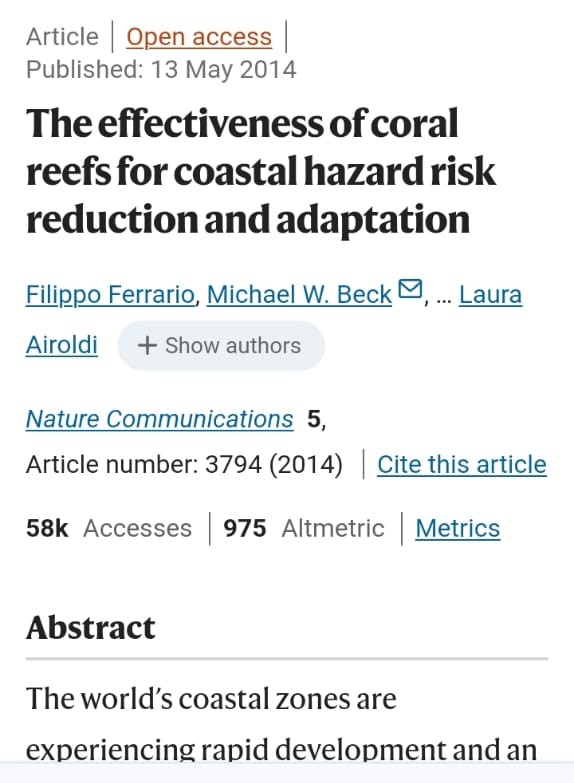
Sample Case Study
To better illustrate this concept, let’s refer to a study I published previously titled,
“The Effectiveness of Coral Reefs for coastal hazard risk reduction and Adaptation.”
Here are some questions I asked and the responses I received from one of the experts:
Expert One: Interview Questions & Responses
Q1: What adaptive measures can be adopted to reverse the trend?
A:
• Reducing overall global warming pollution is essential to minimize ocean temperature increase. However, minimizing other impacts not directly related to global warming can improve the ability of these sensitive ecosystems to withstand the duress of global warming.
• Improving watershed management of nearby lands.
• Research is needed to develop new practices and technologies that can mitigate global warming.
Q2: Some researchers suggest that coral reefs could provide defense for coastal regions around the globe. What do you think needs to be done to adopt these methods?
A:
• Establish and strengthen local and national policies and programs to improve coastal water quality and protect reef-dependent watersheds.
• Expand marine protected areas around reefs and collaborate with other nations to promote such efforts in their regions.
• Increase funding for coral reef research and restoration.
• Discourage trade in marine species that have been captured through damaging or unsustainable techniques.
Q3: As an expert in the field, what challenges have hampered Kenya’s efforts to conserve its coastline?
A:
• Lack of investment in research that can develop new practices and technologies that can conserve the coastline.
• Policies that can create an enabling environment for conservation are lacking.
• Poor enforcement of existing rules that guide coastal conservation practices.
Q4: Additionally, are there any other issues you would like to be addressed in the article?
A: Scientific consensus indicates that greenhouse gas emissions need to start falling before 2020 to avoid global temperature rises above the level at which the devastating effects of climate change will cause irreversible damage, including the submersion of low-lying islands and coastal cities.
Expert Two: Interview Questions & Responses
Q1: Do you think Kenya is prepared for any possible submersion? What needs to be done?
A: No, Kenya is making significant efforts to adapt, but it is not sufficiently prepared for issues arising from rising sea levels, storm surges, and flooding. Efforts in adaptation—including research—have been focusing more on semi-arid areas and agriculture.
Q2: What adaptive measures can be adopted to reverse the trend?
A: By carrying out a comprehensive vulnerability assessment, not limited to sea level rise projections. Better participatory urban planning and drainage facilities, particularly in informal settlement areas. Policies and interventions that allow and enable people to relocate from particularly vulnerable areas, or areas where urbanization prevents natural coastal dynamics.
Q3: Some researchers suggest that coral reefs could provide defense for coastal regions around the globe. What do you think needs to be done to adopt these methods?
A: I agree with this position. Coral reefs and mangroves are natural protection/buffer zones. However, coral reefs are ecosystems that are extremely sensitive to changing chemical and temperature parameters of the seawater, some of them related to climate change. There are no efficient engineering solutions to combat the degradation of coral reefs. The best way to facilitate coral restoration and growth would be a large-scale ecosystem-based approach to adaptation and natural resource management, regulating the flow of sediments and pollutants, fisheries, and tourism activities that directly impact the reefs at a local scale.
Q4: As an expert in the field, what challenges have hampered Kenya’s efforts to conserve its coastline?
A: There are multiple challenges. Major obstacles include poverty, limited human and financial resources, lack of awareness, and poor coordination among various actors involved in coastal resource management. Stakeholder engagement and commitment, combined with better resourcing and coordination, are essential to overcoming these challenges.
Article Conclusion
Reporting research findings is both a science and an art. It requires meticulous reading, critical thinking, and the ability to distill complex data into clear, engaging narratives. By carefully interpreting and presenting research, journalists and PR professionals contribute significantly to informed public discourse, enhancing both societal knowledge and decision-making.
A PDF guide can be downloaded here.