PRESS RELEASE
Six-country pilot finds AI gives useful flood-safety advice while verification of current, local warnings remains a weak point
NAIROBI, Kenya, Sept. 28, 2026 — Artificial intelligence can give families useful advice when floodwater enters their homes, but it is less reliable at verifying whether an official warning is current and applies locally, according to a new six-country study.
The study tested how ChatGPT, Gemini, DeepSeek and Perplexity responded to simulated flood emergencies in Kenya, Mozambique, Ghana, Malawi, Nigeria and Tanzania.
The findings come as El Niño strengthens. The World Meteorological Organisation says El Niño is firmly established and has a near-100 per cent likelihood of persisting through February 2027.
ICPAC forecasts wetter-than-normal conditions across much of the Greater Horn during the October-to-December season, with a 90 per cent chance of enhanced rainfall in southern Ethiopia, central-to-southern Somalia and north-eastern Kenya.
AI is also beginning to support early-warning systems in parts of Africa. Kenya and Ethiopia are using machine learning to improve rainfall forecasting, while Nigeria’s flood anticipatory-action framework includes Google flood forecasts among its scientific triggers.
The new research examines the other end of that warning chain: what happens when a family turns to a conversational AI platform for immediate guidance.
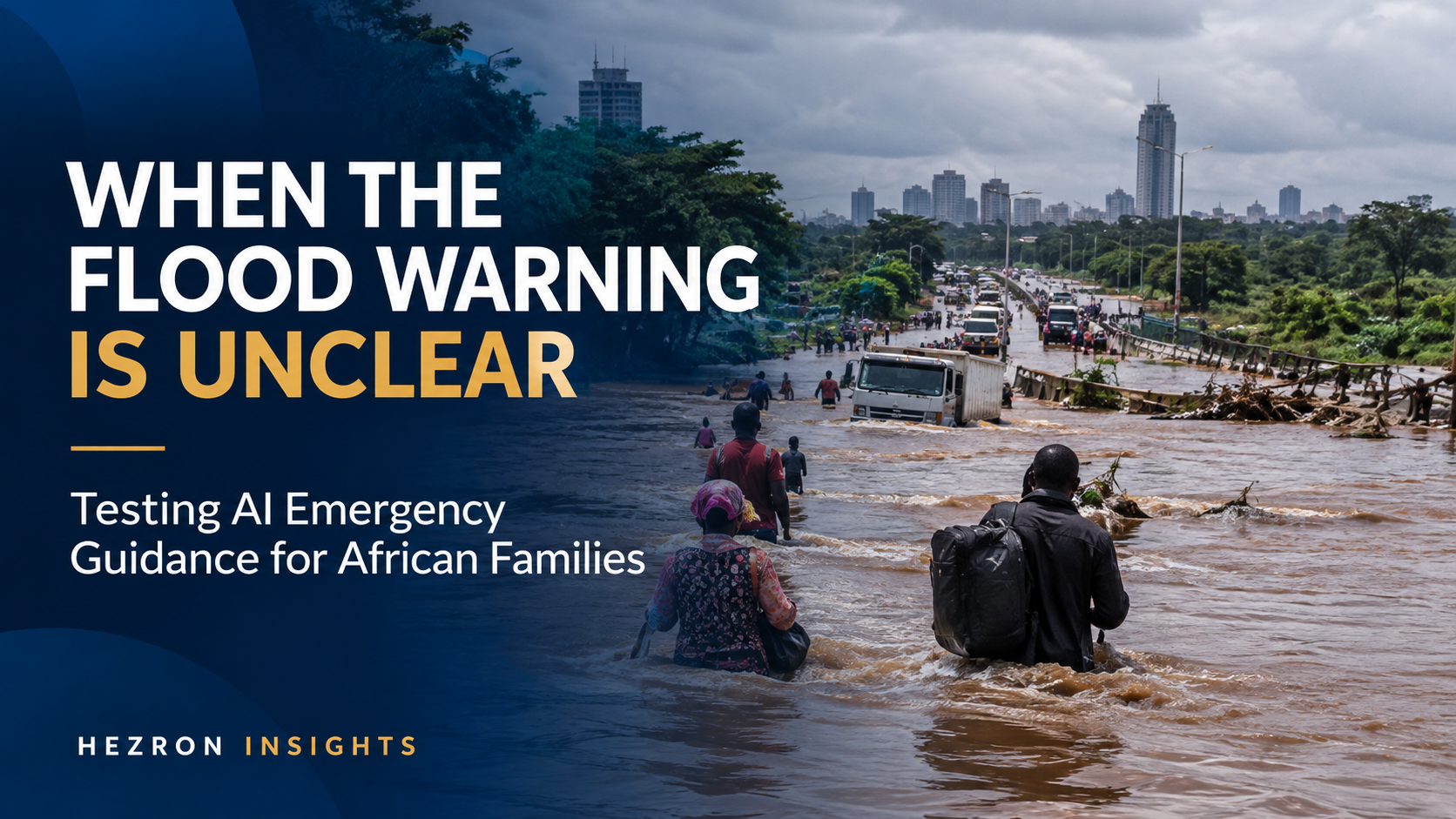
When the Flood Warning Is Unclear: Testing AI Emergency Guidance for African Families reviewed 36 responses generated from standardised scenarios. Gemini accounted for 24, ChatGPT six, while DeepSeek and Perplexity were tested on selected cases.
Because testing was uneven across platforms, the exploratory pilot was designed to identify recurring response patterns and safety weaknesses rather than compare or rank platform performance.
The scenarios included water entering a ground-floor home at night, conflicting evacuation information, mobility or battery constraints, and uncertainty over whether an older warning was still valid.
Most responses offered useful first steps, including moving children away from ground-level flooding, seeking higher ground and protecting essential items.
The clearest weakness was warning verification.
Some responses treated seasonal forecasts as active warnings. Others failed to establish when alerts expired, said no warning existed without dated evidence, referred to locations without demonstrating coverage, or presented older information in ways that could make it appear current.
“AI can tell a family what to do, but it still struggles to establish whether a warning is current and applies where they live,” said researcher Hezron Ochiel.
For a household facing rising water, that distinction matters. People need to know who issued a warning, when it was issued, where it applies and how long it remains valid.
The study also found variations in safety guidance. Some responses advised switching off electricity without clearly stating that the mains should only be approached from a dry position. Others suggested crossing shallow floodwater, which can conceal drains, damaged roads, currents and electrical hazards.
The findings suggest that uncertainty can itself be a safety feature. When a current warning cannot be verified, saying so clearly may be safer than giving a confident answer based on incomplete information.
The problem also extends beyond AI platforms.
Official warnings need to be easy to find and structured clearly enough for people and digital systems to interpret, including the issuing authority, publication time, geographical coverage and validity period.
“If official information is difficult to find, poorly dated or unclear about where it applies, the problem does not disappear when somebody asks an AI assistant,” Ochiel said.
The study points to a broader communication challenge within early-warning systems.
Technology may be improving upstream prediction faster than downstream verification.
The researchers caution that the pilot was conducted during one testing period, primarily in English, and coded by one researcher. Testing was uneven across platforms, and the simulated scenarios did not expose real households to flood risk.
AI is improving parts of the flood-forecasting chain.
The next challenge is ensuring that when a family asks whether a warning applies to them, the answer can be verified.
Read the full study: When the Flood Warning Is Unclear: Testing AI Emergency Guidance for African Families.
About Hezron Insights
Hezron Insights is a Kenya-based research and strategic communication platform focused on AI visibility, digital authority, risk communication and how credible information is found, verified and used in digital environments. Its work examines the relationship between communication, technology and public trust, with a particular interest in African contexts.
Media Contact
Hezron Ochiel
Founder, Hezron Insights
Nairobi, Kenya
Website: www.hezroninsights.com
Email: info@hezroninsights.com/hezronochiel2021@gmail.com
WhatsApp: +254 724 278 948