

In April 2023, Kenya made a significant stride by providing stipends and health insurance to 100,000 Community Health Promoters (CHPs), previously known as Community Health Volunteers (CHVs). This landmark initiative was a substantial development in community health support and public health policy. To many, this might have seemed like just another news item. However, for those of us who were on the frontline advocating for these community champions, it was an immense win for the well-being of our communities.
I still recall that moment on September 25, 2023, when Kenya’s President Dr. William Ruto announced this initiative live on national TV. The formal integration of CHPs into the healthcare system gave me a sense of pride. This achievement marked the culmination of years of dedicated advocacy and communication efforts for these men and women who are unsung heroes in the health sector. Whether referred to as CHPs, CHWs, or CHVs in various countries, these individuals are the lifeblood of our communities. Their firm commitment to promoting nutrition, hygiene, and disease prevention has been instrumental in bridging health disparities across sub-Saharan Africa.
Where My Journey Began
My commitment to this cause was kindled when I joined Amref Health Africa in 2017 as a Strategic Communication Specialist. Being part of a project that I deeply loved was so exciting. Growing up in the village, I still remember my parents welcoming CHPs into our home. Whenever a disease outbreak occurred in my village, they were the first to arrive and provide us with education and information. These encounters left a lasting impression on me. As my career evolved, I had the honor of capturing their work in documentaries. These films spotlighted their indispensable role in strengthening our healthcare system.
At Amref, I became involved with the Health Systems Advocacy Partnership, a five-year initiative funded by the Ministry of Foreign Affairs of the Netherlands. Our core objective was to lobby governments in Kenya, Uganda, Tanzania, Malawi, and Zambia to allocate 15 percent of their annual budgets to healthcare. This goal resonates with the ‘Abuja Declaration’ of April 2021, where African leaders committed to dedicating 15 percent of resources to health. For us, this declaration was more than a mere pledge—it became our guiding principle.
At the heart of our advocacy efforts was the acknowledgment of CHVs. We were convinced that by strengthening community health systems, we could make significant strides towards achieving universal health coverage for everyone.
Advocacy Strategic Approaches
While the program used various advocacy strategies that likely contributed to its overall success, I will focus on highlighting just a few in this article.
1. Building Coalitions
The Africa Health Accountability Platform (AHAP) was formed as a coalition of Civil Society Organizations (CSOs) primarily to advocate for the project. These advocates were instrumental in promoting the advocacy agenda across various platforms. AHAP had members from five countries and aimed to urge regional governments to allocate and protect health budgets with specific usage restrictions. During this time, several other organizations were also advocating for strengthening health systems. They included ENAI Africa, Financing Alliance for Health, Living Goods, Lwala Community Alliance, Medic, and UNICEF, among others.
2. Engaging Decision Makers
Lobbying policymakers, government officials, and other decision-makers to enact laws took various forms. The project team organized numerous roundtable meetings with parliamentarians, particularly those on health committees. Meetings were also held with the county governments. A notable achievement was enhancing the capacities of legislators, which led to the drafting of quality bills later tabled in various parliaments for discussion. One such bill was the Community Health Service Bill 2020, sponsored by then-nominated Senator Agnes Zani. Additionally, our advocacy work influenced the development of important strategies including the Kenya Community Health Strategy 2020-2025.
3. Mobilizing Supporters
The Community Health Workers (CHWs), benefiting from the initiative, were organized and empowered by the project to engage in advocacy. With both technical and financial backing, CHWs participated in various forums, such as the World Health Assembly 2019. Here, they communicated directly to attending health ministers through a campaign titled “Dear Minister.” This campaign stands as one of the most impactful advocacy initiatives ever launched in Africa. The campaign utilized videos, audio recordings, and posters featuring CHWs. One poster message read:
‘Dear Minister,
Community Health Workers are very important in the community.
I’d like to ask you to recognize us and pay us.’
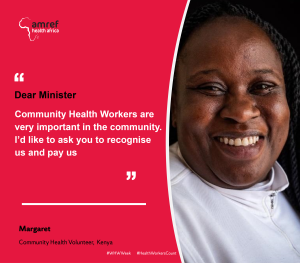 Photo courtesy of AMREF
4. Media Campaign
Through the Africa Media Network on Health, a network of health reporting journalists, continuous reporting may have played a crucial role in informing policymakers about health priority areas and exerting significant pressure on them to embrace CHWs (Community Health Workers). The health messages in media, including talk shows, opinion pieces, and features, adopted a strategy called ‘framing‘—the intentional crafting of a message to achieve a specific impact on the recipient. The project invested heavily in mentoring journalists to equip them with the latest information and trends in health. Additionally, a pool of experts was identified and made available to respond to media queries and participate in panel discussions. This had a positive impact on sustaining the advocacy debate.
5. Manifestos of Political Parties
Recommendations
While pinpointing the most effective strategy that yielded the desired results may be challenging without concrete scientific evidence, I believe that media engagement, manifesto development, and engagement with decision-makers were the game changers in driving our success. I strongly recommend conducting a study to identify the precise strategies behind the overall success. Such insights could help shape future advocacy strategies.
Final thoughts
The insights gained from this advocacy journey highlight the value of persistence, teamwork, and thoughtful communication. It shows the power of coming together with a shared goal and advocating wholeheartedly for our communities’ welfare. Let’s carry forward these lessons, draw from our experiences, and strive towards creating a healthier and more equitable future for everyone.
Do you know someone who might benefit from my insights? Please forward them this article so they can subscribe to my updates at hezroninsights.