

By Hezron Ochiel
Not long ago, I visited one of our satellite campuses with our senior management team.
When it was my time to address the students, I decided to test whether our communication was truly reaching them.
So I asked a simple question: “How many of you follow our official social media pages?”
Our college invests considerable time and resources in X, Facebook, Instagram, TikTok, and YouTube.
Since most of our students are between 18 and 25 years old, I expected almost every hand to go up.
Only a few did.
That moment was uncomfortable.
So I asked a second question: “If you do not follow our official pages, where do you get updates from the college?”
Their answers revealed something every communication professional should pay attention to.
Some said they relied on classmates. Others followed their class WhatsApp groups. A few checked the student portal. Some waited for notices to be forwarded to them.
That was when I realised something important: students had access to official updates, but the route to those updates was not always direct.
That conversation stayed with me long after I left the campus.
It challenged one of my long-held assumptions about organisational communication.
It also raised an important question every communication professional should ask:
Are we getting real value from our social media investments if we have not first understood where our audiences turn for answers?
That question extends well beyond higher education.
New channels keep emerging. Each one arrives with the promise of reach, engagement, and growth.
Faced with this pressure, many PR teams feel compelled to establish a presence as quickly as possible.
Before long, brands find themselves managing six, eight, or even ten accounts, with engagement spread thin across most of them.
From a strategic communication standpoint, this points to a deeper planning issue.
Before investing in any channel, institutions should first understand how their audiences find, verify, discuss, and act on information.
Yet in many planning conversations, the opening question is usually the same: Which social media platform should we introduce next?
After years of working in strategic communication, leading one of Africa’s largest institutional communication audits, and observing how people find and use information, I have come to believe that effective communication strategy needs a stronger foundation.
That foundation begins with a better question: Where does our audience naturally begin its search for information?
This may sound simple, but it changes how communication is planned, measured, and evaluated.
It also gives organisations a stronger basis for decision-making at a time when AI-powered search tools are influencing how people search, compare, and act on information.
That is why effective communication begins with a clear understanding of how people seek, trust, and use information.
When a brand understands how its audiences look for answers, decide what to trust, seek clarification, and take action, it can make better decisions about where to show up and what to say.
It also becomes easier to remain visible in a world shaped by search engines, social media, websites, and trusted human recommendations.
Defining our terms
Before we go further, let us define the core concepts that shape this approach.
Audience-Centred Communication: An approach where an organisation’s communication strategy is built around the specific needs, habits, and preferences of its audiences.
Audience Information Journey™: A framework that maps the five stages people move through when seeking information: Discovery, Verification, Discussion, Action, and Advocacy.
Communication Audit: A systematic, evidence-based assessment of how information flows between an organisation and its stakeholders. It helps identify gaps, measure effectiveness, and understand where audiences place trust.
These concepts matter as effective communication depends on understanding how people move from a question to a decision.
The communications industry has been solving the wrong problem
For years, communication professionals have focused on comparing platforms.
Should organisations invest more in Facebook or LinkedIn? Should they move from X to Threads? Is TikTok replacing Instagram? Which platform generates the highest engagement?
These are reasonable questions, but they begin at the wrong place. They assume that a communication strategy should start with platforms.
In reality, people begin with a problem to solve, a question to answer, or a decision to make.
A student may need an examination timetable, a patient may be looking for the nearest health facility, and a parent may want university admission requirements.
People often begin with a question they need answered.
They then choose the communication channel that seems most likely to provide a quick, clear, and trusted answer.
That path may lead to Google, YouTube, WhatsApp, an institutional website, the student portal, or a conversation with a friend.
This is consistent with long-standing research on how people seek information. T.D. Wilson’s work explains that people’s information needs are often shaped by their context, roles, and the problems they are trying to solve.
In other words, people do not search in isolation. Their search behaviour is shaped by their situation, task, and environment.
Understanding this idea changes how we think about communication.
Instead of asking where information should be published, communication professionals should ask where people naturally look for answers and how they move from one source to another before taking action.
Audiences do not follow institutional structures. They follow the routes that help them solve problems, confirm information, and make decisions.
People do not search for platforms. They search for answers
People do not follow channels out of loyalty. They turn to the source that is most likely to help them solve an immediate problem.
A patient looking for clinic opening hours, for example, is not thinking about an organisation’s preferred communication channel. The patient wants a reliable answer before deciding whether to travel, call, or seek care elsewhere.
A student looking for an examination timetable is not thinking about platform strategy. The student wants to know where to find the timetable, whether it is official, and what to do next.
A prospective learner searching for admission requirements is not interested in how many channels the institution manages. The learner wants clear information that can support a decision.
This is why communication should be planned around information needs, not platform availability.
Brenda Dervin’s Sense-Making approach also helps explain this behaviour. Her work showed that people search for information when they experience a gap between what they know and what they need to understand. They then use information to make sense of a situation and move forward.
That is exactly what happens in everyday communication. People encounter a question, seek clarity, compare sources, ask others, and make decisions based on what feels useful and trustworthy.
In the digital age, this movement has become even more fluid. A person may first notice information on social media, confirm it on an official website, discuss it in a WhatsApp group, ask an AI assistant for additional details, and finally act after speaking with someone they trust.
That is why this line matters: Communication strategy is becoming a discoverability strategy.
The Audience Presence Principle™
This observation led me to develop what I call the Audience Presence Principle™.

Figure 1: The Audience Presence Principle™
A framework developed by Hezron Ochiel showing why organisations should be present where audiences naturally seek, verify, discuss, act on, and share information. Source: Hezron Insights.
The Audience Presence Principle™ states that organisations should invest in the communication channels that support how their audiences seek, verify, discuss, and act on information.
The principle sounds simple, yet many communication strategies still begin in the wrong place.
When a new platform emerges, someone suggests that the brands should join it, so an account is opened, existing content is repurposed, and posts begin to appear.
After a few months, engagement remains low, and the platform is declared ineffective.
The problem is that one important question was never asked: Did the audience expect to find the institution there?
Without that insight, it becomes difficult to know whether the investment was worthwhile.
The Audience Presence Principle™ encourages organisations to begin with evidence. It asks where people naturally look for information, how they move between sources, and what role each channel should play along the way.
This changes where communication planning begins.
The guiding question then becomes: Where do our audiences naturally go when they need information, and what role should we play at each stage?
That question reshapes every decision that follows.
It influences where brands invest resources, how they measure success, the content they create, the channels they prioritise, and how they evaluate return on investment.
Planning becomes easier when every channel is linked to a clear purpose.
The Audience Information Journey™
As I reflected on conversations with students and the audit findings, I realised that audiences often follow a predictable process when seeking important information.

Figure 2: The Audience Information Journey™ by Hezron Insights
A framework developed by Hezron Ochiel showing how audiences move from discovery and verification to discussion, action, and advocacy. Source: Hezron Insights.
I call this the Audience Information Journey™.
People rarely discover information, trust it, act on it, and share it in a single moment. They move through connected stages that help them understand the message, build confidence, and decide what to do next.
This journey can be understood through five connected stages.
1. Discovery
This is where people first become aware that information exists.
They may see a social media post, receive a forwarded message, hear from a classmate, check a notice, receive an email, or ask an AI assistant.
Discovery creates awareness. It tells people that something exists.
2. Verification
After discovering information, people often ask, “Is this true?”
They may check the official website, student portal, email, or recognised institutional source. This stage matters because people act with more confidence when they can confirm that information is official and reliable.
3. Discussion
People often make sense of information through conversation.
Students may turn to classmates, employees to colleagues, citizens to community leaders, and customers to friends, family, or trusted contacts.
These conversations may happen outside official channels, but they strongly influence how information is understood.
4. Action
This is where communication becomes useful.
At this stage, people take the next step – a student registers for examinations, a patient books an appointment, a prospective learner submits an application, a customer completes a purchase, or an employee follows a new procedure.
Good communication reduces confusion and makes action easier.
5. Advocacy
People who understand information clearly often become sources of guidance for others.
They answer questions, correct misinformation, recommend services, and help others navigate processes. This is where informed audiences become part of the communication system.
Evidence from the KMTC Communication Audit
This understanding became even clearer when I conducted the KMTC Communication Audit.
One of the most valuable findings from the audit was that students relied on different channels for different purposes.
Social media was one of the strongest channels for awareness, with 68.97% of respondents aware of it as a means of communication. Print communication recorded 73.56% awareness, while electronic channels recorded 51.72% and face-to-face communication 48.28%.
When asked which channels they used most, students identified social media and print communication at 48.28%. However, when asked which channels contributed to effective communication to a very great extent, social media scored 36.78%, while face-to-face communication scored 32.18%.
These findings showed that students did not rely on a single channel. Some channels raised awareness; face-to-face conversations helped explain complex issues; peer networks filled everyday information gaps; and official platforms provided the authority students needed to act with confidence.
Viewed individually, every communication channel had strengths and limitations. Viewed as a connected system, those same channels complemented one another.
That insight clarified a common weakness in many communication strategies. Effective communication requires more than adding platforms. It requires a connected system in which each channel performs a clear role.
The planning question, therefore, changes: How does each channel help audiences find, confirm, understand, and act on information?
The Social Platform Investment Matrix™
Understanding how audiences move through information is only the first step. The next challenge is deciding where organisations should invest their limited time, staff, skills, and budget.
Maintaining multiple communication channels can be really demanding. Each hour spent on one platform is time that cannot be invested elsewhere.
That is why every platform should answer one fundamental question: Does this channel make a meaningful contribution to how our audience finds and uses information?
To answer that question, I developed the Social Platform Investment Matrix™.
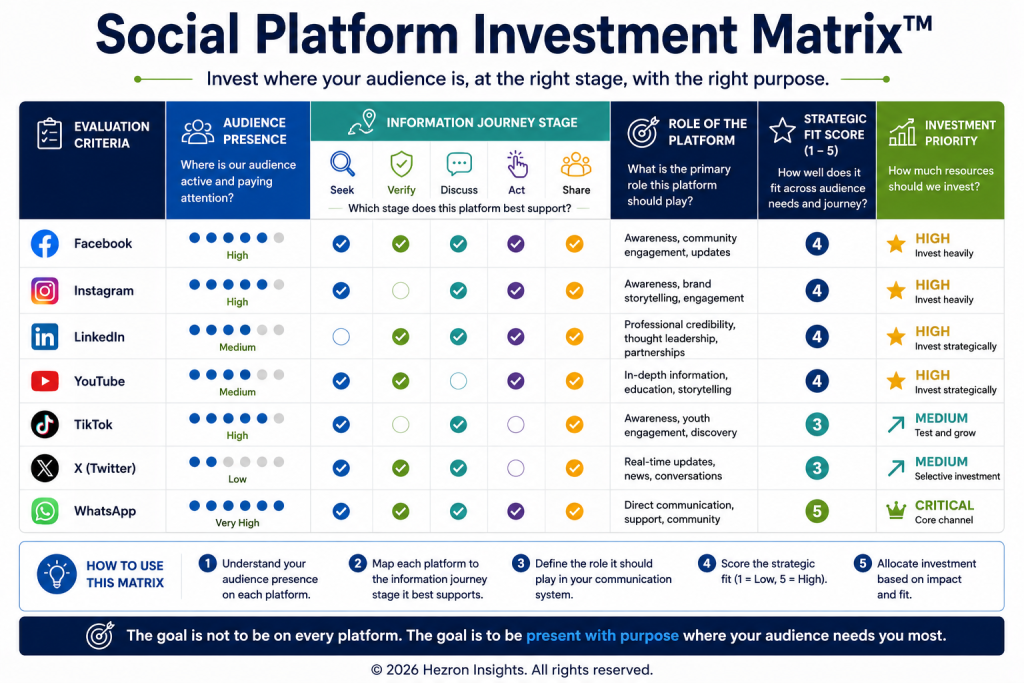
Figure 3: The Social Platform Investment Matrix™ by Hezron Insights
A framework for evaluating which platforms deserve communication investment based on audience presence, trust, strategic value, and organisational capacity. Source: Hezron Insights.
This matrix helps communication teams avoid platform pressure. It also helps leaders make decisions based on evidence instead of trends.
For example, TikTok may be useful for short educational or entertaining videos. LinkedIn may support professional knowledge, industry insights, and career opportunities. AI assistants help people find direct answers to specific questions. WhatsApp supports private communication among people who already know and trust one another.
Each channel has a different role. The task of communication leadership is to understand where each one fits.
Why communication audits matter more than trend reports
Every year, new reports identify the fastest-growing platforms and the latest digital trends. These reports are useful because they show how the wider digital environment is changing.
They cannot fully explain how your specific audience searches for information.
Students in Institution A may search for information differently from students in Institution B. Customers in Market C may trust different channels from customers in Market D. Citizens in Community E may depend on community radio and digital platforms, while those in Community F may prefer search engines, messaging applications, or AI assistants.
Only a communication audit can reveal these local patterns.
A well-designed audit answers questions that industry reports cannot:
- Where do our audiences first encounter information?
- Which channels do they trust most?
- Where do they seek clarification?
- Which platforms help them take action?
- Which communication activities continue to create value?
The answers provide something more useful than general platform statistics. They provide evidence for better decisions.
Why this matters in the age of AI
AI is changing how people discover information.
For many years, communication professionals focused on websites, search engines, and social media as the primary gateways to information. Today, AI searches are becoming another starting point.
Increasingly, people ask full questions instead of typing short keywords. Many now expect clear, direct answers without having to scroll through long lists of search results.
Research by Nielsen Norman Group shows that users are increasingly turning to AI tools for complex questions and synthesis, while still relying on traditional search when accuracy and trust are critical.
This matters for communication professionals because it changes what visibility means.
AI systems recommend information that is accurate, well-structured, consistently published, easy to understand, and supported by credible sources across the web. These are many of the same qualities people have always looked for when deciding whether to trust information.
That makes audience-centred communication even more important.
The objective is to make reliable information easy to find wherever people seek answers.
In this environment, communication, search, content, and reputation strategies are becoming increasingly interconnected.
Five steps for communication leaders
For communication leaders, this idea becomes practical when it is translated into five clear steps.
1. Conduct communication audits regularly
Do not assume you know how your audiences find information. Ask them directly, measure their behaviour, and study the channels they already use and trust.
2. Design Communication around people’s information needs
Begin with the questions your audience is trying to answer. Then decide which channels can help them move from awareness to understanding and action.
3. Give every channel a clearly defined role
Social media, websites, email, WhatsApp, portals, search engines, and face-to-face conversations should not be treated as isolated tools. Each should support a specific part of the wider communication system.
4. Measure outcomes rather than activity
More meaningful questions include:
- Did people find the information?
- Did they understand it?
- Did they trust it?
- Did they complete the intended action?
These questions reveal more than likes, impressions, or follower growth.
5. Review Communication Decisions Continuously
Audience habits will continue to change. New platforms will emerge, search behaviour will evolve, and AI assistants will become more influential. Regular review helps keep communication resources aligned with organisational priorities.
Final thought
The future belongs to audience-centred communication.
Technology will continue to evolve. New platforms will emerge, search behaviour will change, and AI assistants will become a more common part of how people find information and make decisions.
Through all these changes, understanding people will remain the foundation of strategic communication. Institutions that know how their audiences search for information, decide what to trust, and take action will be better positioned to communicate with clarity and impact.
Publishing information is only the beginning. Communication creates value when people can find what they need, understand it with confidence, trust its accuracy, and use it to make informed decisions.
That is why brands should build a strong presence in the channels that matter most to their audiences. Each channel should have a clear purpose and contribute to a connected communication ecosystem.
The guiding question for communication professionals is simple: Where does our audience naturally begin its search for information, and how can we make every step easier?
Organisations that answer that question well will remain visible, trusted, and relevant in the years ahead.
Hezron Ochiel is a strategic communications and public relations professional with over 15 years of experience in media, digital communication, and reputation strategy. He serves as the Deputy Corporate Communications Manager at the government-owned Kenya Medical Training College (KMTC) and is the founder of Hezron Insights, where he writes about AI visibility, Digital PR, SEO, GEO, and digital authority. His work has appeared on platforms including Reuters, The New Humanitarian, and The Standard.