
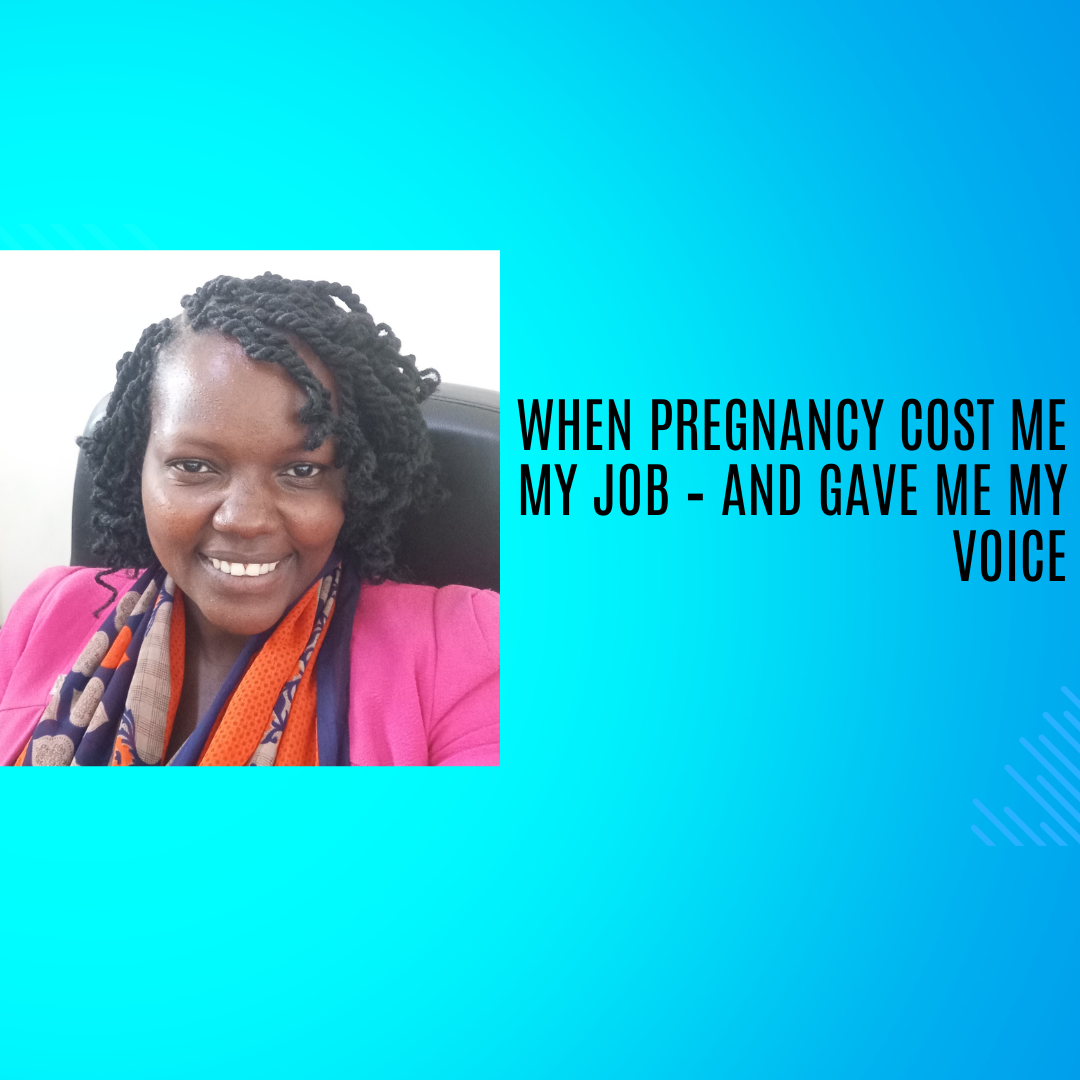
By Judith Akoth
I didn’t cry.
Not when they handed me the new contract. Not when I realized it stripped me of everything: no maternity leave, no health cover, no annual days off. Not even when I saw I had been demoted to the level of a casual worker.
But something inside me broke.
A couple of years ago, I joined a company that promised growth, mentorship, and opportunity. I had landed a dream role, one that allowed me to lead, thrive, and shine in public relations. Within a year, I had become the go-to person for everything communications.
Then something changed.
I became pregnant. And slowly, silently, the walls began to close in. My tasks were reassigned. My meetings disappeared. My presence felt unwanted.
And just like that, I was being pushed out.
In this edition, I share the untold truth about how pregnancy cost me my job and how that pain became the spark that lit a new path. It is a story of loss, rediscovery, and the fight to balance motherhood with ambition in a world that still hasn’t made space for both.
I Saw It Coming
I could feel the shift even before the HR email landed in my inbox. My supervisor, who once looped me in on every decision, suddenly became cold. Tasks I had spearheaded were reassigned without explanation, and my name disappeared from meeting invites.
At first, I brushed it off. Maybe they thought I needed to rest. But deep down, I knew. And it was confirmed when a “revised contract” showed up months before the current one was due to expire. A shorter one. With fewer benefits. A role that looked nothing like the one I had worked so hard to grow into.
I felt betrayed. And deeply hurt.
The High Price of Motherhood
This was a harsh reminder of what so many working mothers quietly go through every day.
Across the globe, millions of women face what economists now call the “Motherhood Penalty” – a measurable disadvantage in pay, opportunities, and career advancement simply for having children. According to a 2023 report by McKinsey & Company, women are twice as likely to be pushed out of the workforce after becoming mothers compared to men after becoming fathers.
In Kenya, the statistics are no less sobering. Research by UN Women highlights that women’s participation in the formal workforce drops significantly post-childbirth, with many citing hostile work environments, lack of flexible policies, and biased leadership as the reasons.
But numbers do not always capture its ache, the isolation, the whispered judgments, and the doors that silently close.
My Friend’s Warning
Around that same time, I met up with a close friend, also a new mother. She serves as a Reverend in our local church and someone I turn to for spiritual guidance.
When I told her about my situation, she simply nodded. “Me too,” she whispered.
Her story mirrored mine. Same neighborhood. Children the same age. She, too, had been quietly edged out – tasks reassigned, support withdrawn, and a sense of being “in the way.”
That day, we wept. And then we prayed. Because when you’ve been stripped of your job, your dignity, and your confidence, sometimes all you have left is your faith.
When Society Chooses to Look Away
This story goes beyond just the two of us.
One woman was recently removed from a high-level conference meant to celebrate International Women’s Day because she brought along her baby. She later posted online, “If I came with my child, it means I had no other choice. Isn’t this a space where women should be seen and heard, even as mothers?”
And then there is the case of Nakuru Governor Susan Kihika, who took maternity leave and now faces impeachment efforts, some of which stem from accusations that she was “absent.” As if motherhood is incompatible with leadership.
These stories matter because they illustrate a deeper, systemic rot.
Why Mothers Disappear From the Workforce
Here’s the harsh reality: mothers are not underperforming. They are under-supported.
The barriers are subtle but pervasive:
1. Career Progression Gaps
Before motherhood, the difference in career growth between men and women was often negligible. But after the birth of a child? Women are more likely to shift to part-time roles or leave altogether. According to the World Economic Forum, this results in a cumulative career gap that becomes harder to bridge over time.
2. Gendered Leadership Stereotypes
Leadership is still associated with being tough, available 24/7, and devoid of emotional “distractions.” Mothers, viewed as nurturers and caregivers, are often seen as incompatible with these traits, causing them to be passed over for promotions or visible roles.
3. Patriarchal Structures
From media portrayals to pay gaps, women continue to navigate a world where their roles are secondary to men’s. In Kenya, men still dominate leadership positions, boardrooms, and politics, often justified by their “availability” and “uninterrupted” career trajectories.
4. Punitive Work Policies
Few companies in Kenya offer flexible schedules, proper lactation rooms, or remote work options for new mothers. Those who do are the exception, not the norm.
Thriving in a Tight Space
When I was edged out, I felt cornered. I had no plan B. But sometimes, pressure births purpose.
I used my savings to start small businesses – side hustles, really. But they paid rent, bought diapers, and reminded me that I was still capable.
For three years, they carried me when no employer would.
My family stood by me. My church became a sanctuary. And slowly, I returned to myself. I even resumed my studies, enrolling in a Master’s degree that I had shelved the moment I found out I was pregnant.
A Path Forward: What Workplaces Must Do
It is time to break the maternal wall, the invisible yet impenetrable barrier that sidelines mothers. Here’s what needs to change:
- Flexible Work Arrangements: Remote options and adaptable hours help mothers manage family and work.
- Parental Leave for All: Both men and women should be given time to bond with their children, normalizing parenting as a shared role.
- Equal Pay and Promotions: Reward output, not availability. Evaluate performance, not gender.
- Lactation Rooms and Child-Friendly Spaces: If companies can design lounges for executives, they can certainly build spaces where women can breastfeed or pump safely.
- Zero Tolerance for Discrimination: There must be legal and cultural accountability for bias against pregnant employees or mothers.
Final Thoughts
I am not sharing this story for sympathy but for solidarity.
Motherhood should never cost a woman her job, her dignity, or her voice. Yet for far too many, it still does.
Sometimes, the chapters that feel like setbacks are actually where your power begins to rise. Because rejection does not define you. Tough times do not last. But tough mothers do.
The conversation around balancing motherhood and career will always be layered because every mother walks a different path. Some of the hurdles we face are beyond our control. And yes, in many ways, a male-dominated society still shapes how mothers are treated in the workplace.
I have lived both sides of the story, once silenced by bias and now slowly reclaiming my voice. One truth stands out through it all: it is deeply empowering to work in a space that sees and supports mothers. That kind of workplace gives you room to thrive.
And every mother deserves that.
The writer is a Corporate Communications Specialist at the Technical University of Kenya.