

By Hezron Ochiel
Public relations specialists will tell you there is nothing as frustrating as putting out a social media post and bracing yourself for negative feedback. It is the kind of moment that makes you wish you could skip posting for a day or two. But in digital communications, that is not an option. Social platforms are open books. Everyone in your organization, including your bosses, can see when there is a gap. And when there is silence, it raises questions.
I know this firsthand. There were days I dreaded publishing posts because I anticipated harsh criticism. I remember attending a daylong event with one of my senior executives. I was seated right next to him, and every time he got bored, he would turn to his phone, scrolling through our company platforms to check what we had posted and how people were reacting.
Unfortunately, that day we had nothing scheduled, not for lack of content, but because the fear of public backlash was overwhelming. Sometimes, you have a well-crafted post ready to go, but your finger hovers over the “publish” button. When you represent a brand that’s often a lightning rod for criticism, you think twice. One click, and the comments section can turn into a battlefield.
This article reflects my close to five-year journey overseeing digital communications at the Kenya Medical Training College (KMTC). I want to share the good and challenging moments, the myths and realities I encountered, and the strategies I implemented to rebuild trust. If you have ever struggled with negative sentiment online, I hope these insights will help you.
The journey in the digital communications unit
In September 2020, I joined KMTC and was handed the role of leading the digital communications unit, among other tasks. At the time, the college’s online platforms had strong foundations but still needed some panel beating to be on par with its peers in the industry. Facebook had about 70,000 followers, X (then Twitter) was hovering around 10,000, and Instagram was still relatively new with just over 2,500 followers. YouTube was barely active because it was just beginning to receive content, even though it was launched many years ago, thanks to the addition of a new team member.
I was stepping in to bring fresh ideas to an already established team that was equally up to the task.
Every communications specialist knows that growing digital channels organically takes time, resources, and a well-structured strategy. Yet, even with these impressive numbers the team had achieved over the years, a deeper challenge remained: the comment sections, particularly on Facebook, were filled with negativity.
Many users felt disconnected from the institution, and online discussions were dominated by backlash. This environment made it difficult to engage meaningfully with followers, let alone grow the audience further.

Why digital communications matter more than ever
The rise of digital media has completely transformed how organizations communicate. Gone are the days when official letters and notice boards were the primary sources of updates. Today, audiences expect real-time information and interaction.

Photo courtesy of Google
Digital platforms give organizations direct access to their audiences, but they also demand accountability. Feedback is instant and sometimes public. This can be intimidating for PR professionals, but it is also an opportunity. Unlike traditional media, digital platforms provide:
1. Real-time interaction: You can engage with followers immediately, answer questions, and clarify misinformation as it arises.
2. Wider reach and precise targeting: Campaigns can reach both local and global audiences, with the ability to target by demographics, location, and interests.
3. Cost-effectiveness: Running campaigns on social media or email is more affordable than print or TV advertising.
4. Measurable results: Digital tools offer analytics on reach, engagement, and conversions, allowing continuous optimization.
5. Content flexibility: Text, videos, live streams, and infographics can all be integrated to make content engaging.
For me, these advantages meant one thing: if we could craft the right strategy, we could definitely turn things around.

Photo courtesy of Google
Understanding the audience
Before designing a new strategy, I spent time scanning comments and analyzing the feedback we were receiving online. One thing became clear: much of the negativity stemmed from misconceptions and misinformation.
A few of the concerns raised were valid, but many were based on perceptions that had taken root for years. It reminded me of the bandwagon effect, where one person’s statement is quickly adopted as fact by others without verification. Here are some of the recurring perceptions we identified:

1. Getting a training slot was ‘almost impossible’. Many believed it was nearly impossible to secure admission to the college.
2. Rapid expansion was a ‘mistake’. Critics argued that opening new campuses diluted the quality of training.
3. ‘Discrimination’ in selection. There were allegations that qualified applicants, especially those eligible for university, were unfairly excluded.
4. Too many scammers during admissions. Some believed that one had to use unorthodox means to acquire admission.
5. Graduates faced unemployment. There was frustration that the college trained more students than the job market could absorb.
Separating facts from fictions
To address these perceptions, we first needed to ground our communications in facts:
1. Admissions are highly competitive: The reality was that demand for specific courses far outstripped supply. For instance, in the March 2025 intake alone, the college received 27,000 nursing program applications for just 2,986 available slots. Each year, the college admits around 20,000 students across more than 100 programs, many of whom are equally competitive in the job market.
2. Expansion meets growing demand: As of 2020, KMTC had 71 campuses. This growth was not arbitrary; it was designed to bridge the gap between demand and supply. Kenya produces close to 900,000 high school graduates annually. Only about 153,000 secure university placements, and another 106,000 are absorbed by Technical and Vocational Education and Training (TVET) institutions. The rest either defer studies or seek alternative options. The truth of the matter is that expanding campuses helps more students access quality training. In 2019, a total of 12,621 graduates were released into the job market, which means the number admitted to the college had almost doubled in six years.
3. Selection is fair: Contrary to popular perceptions, the college does not only admit those who fall short of university entry requirements. A significant number of students who are fully eligible for university programs also choose to join the institution. For instance, in the March 2025 intake alone, over 7,000 applicants who qualified for university admission opted to enroll at the college, attracted by its competitive and market-driven programs.
4. Emergence of scams: During admission cycles, fake accounts often emerge claiming they can secure slots, only to deceive and defraud unsuspecting applicants. In response, we intensified campaigns warning applicants about these scams. Additionally, the college trained its desk officers to assist applicants directly, reducing reliance on scammers.
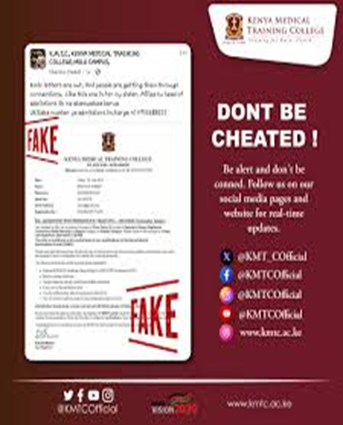
5. Employment opportunities: While KMTC’s primary mandate is training, we recognized the need to help graduates transition into jobs. The college strengthened partnerships with organizations like the German Chamber of Commerce, the National Council Licensure Examination for Registered Nurses (NCLEX-RN), and lobbied county governments to employ its graduates. The institution also fast-tracked transcript issuance to help graduates secure opportunities abroad.
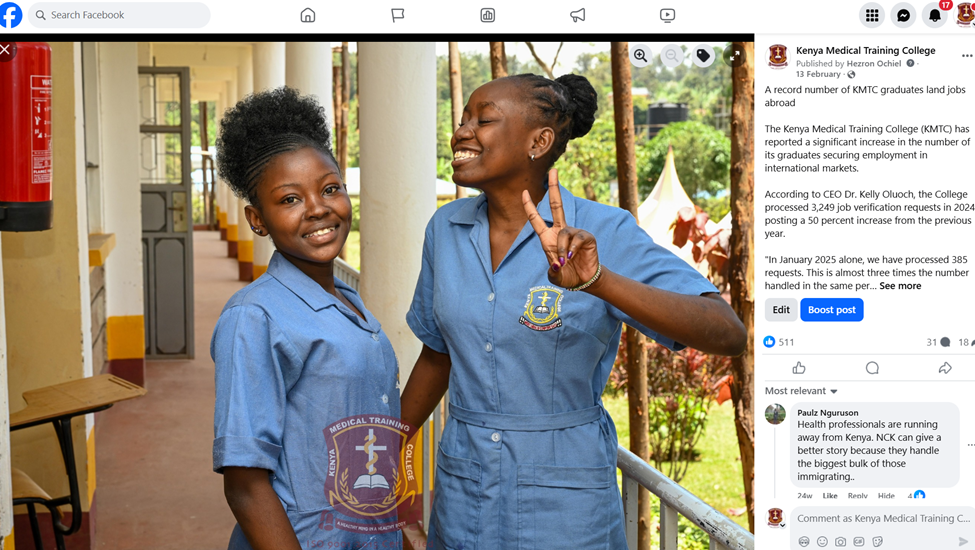
Source: Public comment on KMTC’s official Facebook page
Designing a robust content strategy
Before developing any communication strategy, it is essential for public relations specialists to first identify and map out their real supporters. Amid the negativity we were experiencing online, there was a segment of the community that consistently expressed appreciation for the institution, crediting it for shaping their lives and careers. This group was our alumni.
A quick analysis of our social platforms revealed that alumni made up more than 40 percent of our followers. This insight was critical because it meant that we already had a significant base of supporters who valued the institution and its impact. The next logical step was to rally them and give them a voice. We deliberately crafted content that would resonate with them, tap into their pride, and remind them of their connection to the college.
One of the most effective initiatives we rolled out was launching the #KnowYourCampus and #KnowYourAlumni campaigns. These campaigns celebrated the institution’s heritage and its graduates’ achievements. By putting alumni at the center of the narrative, we were not only reconnecting with a vital constituency but also creating a powerful counterweight to the negative voices that had dominated the online conversation.

Source: Public comment on KMTC’s official Facebook page
In image restoration, identifying and leveraging your core supporters is vital. Alums, in this case, became the voice of credibility. They knew the institution from personal experience and could share authentic stories that carried far more weight than any official statement could. The two most popular campaigns I have ever mounted became opportunities to bring the audience back to cherished memories, shared goals, and a collective sense of pride.
The results were remarkable. The comments sections, which complaints and skepticism had once dominated, were now exploding with positive reflections and celebrations of the college. Alums recounted stories of their time at the institution, shared how their training had shaped their professional lives, and encouraged prospective students not to lose hope. This shift in tone was not accidental; it was a psychological recalibration.
 Source: Public comment on KMTC’s official Facebook page
When a person who frequently complains or spreads negativity sees others openly expressing pride and gratitude toward the very organization they are criticizing, it forces a moment of reflection. The unspoken question becomes: If others are this proud and appreciative, could it be that I am missing something? This change in mindset was a crucial step in restoring trust and reducing the impact of detractors.
The alumni-led campaigns were just the beginning. They provided the foundation on which other strategic initiatives could be built, all aimed at dispelling misconceptions and rebuilding the institution’s credibility.

Source: Public comment on KMTC’s official Facebook page
Other key strategies deployed
1. Showcasing real stories
One of the first strategies was to highlight stories of persistence and success. We profiled candidates who had applied multiple times before finally securing a slot at the college. These stories served two essential purposes. First, they inspired prospective applicants not to give up, even if they did not secure admission on their first attempt. Second, they reinforced the fact that the selection process was merit-based and fair. By showing that perseverance paid off, we communicated that those admissions were purely about merit and luck.

Source: Public comment on KMTC’s official Facebook page
2. Highlighting the benefits of expansion
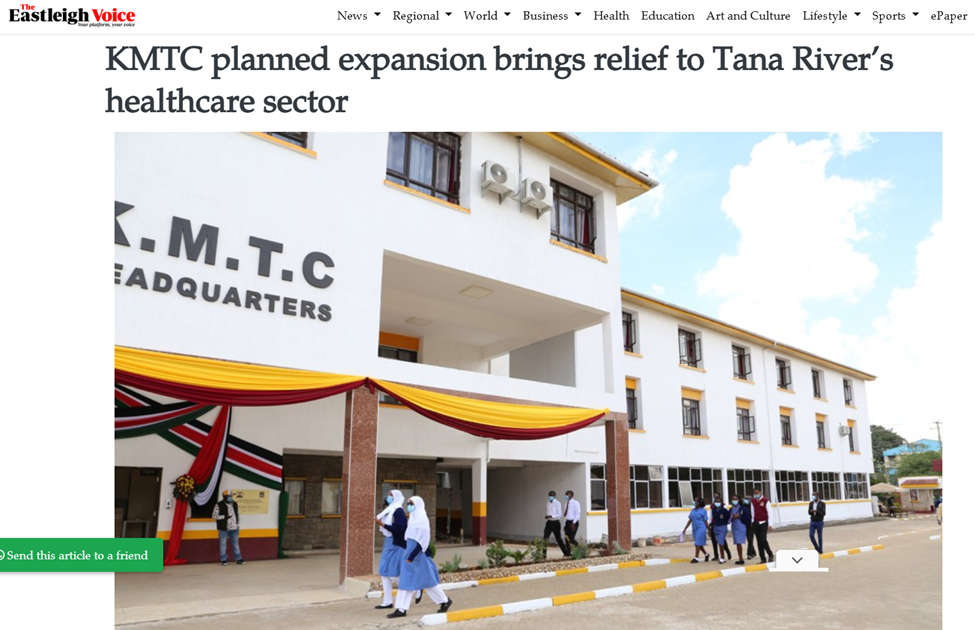
Another key part of the strategy was reframing the narrative around the rapid expansion of the college. Negative voices often portrayed the opening of new campuses as unnecessary, yet the truth was the exact opposite. We consistently framed expansion as a deliberate solution to address the overwhelming demand for training opportunities. Using precise data and testimonials, we showed how each new campus created opportunities for students in underserved regions who might otherwise have been locked out.
These narratives humanized the numbers. Instead of abstract statistics, audiences saw real students who could now access quality training closer to home because of the expanded footprint. By presenting expansion as an effort to bridge the demand-and-supply gap rather than an unnecessary growth strategy, we shifted perceptions and demonstrated the institution’s commitment to equitable access.
Source: Public comment on KMTC’s official Facebook page
3. Proving fairness in selection
Another myth we tackled head-on was the claim that admissions were discriminatory or biased. To address this, we adopted a transparent approach, publishing admission statistics that broke down who had been selected and from which backgrounds. This was complemented by stories highlighting the diversity of successful applicants, including university graduates who had chosen to return to the college to pursue highly marketable diploma courses.
These stories carried significant weight because they were rooted in fact. They helped dismantle the perception that certain groups were unfairly favored, showing instead that opportunities were accessible to anyone who met the requirements. Over time, this transparency built credibility and reassured prospective students and parents that the institution’s selection process was both competitive and fair.

Photo: Courtesy
4. Exposing scams and protecting applicants
We also recognized that misinformation often thrived because of external actors seeking to exploit hopeful applicants. Fake accounts and fraudulent intermediaries would surface during every intake cycle, claiming they could secure training slots for a fee.
To combat this, we launched proactive campaigns to flag and expose these scams. Our content educated applicants on how to spot fraudulent accounts and provided clear instructions on how to report them. Beyond just warning people, we empowered applicants with knowledge and made it harder for scammers to take advantage of their desperation. This effort not only protected individuals but also strengthened trust in the institution’s official communication channels.
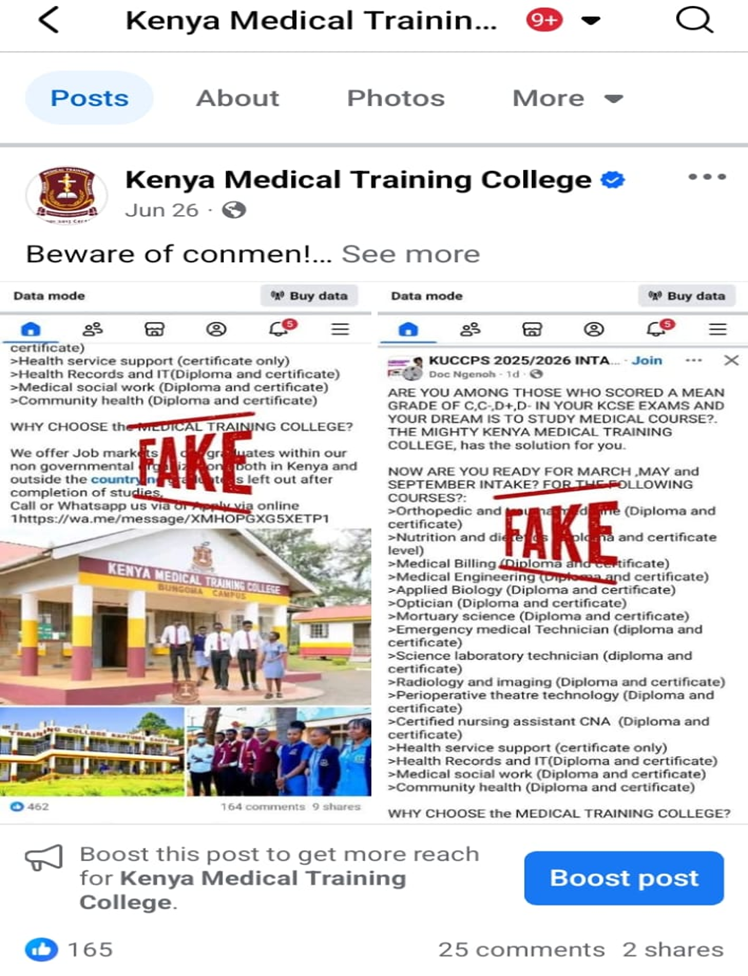
Photo: Courtesy
5. Linking training to employment opportunities
One persistent narrative we had to address was that the college was focused only on training without caring about graduates’ employability. To counter this, we developed content that demonstrated the strong link between training and career success. We shared stories of alumni thriving in the job market, using their experiences as proof of the value of the institution’s programs.
Additionally, we consistently updated followers about new partnerships with employers and ongoing initiatives aimed at creating opportunities for graduates. These included collaborations with various entities, engagements with county governments to prioritize hiring college graduates, and efforts to fast-track the issuance of transcripts so that graduates could compete for jobs abroad.
By drawing this direct connection between training and employment, we reinforced the college’s role not only in education but also in enhancing livelihoods. This strategy relied heavily on storytelling.
Facts alone are not enough; audiences connect with human-interest stories. Just as newsrooms prioritize these stories, we learned that weaving real experiences into our content made our messaging more relatable.
Photo: Courtesy
The impact
As we continued to counter misinformation with facts and authentic storytelling, we began to notice a remarkable transformation; the tone of online conversations started to change, and followers who once doubted us became far more engaged and openly supportive of our work.
The change was immense as applications, which had previously been fewer than 20,000 in 2019, steadily increased year after year and reached over 50,000 by 2025, a clear indication that the brand’s reputation as a trusted training institution had been fully restored and that KMTC had once again become a preferred choice for students in Kenya and beyond.

Photo: Courtesy
Lessons learned
Reflecting on this journey, I have identified several pitfalls that often undermine digital strategies:
1. Content that ignores the audience: Too often, organizations focus on what senior leadership wants to communicate rather than what the audience cares about. Every post should answer the question: What is in it for the reader?
2. Inconsistent tone: Your brand voice should be steady. Shifting from formal to casual or severe to playful without context erodes trust.
3. Lack of clear purpose: Posting for the sake of posting is counterproductive. Each piece of content should have a defined goal, whether it is to inform, engage, or inspire.
4. Ignoring engagement: Social media is not a one-way street. Failing to respond to comments and questions makes followers feel unheard.
5. Overposting or spamming: Bombarding followers with irrelevant posts can lead to disengagement. Quality always trumps quantity.
Final thoughts
The assertion that KMTC enjoys a positive reputation and is ranked among the top employers by Indeed may have seemed like just another milestone to outsider observers.
Still, for those of us who were deep in the trenches, it represented the culmination of four years of deliberate effort grounded in strategic communication, careful listening, and relentless myth-busting. While the surge in applications and renewed trust were highly encouraging, it is essential to acknowledge that the turnaround may not have been driven by communication alone, but by a combination of complementary factors that worked together to transform the institution’s image.
High-quality training programs consistently reinforced KMTC’s credibility in the eyes of students and stakeholders, while digitalization initiatives improved service delivery and made the College more accessible and efficient. Fresh ideas and renewed energy from the leadership further strengthened the institution’s direction, and community initiatives, particularly through corporate social responsibility programs, helped to build stronger ties with the public and elevate the College’s reputation at the grassroots level.
Managing digital communications in such an environment is not for the faint-hearted, as it requires resilience, adaptability, and the courage to confront uncomfortable truths even when the pressure is immense. However, when strategic communication is done with consistency, empathy, and a steadfast focus on facts, it can transform how audiences perceive an organization and even change the trajectory of its future.
This is the true power of strategic communication: the ability to turn the fear of backlash into confidence and widespread skepticism into lasting trust.