By Hezron Ochiel
A press release can be well written and still be ignored.
During my years in journalism, I received many press releases that never became stories. Some were too promotional. Others buried the real news or sent it to journalists with little interest in the subject.
Later, working in public relations, I saw the same challenge from the other side.
That experience taught me something important: A press release only becomes useful when it gives journalists a clear, timely and verifiable story they can work with.
If your press release isn’t getting media attention, here are some mistakes to check for.
1. Making the press release too promotional
Many organisations write press releases as though they are advertisements.
Words such as incredible, ground-breaking and leading may sound impressive internally, but they rarely help a journalist understand why the story matters.
Journalists are looking for information they can assess independently.
Instead of writing:
“Company X has launched an incredible new programme that will transform communities.”
Give the journalist something more useful:
“Company X has launched a programme expected to reach 20,000 households across three counties over the next two years.”
The second version gives the journalist a specific fact they can examine, verify and build on.
A press release becomes stronger when the evidence carries the message.
This same principle applies beyond press releases. In my article on What PR Teams Should Measure in 2026, I argue that communication becomes more useful when teams can show what changed, who was reached and what evidence supports the result.
2. Burying the real news
One of the most common press release mistakes is making journalists work too hard to find the story.
The strongest information should appear near the beginning.
Your first paragraph should quickly answer the most important questions:
What happened? Who is involved? Where? When? Why does it matter?
This is why the inverted pyramid remains useful in press release writing. Lead with the most important information, then add the supporting context.
If the real story only appears halfway down the page, a busy journalist may never reach it.
The headline and opening paragraph should make the news value clear within seconds.
That same audience-first thinking underpins my broader argument that communication should begin with how people seek and use information. I explore this in Stop Building Communication Strategies Around Platforms. Build Them Around Audience Behaviour.
3. Using quotes that add nothing
Quotes can strengthen a press release, but many organisations use them as decoration.
A typical example might read: “We are delighted to launch this exciting initiative.”
The sentence expresses enthusiasm, but it tells the journalist very little.
A useful quote should add something the surrounding facts cannot.
For example: “Many families in these counties travel long distances to access the service. This programme will bring support closer to the communities that need it most.”
That gives the journalist meaning and human context.
The strongest press release quote adds interpretation, judgement or perspective that the facts alone cannot provide.
4. Sending a story that is not newsworthy
Not every organisational activity requires a press release.
A routine meeting may matter internally without offering much value to a wider audience.
Before writing, ask: What has changed because of this development?
The answer may involve a new policy, funding decision, research finding, major milestone or development affecting a significant group of people.
If the news value is difficult to identify, another communication format may work better.
I have seen this repeatedly in media advocacy work. Journalists respond more strongly when they can see the public significance of an issue, understand the evidence and access credible sources.
That lesson came through clearly in my work engaging more than 200 media actors across five African countries, which I discuss in my article on building sustainable media advocacy in Africa. That experience showed how training, access to experts, reporting support, and editorial engagement can help journalists pursue stronger stories.
5. Sending the press release to the wrong journalists
A strong story can still disappear when it reaches the wrong inbox.
Media targeting is part of the story strategy.
Before sending a press release, understand what the journalist or publication actually covers. Look at their recent work, identify their beat and ask whether your announcement genuinely fits their audience.
A good press release sent to the wrong journalist is still poorly distributed.
Building media relationships before you need coverage also helps. Consistent, relevant communication makes it easier for journalists to understand your organisation and the areas where you can provide useful information.
That relationship-building matters even more in the digital and AI age because earned media can continue shaping reputation and discoverability long after the original story is published. I explore that broader role in Why Media Relations Still Matters in the Digital and AI Age. Your site currently includes that article in its PR archive.
6. Giving journalists too little evidence
A press release becomes harder to use when important claims have no supporting information.
If you say a programme has achieved significant impact, show what that means.
A specific figure, research finding or clearly attributed source can make the story more credible and easier to report.
This matters especially when communicating research or technical subjects, where journalists need enough context to understand the evidence without being overwhelmed by jargon.
I explore this further in Bridging the Gap Between Research and the Public: A Practical Guide for Journalists and Communication Specialists, where I examine how journalists and communication professionals can translate research into clear, useful public information.
Specific evidence gives journalists something they can verify, explain and build into a stronger story.
7. Forgetting the practical details journalists need
Small omissions can make an otherwise good press release difficult to use.
Before sending it, check that the journalist can easily identify:
- the organisation involved
- the date and location
- the key spokesperson
- accurate names and titles
- relevant supporting information
- a media contact who can respond quickly
Proofread the release carefully as well.
Names, figures and titles deserve particular attention because mistakes in these areas can quickly damage credibility.
A journalist who wants clarification should not have to search your website to find someone to contact.
What makes an effective press release?
An effective press release gives a journalist enough information to quickly decide whether a story is worth pursuing.
A useful sequence is:
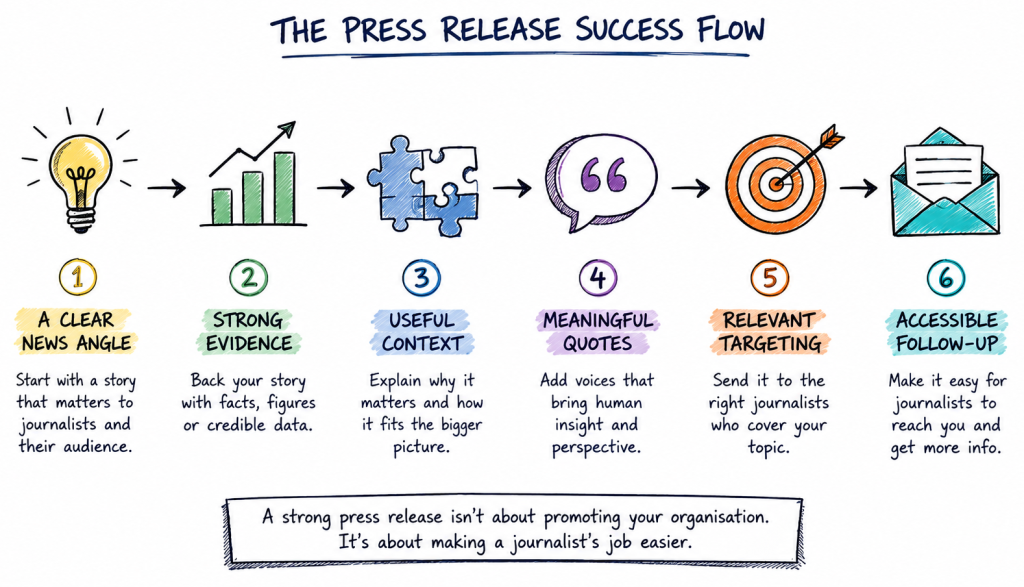
The news angle earns attention, evidence builds credibility, and context explains significance. Quotes add human meaning, targeting places the story in front of the right journalist, and follow-up support helps the journalist complete the reporting.
That is where press release writing becomes part of a broader media relations strategy.
It also connects with the broader direction of modern PR. In The Ultimate Guide to AI Search, Brand Reputation, and Public Relations in Africa, I discuss how credible media coverage, expert commentary and useful public information can contribute to long-term digital authority.
Hezron Ochiel is an award-winning strategic communications and public relations professional with over 15 years of experience in media, digital communication, and reputation strategy. He serves as the Deputy Corporate Communications Manager at the government-owned Kenya Medical Training College (KMTC) and is the founder of Hezron Insights, where he writes about AI visibility, Digital PR, SEO, GEO, and digital authority. His work has appeared on platforms including Reuters, The New Humanitarian, and The Standard.