
How Organisations Can Build Trust, Authority, and Visibility in the Age of Artificial Intelligence
By Hezron Ochiel
Introduction: The Search That Changed Everything
A few years ago, finding information online followed a familiar routine. You opened Google, typed a question, scrolled through pages of blue links, compared different websites, read several articles, and eventually decided which answer seemed most reliable.
Today, that experience is changing. People increasingly ask a question and receive a clear, evidence-based answer without having to visit multiple websites.
Business executives use ChatGPT to compare suppliers before making purchasing decisions.
Students turn to Google AI Overviews to better understand medical courses. Journalists rely on Claude to unpack complex policies, while travellers use Perplexity for destination recommendations. Patients also consult Gemini before visiting a doctor.
Search is becoming less about navigating websites and more about finding trusted answers. This shift is reshaping digital communication, influencing how people discover information, how organisations become visible, and how trust is earned.
For many years, digital visibility centred on search engine optimisation. Success often depended on appearing on the first page of Google.
Public relations focused on media relations, reputation management, and stakeholder engagement, while content marketing aimed to attract visitors to organisational websites. As AI search becomes part of everyday life, these disciplines are becoming increasingly connected.
Search, public relations, brand reputation, thought leadership, content strategy, digital authority, and organisational trust now influence one another within the same digital ecosystem.
Every article, research paper, media interview, conference presentation, and case study adds another signal that shapes how an organisation is understood by people and AI systems.
This guide explores that transformation. It explains how artificial intelligence is changing the way expertise is recognised and why organisations need to think differently about visibility in the age of AI search. It also examines the growing relationship among public relations, search, reputation, and digital authority, showing why communication professionals are becoming custodians of organisational knowledge and reputation.
For Africa, these changes present an important opportunity. Universities are producing revolutionary research, healthcare institutions are transforming lives, entrepreneurs are solving local challenges, and public institutions are driving innovation. Much of this expertise remains underrepresented in global digital conversations, making it harder for people and AI systems to discover the knowledge already being generated across the continent.
Organisations that document their expertise, publish evidence-based knowledge, answer important questions, and share practical insights strengthen their visibility over time. Their work becomes easier for journalists, researchers, professionals, and AI search systems to discover, reference, and recommend.
That is the purpose of this guide. It provides a practical roadmap for helping organisations build lasting authority, strengthen their reputation, and become trusted sources of knowledge in the age of artificial intelligence.

Why AI Search Matters More Than Most Organisations Realise
Artificial intelligence is often described as another technological innovation, yet its influence extends far beyond technology.
It is reshaping how knowledge is organised, evaluated, and accessed, changing the way people discover information and how organisations build visibility.
For decades, organisations competed for a place at the top of search results, where success depended largely on persuading people to click through to a website.
AI search is transforming that journey by interpreting information, comparing multiple sources, summarising evidence, and generating direct answers that help people make decisions more quickly.
This shift has significant implications for organisational visibility.
A strong search ranking remains valuable, although AI systems increasingly look beyond rankings to determine whether an organisation has built enough digital authority to be recognised as a trustworthy source.
As a result, some organisations with impressive websites receive little attention from AI systems, while others with modest digital marketing efforts are frequently referenced.
The difference is rarely website design. More often, it is the strength of the trust, credibility, and evidence an organisation has built over time. I explore this broader shift in greater detail in my article, How AI search is changing trust, visibility, and public relations in Africa, which explains why AI is redefining the
relationship between visibility, reputation, and organisational trust.
My Turning Point
My understanding of AI search changed as I asked ChatGPT about an organisation I knew well.
The response surprised me. It drew on years of media coverage, research publications, executive interviews, and public conversations spread across the internet. Some of the issues it highlighted had been resolved years earlier, yet they still formed part of the organisation’s digital footprint and influenced how AI described it.
That experience made me realise that reputation had become searchable in an entirely new way. AI was connecting years of organisational history into a single narrative, drawing on both current information and historical evidence to explain how the organisation was understood online.
From that moment, I began to see AI search as a reputation engine shaped by trust, authority, and accumulated evidence. It also reinforced an important lesson for communication professionals: every publication, media interview, research paper, and public response contributes to the digital record that people and AI systems may rely on for years to come.
AI Is Not Replacing Search. It Is Redefining It
Search engines transformed the way people locate information, while AI systems are changing how they understand it.
Instead of simply presenting a list of webpages, AI can analyse information from multiple sources, identify recurring themes, compare evidence, and generate a structured response.
Imagine someone searching, “How can a university improve its reputation?” A traditional search engine returns a collection of relevant websites, leaving the user to compare different perspectives.
An AI system brings those perspectives together by analysing articles, research papers, expert commentary, case studies, and institutional reports before producing a clear, evidence-informed explanation.
This shift changes the way organisations should think about the information they publish.
Every article, report, interview, research paper, case study, and media feature becomes part of a much broader knowledge ecosystem, where AI systems connect ideas from multiple sources to develop a deeper understanding of an organisation’s expertise.
The New Currency of Digital Visibility
Many organisations still believe visibility is measured primarily through website traffic.
While traffic remains important, it no longer tells the whole story.
Imagine publishing an outstanding article that receives fewer visitors than expected.
Months later, journalists begin referencing it, researchers cite it, universities recommend it to students, professional associations incorporate it into their training materials, and artificial intelligence starts drawing on its key insights to answer related questions.
The article has become influential even without generating millions of page views.
This illustrates an important shift: Digital visibility is increasingly measured by influence rather than attention.
The organisations that contribute useful knowledge often create lasting authority.
Authority generates trust; trust improves discoverability; discoverability creates opportunities; and, over time, the cycle strengthens itself.
I refer to this process as The Digital Trust Cycle™.
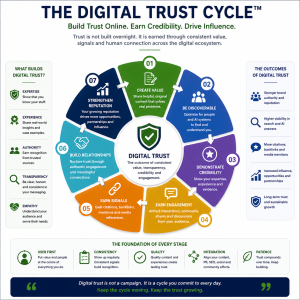
The Digital Trust Cycle™
1. Publish valuable knowledge.
2. Earn recognition from trusted sources.
3. Build digital authority.
4. Increase AI confidence.
5. Improve discoverability.
6. Attract new audiences.
7. Generate additional recognition.
Each stage reinforces the next.
Unlike advertising campaigns, this cycle continues long after a single publication has been released.
The Three Questions Every Organisation Should Be Asking
Artificial intelligence is reshaping the strategic questions communication leaders need to ask.
Alongside improving search visibility, organisations are increasingly asking whether AI systems would recognise them as trusted sources of expertise.
That reflection naturally leads to deeper questions.
What evidence supports our reputation? If someone asked an AI platform about our organisation today, what story would it tell?
The answers reveal how consistently an organisation has documented its expertise, communicated its impact, and earned recognition from credible sources.
These questions also highlight the growing strategic importance of communication.
Public relations helps organisations build trust by making their expertise, values, and contributions easier for people and AI systems to understand, recognise, and recommend.
Understanding AI Search
Artificial intelligence search systems approach information differently from traditional search engines. Instead of identifying webpages that match a user’s keywords, they analyse information from multiple sources to generate a direct, evidence-based response.
Consider someone asking, “Which African university is recognised for health sciences?”
A traditional search engine returns a list of websites containing those keywords, leaving the user to compare the results. An AI search system takes a broader view by examining institutional websites, academic publications, media coverage, strategic partnerships, and other publicly available information. It also looks for consistent patterns across trusted sources before generating a single response.
The quality of that response depends on the evidence available across the wider internet, not on the content of a single webpage.
This explains why digital authority has become increasingly important. AI systems build confidence by identifying organisations whose expertise is consistently supported by credible evidence across multiple sources.

How AI Builds Confidence
Artificial intelligence does not experience trust the way people do. Instead, it estimates confidence by evaluating how consistently credible sources support the same conclusion.
Imagine reading ten independent articles that all identify an institution as a leader in nursing education. You then come across conference presentations, research collaborations, government partnerships, industry awards, and expert interviews that reinforce the same message. As the evidence continues to point in one direction, confidence naturally grows.
AI systems follow a similar process. They identify recurring patterns across the digital landscape and become more confident when an organisation’s expertise is consistently validated by multiple independent sources.
This explains why consistency is essential to building digital authority. Organisations strengthen their reputation when research publications, media coverage, industry awards, expert interviews, academic collaborations, and other trusted sources consistently reinforce the same story.
Each contribution adds another layer of evidence, strengthening the organisation’s authority over time.
Why Public Relations Has Entered a New Era
Public relations has always been built on trust, and artificial intelligence is making that trust easier to recognise and evaluate. As AI systems increasingly rely on credible digital signals, the work of communication professionals is expanding beyond managing reputation to making organisational expertise visible and discoverable.
Storytelling remains at the heart of public relations, although it now carries a broader purpose.
Communication teams are expected to identify internal experts, document institutional knowledge, communicate research, strengthen executive visibility, build relationships with journalists, monitor online conversations, and help organisations contribute meaningful knowledge that benefits society.
This evolution has moved communication closer to the centre of organisational strategy. Success is no longer measured only by media coverage or publicity, but also by the quality of the questions communication leaders can answer.
Has the organisation become a recognised authority? Are its experts shaping industry conversations? Does its knowledge help people solve real problems? Would AI systems confidently identify it as a trusted source?
The answers to these questions are shaping the future of public relations.
Communication professionals are becoming custodians of organisational knowledge, helping institutions earn trust by making their expertise visible, accessible, and valuable to the audiences they serve.
This changing role is also influencing communication careers. In my article, Why More Journalists Are Moving Into PR in the Age of Digital Visibility, I examine how AI search, digital authority, and evolving communication strategies are reshaping the skills that organisations increasingly value.
How Artificial Intelligence Decides Who to Trust
One of the biggest misconceptions about AI search is that it recommends the most popular website.
In reality, artificial intelligence is designed to reduce uncertainty by evaluating digital signals that indicate how much confidence it can place in a source. As those signals become stronger and more consistent, AI becomes increasingly confident in recommending that source.
The process is not very different from how people decide whom to trust.
When choosing a professional, you consider their qualifications, experience, reputation, professional recognition, recommendations from respected organisations, references from peers, and their ability to explain complex ideas clearly. Each of these factors contributes to your overall confidence.
AI systems follow a similar approach.
They evaluate evidence from across the digital ecosystem to determine which organisations and experts consistently demonstrate credibility and expertise.
For communication professionals, this represents an important shift.
Success depends less on publishing more content and more on building the trust and authority that make an organisation easier for both people and AI systems to recommend.
The Five Trust Signals AI Looks For
Although every AI platform has its own methods, most rely on similar indicators when evaluating authority.
1. Expertise
An important question every organisation should ask is whether its expertise is clearly visible to the people it serves.
Genuine knowledge is reflected in research, practical guidance, industry analysis, educational content, expert interviews, conference presentations, books, and original insights that help people solve real problems.
Consider two hospital websites.
One focuses on appointment schedules and service announcements, while the other explains medical conditions, shares research findings, answers common patient questions, highlights clinical innovations, and features doctors discussing emerging healthcare issues.
Visitors are likely to leave the second website with a deeper understanding of the organisation’s expertise because it educates as well as informs.
This is one of the strongest signals of authority.
Organisations that consistently teach, explain, and share knowledge make their expertise easier for people to recognise and easier for AI systems to understand and recommend.
2. Consistency
Authority rarely develops from a single exceptional article. It grows through consistent contributions that demonstrate expertise over time.
Imagine someone publishes an insightful article on digital transformation. The article attracts attention, and readers recognise its value.
Over the following years, the same person continues to share thoughtful insights, speak at conferences, contribute to research, mentor professionals, and participate in industry discussions. As their body of work expands, confidence in their expertise naturally grows.
AI systems recognise these recurring patterns. Consistent contributions build familiarity; familiarity strengthens trust; and, over time, that trust develops into lasting authority.
3. Independent Recognition
Recognition from others is one of the strongest indicators of authority because it demonstrates that your expertise has earned the confidence of independent sources.
That recognition may come through media interviews, academic citations, industry awards, professional memberships, government partnerships, conference speaking invitations, or references from respected organisations.
Each endorsement adds another layer of credibility, reinforcing your reputation across the digital ecosystem.
This is one of the reasons public relations remains a strategic investment, as every credible mention strengthens the evidence that people and AI systems use to evaluate your organisation.
4. Accuracy
Artificial intelligence performs best when information is reliable, well-structured, and easy to understand.
Content that explains concepts clearly, defines important terms, supports its claims with credible evidence, and remains consistent throughout is more likely to earn confidence from both readers and AI systems.
Clear communication matters more than complex language. Organisations that explain difficult ideas in simple, accurate, and accessible ways make their knowledge easier to understand, share, and trust.
5. Reputation
Every interaction shapes an organisation’s reputation.
Customer experiences, employee reviews, research output, community engagement, leadership visibility, service quality, media coverage, and online discussions all contribute to how the organisation is perceived.
Together, these signals form a digital reputation that people and AI systems use to understand an organisation’s credibility.
Over time, recurring patterns across these interactions create a far more complete picture than any single publication ever could.
Why SEO Alone Is No Longer Enough
Search Engine Optimisation (SEO) transformed digital marketing by helping organisations make their websites easier for search engines to discover.
The principles behind SEO remain essential, including strong website architecture, fast-loading pages, clear headings, relevant keywords, effective internal linking, and helpful content that meets users’ needs.
As AI search becomes part of the way people find information, the digital landscape is expanding.
AI systems increasingly answer questions directly by drawing insights from trusted sources across the web, creating new opportunities for organisations to strengthen their visibility.
This shift has given rise to Generative Engine Optimisation (GEO), an emerging discipline focused on helping AI systems understand, interpret, and confidently reference organisational expertise.
While SEO focuses on improving discoverability, GEO helps organisations become trusted sources of information that AI systems are willing to recommend.
The conversation is therefore evolving. Alongside asking, “How do we rank?” organisations are increasingly asking, “How do we become a source AI recommends?”
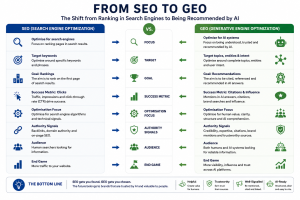
From SEO to GEO
SEO and GEO work best when they support one another.
SEO helps people discover your content, while GEO helps AI systems understand, interpret, and confidently recommend it.
Strong search visibility creates more opportunities for people to find your expertise, while authority, evidence, and clear communication help AI systems recognise its value.
The most effective digital strategies bring these disciplines together, making content easy to discover and easy to trust.
One way to think about the relationship is this: SEO builds the roads that lead people to your content, and GEO helps create destinations worth recommending.
The roads enable discovery, while the destination gives people and AI systems a reason to return, reference, and recommend your expertise.
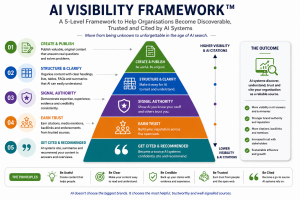
The AI Visibility Framework™
Over the past several years, I have come to see AI visibility as something far broader than search optimisation.
It is the outcome of several interconnected elements working together to build trust, authority, and discoverability over time.
I describe this approach as the AI Visibility Framework™, a practical model built around six stages that help organisations strengthen their digital presence.
The framework in this guide did not emerge from a single project. It developed gradually through my work in journalism, strategic communication, healthcare, higher education, and digital reputation management. Across those roles, I noticed the same pattern.
Organisations that consistently documented their expertise, communicated openly, and earned independent recognition were also the ones that became easier to trust, recommend, and discover online.
Over time, those observations evolved into what I now describe as the AI Visibility Framework™.
Stage One — Build Credibility
Every successful AI visibility strategy begins with organisational credibility.
Trust grows when organisations consistently deliver on their promises, and that reputation is reinforced through every customer interaction, service experience, and public engagement.
Communication can amplify genuine strengths, while quality remains the foundation on which lasting visibility is built.
Stage Two — Document Knowledge
Every organisation possesses valuable expertise.
The challenge lies in making that knowledge visible through research, case studies, practical guides, frequently asked questions, white papers, industry analysis, annual reports, and educational articles that help others learn and solve problems.
Knowledge locked away in internal reports contributes little to public authority.
When organisations share their expertise responsibly, they strengthen their reputation, expand their influence, and create lasting value for the communities they serve.
Stage Three — Improve Discoverability
Outstanding knowledge creates little impact if people cannot find it.
Organisations increase discoverability by making their expertise easy to access through a logical website structure, clear navigation, meaningful headings, descriptive page titles, effective internal linking, helpful summaries, and consistent terminology.
These elements make content easier for readers to navigate and help AI systems understand, interpret, and confidently reference your expertise.
Stage Four — Earn Recognition
Authority grows when respected organisations recognise your contribution.
That recognition may come through media coverage, speaking engagements, industry awards, academic citations, strategic partnerships, backlinks, or expert interviews, each adding another layer of credibility to your digital presence.
As independent recognition grows, so does digital trust, strengthening the evidence that people and AI systems use to evaluate your expertise.
Stage Five — Build Authority
Authority develops gradually through consistent effort and meaningful contributions.
Every publication, strategic partnership, conference presentation, and professional engagement expands your visibility and creates new opportunities to strengthen your reputation.
Much like a long-term investment, authority compounds over time.
Small, consistent contributions accumulate into lasting influence, making your expertise increasingly valuable to both people and AI systems.
Stage Six — Become AI Discoverable
This is the outcome of the AI Visibility Framework™.
As organisations consistently demonstrate expertise across multiple trusted sources, AI systems become increasingly confident in recognising and recommending them.
Lasting AI visibility is built through credibility, authority, and meaningful contributions that organisations earn over time.
Why Thought Leadership Has Become a Strategic Asset
Many people associate thought leadership with publishing on LinkedIn, yet the concept extends far beyond any single platform.
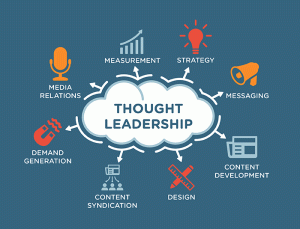
Thought leadership is the consistent sharing of useful expertise that helps people understand a subject more clearly, answer important questions, simplify complex ideas, introduce practical frameworks, share lessons from experience, and contribute meaningful insights to professional conversations.
At its core, thought leadership is about education.
It builds credibility by helping others learn, solve problems, and make better decisions, creating the trust that strengthens professional and organisational reputation over time.
AI systems increasingly recognise these patterns. The experts most frequently recommended have usually spent years teaching, publishing, researching, speaking, mentoring, and contributing to their professions.
Every article, presentation, interview, or research paper adds another layer of authority, making their expertise easier for both people and AI systems to recognise.
Every organisation has the opportunity to build the same foundation by consistently sharing knowledge that informs, educates, and creates lasting value.
Digital Authority: Why Recognition Matters More Than Reach
One of the biggest mistakes organisations make is assuming that visibility automatically creates authority.
Visibility attracts attention, while authority builds the trust that turns attention into lasting influence.
An organisation may invest heavily in advertising and become widely recognised, yet people still ask important questions.
Can I trust this organisation? Does it genuinely understand the subject?
What evidence supports its claims?
AI systems ask similar questions by looking beyond an organisation’s website for signals that confirm its expertise.
Those signals include media coverage, academic citations, conference presentations, research publications, strategic partnerships, expert interviews, books, and references from respected organisations.
Imagine being introduced as a speaker at an international conference.
You could introduce yourself by listing your achievements, or respected colleagues could introduce you by describing your work, your contributions, and the impact you have made.
The second introduction carries greater credibility because it reflects independent recognition rather than self-description.
Digital authority is built in much the same way.
Organisations become trusted when credible third parties consistently recognise and reference their work, creating the evidence that strengthens their reputation over time. That is why backlinks matter.
They represent more than technical SEO signals; they are digital endorsements that reinforce authority across the wider web.

Backlinks Are Digital Votes of Confidence
Search engine optimisation often measures backlinks by numbers, focusing on how many websites link to your content and the authority of those websites.
While these metrics provide useful insights, they tell only part of the story.
Every high-quality backlink reflects a relationship built on trust and value.
Journalists link to your research because it strengthens their stories. Universities reference your guides because they help students learn. Government agencies cite your reports to support public policy, while professional associations recommend your frameworks because practitioners find them valuable.
Each backlink is more than a technical signal. It reflects a decision by someone who considered your work valuable enough to share with others.
AI systems increasingly recognise these relationships because they provide independent evidence of expertise and authority.
For communication teams, one of the most valuable questions is not simply how many backlinks an organisation has, but why people choose to link to its work.
The answer often reveals far more about long-term authority than the numbers alone.
Create Resources People Want to Reference
The easiest content to publish is not always the content people remember.
A brief announcement about an internal meeting serves its purpose, while a well-researched guide that helps professionals solve an ongoing challenge can continue attracting readers for years.
Think about the resources you return to time and again. They explain complex topics clearly, answer common questions, provide practical examples, and remain useful long after publication.
These are the resources that naturally earn backlinks because people continue finding value in them.
Every organisation should build a library of evergreen reference materials, including ultimate guides, research reports, industry benchmarks, annual trend analyses, practical toolkits, frameworks, templates, frequently asked questions, case studies, and policy explainers.
Each resource becomes a long-term digital asset that strengthens authority with every citation, recommendation, and backlink it earns.
This guide reflects that philosophy. It is designed to do more than explain AI search by serving as a trusted resource that communication professionals can continue referencing as AI technologies and search behaviours evolve.
Why Media Relations Still Matters
Every few years, predictions emerge that media relations is losing its relevance.
The rise of websites was expected to reduce the influence of newspapers, social media was seen as the next major disruption, and today, artificial intelligence has become the latest force reshaping how information is discovered and shared.
As these technologies have evolved, one principle has remained remarkably consistent. AI systems depend on reliable information, and professional journalism continues to provide some of the strongest independently verified reporting available online.
When respected news organisations interview experts, investigate important issues, or report significant developments, they generate credible evidence that helps shape public understanding and strengthens the digital knowledge AI systems rely on.
Media coverage, therefore, creates value that extends well beyond the day it is published. It informs current audiences, contributes to long-term digital authority, and reinforces the independent trust signals that strengthen organisational reputation over time.
For communication professionals, building strong relationships with journalists remains a strategic priority because earned media continues to provide credible, third-party validation of organisational expertise.
Your Experts Are Your Greatest Competitive Advantage
I explore this idea in greater depth in my article on Why Media Relations Still Matters in the Digital and AI Age, which complements this guide by explaining how earned media continues shaping digital reputation long after publication.
Every organisation possesses valuable knowledge, although much of it never reaches the people who could benefit from it.
Researchers generate important findings, engineers solve complex technical challenges, doctors improve patient outcomes, lecturers develop innovative teaching methods, customer service teams identify recurring issues, and leaders make strategic decisions that shape the organisation’s future.
Communication professionals play a vital role in bringing this expertise into the public domain.
They identify subject matter experts, help them communicate with confidence, and turn specialised knowledge into practical insights that audiences can understand and apply.
Executives can explain industry trends, researchers can interpret emerging evidence, clinicians can answer common patient questions, finance specialists can simplify complex economic issues, and project managers can share lessons learned from implementation.
Together, these contributions strengthen the organisation’s authority, making its expertise more valuable to the people it serves and easier for AI systems to recognise and recommend.
LinkedIn Has Become an Expertise Platform
Professional visibility often begins long before someone visits your website.
Recruiters, journalists, conference organisers, researchers, and potential partners regularly use LinkedIn to evaluate expertise, identify subject-matter experts, and discover professionals worth engaging with.
AI systems are also increasingly recognising LinkedIn as an important source of professional identity and expertise.
Building authority on the platform goes well beyond maintaining a complete profile.
It grows through consistently sharing valuable knowledge, publishing thoughtful articles, explaining complex ideas clearly, contributing to professional discussions, supporting colleagues, and sharing practical lessons drawn from experience.
These contributions accumulate over time, strengthening your professional reputation and making your expertise easier to discover.
One well-researched article published each month often creates more lasting value than a stream of short updates that quickly disappear from view.
If you would like to explore this topic further, my article, How LinkedIn Is Becoming a Search Engine for Expertise and Professional Opportunity, explains how professionals can use LinkedIn to build authority, expand their visibility, and create new career and business opportunities.

Reputation Is Built in Communities
Organisations naturally pay close attention to the conversations they control, including their websites, social media channels, newsletters, and official publications.
Some of the most influential conversations, however, take place across professional forums, industry associations, academic communities, review platforms, discussion websites, and community groups where people freely exchange experiences and opinions.
These conversations help AI systems understand how organisations are perceived beyond their official communication.
People ask practical questions, share experiences, recommend organisations, discuss challenges, and offer advice that adds valuable context to an organisation’s digital reputation.
For communication professionals, understanding where these conversations take place is just as important as participating in them.
Careful listening reveals recurring questions that inspire useful content, highlights information gaps that need clarification, and uncovers constructive feedback that can strengthen products, services, and communication.
Over time, these communities become an invaluable source of insight for organisations seeking to build trust, authority, and long-term visibility.
Reputation Cannot Be Managed in Isolation
One lesson becomes increasingly clear throughout this guide: organisational reputation is everyone’s responsibility.
Every interaction contributes to the level of trust an organisation earns.
Customer service shapes public confidence, human resources influence employer reputation, researchers strengthen academic credibility, leaders demonstrate organisational values, finance builds investor confidence, and operations define the experiences people remember.
Communication professionals bring these experiences together by helping organisations communicate their expertise, values, and impact in a clear and consistent way.
As authentic stories become more visible, it becomes easier for people and AI systems to recognise trust.
This reflects one of the most important changes in the age of AI search.
Organisations that consistently deliver meaningful value and communicate it effectively build stronger digital authority, making sustainable visibility the natural outcome of credibility, contribution, and trust.
The Organisations AI Recommends Share One Characteristic
Across industries, the organisations most likely to earn long-term visibility share a common characteristic.
They consistently make life easier for the people they serve by answering important questions, explaining complex issues, publishing research, sharing practical knowledge, correcting misinformation, supporting professional development, documenting their impact, and helping people make better decisions.
These contributions create lasting value that extends well beyond a single campaign or publication.
As they accumulate over time, they strengthen the patterns of expertise, credibility, and trust that AI systems increasingly recognise when recommending organisations and their content.
The future of visibility belongs to organisations that consistently contribute knowledge, build trust, and create meaningful value for the communities they serve.
The AI Reputation Checklist™
The organisations most likely to succeed in the age of AI rarely rely on one exceptional campaign. They build credibility through hundreds of small actions that reinforce one another over time.
Use this checklist as a practical benchmark.
Organisational Trust
- We consistently deliver quality services.
- Our communication accurately reflects our performance.
- We respond openly when problems occur.
- Our leaders communicate regularly.
- Our experts are visible.
Knowledge
- We publish educational content, not only promotional content.
- We regularly answer stakeholder questions.
- We produce original research or practical insights.
- We explain complex issues clearly.
- We maintain an updated resource library.
Digital Authority
- Trusted media organisations reference our work.
- Our experts speak at conferences.
- Professional associations recognise our expertise.
- Other organisations naturally link to our resources.
- We continue building long-term authority instead of chasing short-term attention.
Reputation
- We monitor online conversations.
- We respond to misinformation with evidence.
- We understand what stakeholders are asking.
- We continuously improve based on feedback.
- We document positive impact.
AI Visibility
- AI can accurately describe what our organisation does.
- Our expertise is consistently represented online.
- Different sources tell a similar story about our organisation.
- We publish information that AI can easily understand.
- We continue strengthening our digital footprint every month.
The more boxes you can confidently tick, the stronger your organisation’s foundation for long-term AI visibility.
A 30-Day AI Visibility Action Plan
Many organisations delay improving their digital presence because the task feels overwhelming.
It becomes much more manageable when broken into small, consistent actions.
Week One: Understand Your Digital Reputation
Search for your organisation using several AI platforms.
Ask questions such as:
1. What does this organisation do?
2. What is it known for?
3. Who are its recognised experts?
4. What challenges are commonly associated with it?
Record the answers.
They reveal how AI currently understands your organisation.
Week Two: Identify Knowledge Gaps
Review your website.
Ask yourself:
1. What important questions remain unanswered?
2. Which topics deserve detailed guides?
3. Which reports remain hidden inside internal documents?
4. Which experts have valuable knowledge that has never been published?
Create a publishing plan around those gaps.
Week Three: Strengthen Authority
1. Reach out to journalists.
2. Encourage experts to write articles.
4. Support conference participation.
5. Publish a case study.
6. Update executive biographies.
7. Review internal linking across your website.
8. Every improvement contributes another layer of authority.
Week Four: Build for the Long Term
1. Measure progress.
2. Review AI responses again.
3. Monitor backlinks.
4. Track media mentions.
5. Identify new publishing opportunities.
Continue the cycle.
Authority grows through consistency.
Frequently Asked Questions
Will AI replace search engines?
Artificial intelligence is changing how people search for information. Traditional search engines continue playing an important role, while AI increasingly helps people interpret information, compare options, and receive direct answers. Both approaches are likely to coexist, with growing integration between them.
Is SEO still important?
Yes.
Strong technical SEO remains the foundation of digital visibility.
The difference is that organisations now benefit from combining SEO with Generative Engine Optimisation (GEO), digital authority, and trusted content.
What is GEO?
Generative Engine Optimisation (GEO) is the practice of creating content and digital signals that help AI systems accurately understand, trust, and recommend your organisation.
It complements traditional SEO by focusing on AI retrieval rather than only search rankings.
What type of content performs best in AI search?
Educational content consistently performs well because it helps answer real questions.
Examples include:
-
- Ultimate guides.
- Research reports.
- Case studies.
- Frequently asked questions.
- Frameworks.
- Practical checklists.
- Industry analysis.
- Expert commentary.
These resources remain valuable long after publication.
Does public relations still matter?
Artificial intelligence depends increasingly on trustworthy information to understand organisations and evaluate their expertise.
Media coverage, expert interviews, thought leadership, research communication, and digital reputation all contribute to the body of evidence AI systems use when recommending trusted sources.
As a result, public relations is taking on an even more strategic role by helping organisations build credibility, strengthen trust, and make their expertise more visible across the digital ecosystem.
Final Thoughts
When the first search engines appeared, organisations learned how to make themselves easier to find. Artificial intelligence is now encouraging a different conversation, one that centres on trust rather than visibility alone.
That question reaches every part of an organisation. It is reflected in the quality of its services, the integrity of its leadership, the expertise of its people, the knowledge it shares, the relationships it builds, and the promises it keeps. Together, these qualities shape the evidence that people and AI systems use to understand an organisation’s credibility.
This is why the age of AI search presents such an important opportunity for communication professionals. Our role has always been to help organisations build trust, strengthen relationships, and communicate with clarity.
Today, that responsibility also includes making expertise easier to discover by turning knowledge into a public resource that informs, educates, and creates lasting value.
Across Africa, the opportunity is especially significant. The continent is producing world-class research, innovative businesses, transformative public institutions, and professionals whose work deserves greater global visibility.
As more organisations document their expertise, publish practical knowledge, share research, explain complex issues, and communicate openly, they contribute to a richer and more accurate digital understanding of Africa.
Every research paper, practical guide, expert interview, thoughtful article, meaningful partnership, and lesson shared adds another piece to that growing body of knowledge.
Over time, these contributions strengthen organisational credibility, expand professional influence, and create trusted digital signals that benefit both current audiences and future generations.
One search can introduce someone to your organisation. One well-researched article can influence a journalist, policymaker, researcher, investor, or future partner.
One practical guide can continue educating people long after it is published, extending its value through every citation, recommendation, and conversation it inspires.
That is the enduring power of authority.
The organisations that invest in knowledge, contribute consistently, and earn trust through meaningful work will be easier to discover, recommend, and remember.
As artificial intelligence continues reshaping how information is found and shared, those organisations will also help shape how Africa’s expertise is understood by the world.
Hezron Ochiel is a strategic communications and public relations professional with over 15 years of experience in media, digital communication, and reputation strategy. He serves as the Deputy Corporate Communications Manager at the government-owned Kenya Medical Training College (KMTC) and is the founder of Hezron Insights, where he writes about AI visibility, Digital PR, SEO, GEO, and digital authority. His work has appeared on platforms including Reuters, The New Humanitarian, and The Standard.