

By Hezron Ochiel
Digital PR for SEO helps organisations earn credible backlinks, improve search visibility and strengthen online authority through original research, expert commentary and independent media coverage. A successful strategy gives journalists, researchers and other publishers information they have a genuine reason to reference.
Not too long ago, I had a conversation with my CEO at Kenya Medical Training College (KMTC) that made me reflect on the value of our digital communication work.
He had attended a university conference in Nairobi where participants wanted to know why KMTC frequently appeared in online searches about medical education and health training.
He had also used AI tools while preparing for a customer satisfaction survey dissemination meeting. He noticed that some answers were becoming more accurate in describing the College, its programmes, and institutional activities.
He welcomed the visibility but emphasised that information appearing online needed to remain accurate, current and reliable.
I found the conversation encouraging.
For several years, we had invested in institutional storytelling, media relations, website publishing and improving the availability of official information. The conversation suggested that these efforts were becoming noticeable beyond the institution.
It also reminded me of a problem I have encountered in communication practice.
An organisation may undertake valuable research, employ experienced professionals and serve thousands of people, yet remain difficult to find online. Relevant information sometimes exists but receives little attention on its own. In other cases, the organisation has not adequately documented its work for wider audiences.
Digital public relations (Digital PR) provides practical ways to address these weaknesses.
In this guide, I explain how digital PR improves SEO, how organisations can earn editorial backlinks and how my H.E.A.R.T Digital PR Framework can help communication teams assess their digital authority.
What is digital PR for SEO?
Digital PR for SEO uses newsworthy information, original research, expert contributions, and earned media coverage to strengthen online visibility and attract relevant backlinks from independent websites.
A backlink is a hyperlink from another website to yours.
When a professional publication discusses a research report and links to the original study, readers can examine the findings directly. The link may also help search engines discover the source.
Digital PR builds on established communication practices, particularly media relations, reputation management and stakeholder engagement. It adds greater attention to online publishing, source accessibility and the lasting value of independent references.
Three outcomes are worth measuring:
- Search visibility: Whether relevant audiences discover an organisation’s information through search engines.
- Editorial authority: Whether independent publications consider its expertise or evidence worth referencing.
- AI citation visibility: Whether AI-generated answers identify and accurately represent the organisation’s information.
Each provides a different perspective on digital communication performance.
An organisation may receive extensive media coverage without generating much referral traffic. Its website may perform well in search results while remaining absent from sampled AI-generated answers.
Communication teams need evidence of what each activity achieves.
How does digital PR improve SEO?
Digital PR can support SEO by earning relevant editorial backlinks, extending the distribution of useful information and increasing recognition within a particular subject area.
Consider an institution that publishes original research on barriers to accessing public services.
A specialist publication covering service delivery may use its findings and link to the original report so readers can examine the research.
The link connects a relevant audience to a primary source. It may also support the source website’s visibility in search.
The quality of the reference matters. A link from a respected specialist publication may contribute more to an organisation’s communication objectives than numerous unrelated mentions.
Google’s spam policies prohibit manipulative practices, including link schemes intended primarily to influence search rankings.
For organisations developing a digital PR strategy, the starting point should be the quality and relevance of the information they offer publishers.
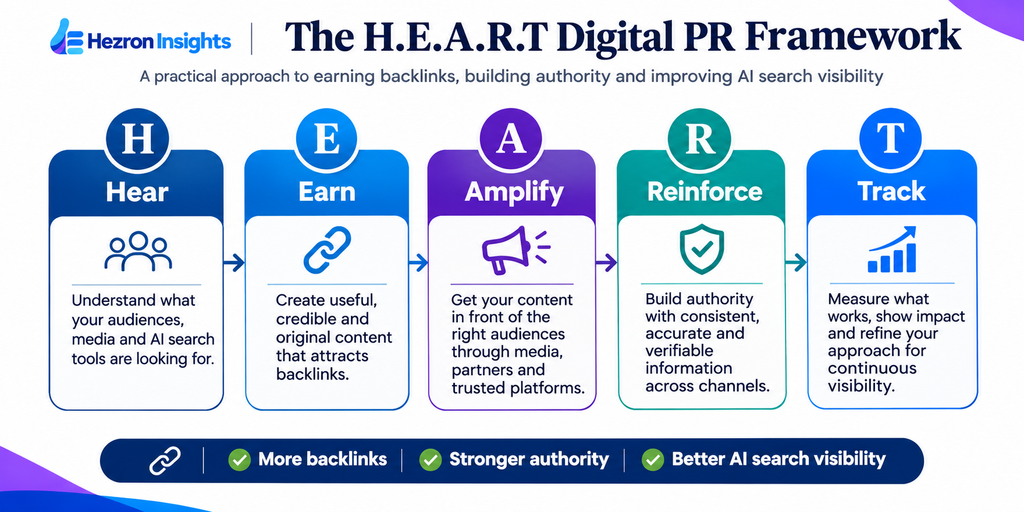
The H.E.A.R.T Digital PR Framework
Over the years, I have organised my approach to digital authority around five areas.
I call this the H.E.A.R.T Digital PR Framework.
The framework offers communication teams a structured way to examine their published information, the independent attention it receives and the conditions that make it accessible to wider audiences.
It consists of five components.
H — Human-Centred Storytelling
Many institutional stories concentrate on activities: meetings held, agreements signed or programmes launched.
These events may deserve coverage, but their significance is sometimes unclear to readers outside the organisation.
Human-centred storytelling explains the audience need, the organisation’s response and the available evidence of what happened.
A story about a health training initiative, for example, becomes more useful when it explains the workforce need being addressed, who the programme serves and what progress has been documented.
A planned benefit should be described as an expectation until there is evidence that it has been achieved.
These stories give journalists more substantial material than routine event announcements.
E — Earned Media Amplification
Earned media refers to independent coverage that an organisation does not control.
It may include a news article, expert interview, research citation or contribution to a professional publication.
Its value depends on editorial relevance, accuracy and the audience reached.
A well-researched article discussing an institution’s findings can remain useful long after publication. When it links to the original evidence, readers can investigate the source.
For digital PR, an important measure is whether independent publishers consider the organisation’s knowledge useful enough to reference.
A — Authority Content Development
Authority content provides information that others can use.
Original reports, documented case studies, professional frameworks and practical guides can become valuable references when they address genuine information needs.
Their credibility depends on the supporting evidence.
A research report should explain how its findings were obtained. A professional toolkit needs instructions that readers can follow. An institutional case study should distinguish documented outcomes from expectations.
Research departments, programme teams and service units often hold valuable knowledge that has not been prepared for wider publication.
Communication professionals can help make that knowledge accessible without compromising its accuracy.
R — Reputation and Entity Optimisation
People encounter information about an organisation across many websites.
Its official website may provide one description, an outdated news report another and a professional directory a third.
These inconsistencies can confuse readers and complicate verification.
Communication teams should regularly review institutional descriptions, leadership information, programmes and official online profiles.
Where important external sources contain errors, the organisation should seek factual corrections.
The objective is a dependable public record that accurately represents the institution.
T — Technical Discoverability
Useful information can remain difficult to find because of website problems.
Research reports may sit behind broken links. Important pages may have unclear titles. Downloadable documents may be difficult to read on mobile devices.
Technical discoverability concerns whether people and search systems can access relevant information without unnecessary obstacles.
Communication teams should work with website administrators to maintain functional links, clear navigation and accessible publishing formats.
These improvements make published knowledge easier to reach and verify.
The H.E.A.R.T Digital PR Audit Scorecard
The five dimensions can be assessed through a preliminary ten-point audit.
The scorecard is designed for communication teams seeking to identify weaknesses in their digital publishing and authority-building practices.
I developed it as a practitioner tool. It has not undergone formal statistical validation.
What should be assessed?
For storytelling, earned media and authority content, examine material published during the preceding 12 months. Institutional profiles and priority webpages should be assessed in their current state.
| Dimension | Evidence to examine | Suggested sample |
| Human-Centred Storytelling | Stories explaining stakeholder needs and outcomes | Up to 5 stories |
| Earned Media Amplification | Relevant independent references to the organisation or its work | Up to 5 references |
| Authority Content Development | Original reports, case studies or substantive guides | Up to 5 resources |
| Reputation and Entity Optimisation | Official website and external institutional profiles | Official website plus up to 3 profiles |
| Technical Discoverability | Priority public webpages | Up to 10 pages |
These are maximum sample sizes, not publication targets.
An institution with two substantive research reports should not automatically receive a lower quality score than one publishing ten reports.
The audit therefore records publication volume separately from the quality of available evidence.
Where the organisation has more material than the sample allows, reviewers should use a documented selection method covering different dates or subjects.
Selecting only the strongest examples would undermine the assessment.
How the H.E.A.R.T scoring system works
Each dimension receives a score of 0, 1 or 2.
An assessed item qualifies when it meets all the relevant criteria for that dimension.
| Dimension | Requirements for a qualifying item |
| Human-Centred Storytelling | Identifies an audience need, explains the organisation’s response and supports significant outcome claims with traceable evidence |
| Earned Media Amplification | Comes from an editorially independent, relevant publication, represents the work accurately and identifies the underlying source sufficiently for verification |
| Authority Content Development | Contains substantive original information, identifiable publishing responsibility, a publication date and supporting evidence, with relevant methodological qualifications |
| Reputation and Entity Optimisation | Accurately identifies the organisation, describes its current mandate and provides consistent official information |
| Technical Discoverability | Loads successfully, has a descriptive title, makes principal content accessible and provides functioning links to essential supporting material |
Calculate the percentage of assessed items that meet these requirements.
Apply the following thresholds consistently:
- 0 points: Fewer than 50% of assessed items qualify.
- 1 point: At least 50%, but fewer than 80%, qualify.
- 2 points: At least 80% qualify.
Suppose a team reviews five institutional stories and finds that four adequately explain stakeholder needs and support their principal claims.
Four out of five qualify, giving Human-Centred Storytelling a score of 2.
If two qualify, the score is 0.
The five dimensions carry equal weight, making the initial assessment straightforward for practitioners. This is a provisional methodological choice, not evidence that each dimension contributes equally to SEO performance or institutional credibility.
Future testing may justify different thresholds or weights.
How are smaller organisations assessed?
Organisations vary in size, resources and publishing activity.
A small institution may have produced only two substantive reports during the assessment period. If both meet the quality requirements, its Authority Content Development score is 2.
The audit must record that the score is based on two qualifying reports out of two assessed.
An institution with five qualifying reports out of five would receive the same dimension score, but its publishing volume would be reported separately.
Where fewer than three items are available for a dimension, the score should be labelled provisional. Such results can support internal improvement planning but should not be used for cross-institutional rankings.
If no qualifying material exists within the assessment period, record the absence and assign 0.
If essential evidence exists but cannot be accessed or assessed reliably, mark the dimension as not assessable (N/A) and explain the limitation.
An overall score out of ten should be calculated only when all five dimensions are assessable.
Interpreting the overall score
| Total score | Provisional interpretation |
| 0–3 | Major documented weaknesses |
| 4–6 | Some developed practices, with significant gaps |
| 7–8 | Generally developed practices requiring targeted improvement |
| 9–10 | Strong evidence across the assessed dimensions |
These categories are intended for internal diagnosis. They are not validated industry benchmarks.
A high H.E.A.R.T score does not establish strong search rankings, public trust or guaranteed AI visibility.
It indicates how well the organisation meets the framework’s documented assessment criteria.
The useful outcome is an improvement plan.
An institution may have well-documented research but limited independent coverage. Another may receive substantial media attention while struggling to keep source documents accessible.
The corrective actions will differ.
For each weakness, the audit should record the supporting evidence, recommended improvement, responsible department and review date.
Can the framework be tested?
Yes.
An appropriate starting point would be a small pilot involving two independent assessors reviewing the same organisations.
Each assessor would apply the published criteria separately.
Their initial scores could then be compared to identify disagreements and unclear definitions.
The findings would help refine the scoring method before using it for wider institutional comparisons.
Until that work is undertaken, H.E.A.R.T should be described as an original practitioner methodology.
Framework attribution: H.E.A.R.T Digital PR Framework, developed by Hezron Ochiel, Hezron Insights. The framework covers Human-Centred Storytelling, Earned Media Amplification, Authority Content Development, Reputation and Entity Optimisation, and Technical Discoverability. The assessment method and provisional scoring rules are documented in this article.
What KMTC taught me about institutional digital visibility
My experience at Kenya Medical Training College has influenced how I approach institutional digital communication.
Over several years, our work included institutional storytelling, website publishing, media engagement and improving access to official information.
We also paid attention to how the College was described across digital platforms.
The conversation with my CEO suggested that these efforts were becoming noticeable beyond the institution.
KMTC’s appearance in the 2026 Webometrics rankings provided another occasion to examine its online presence. However, the rankings reflect several institutional and digital indicators. They cannot independently establish the contribution of particular PR activities.
What I can draw from my professional experience is the importance of maintaining a reliable institutional information record.
Outdated programme descriptions can continue appearing in searches. Useful research may receive limited attention because it is difficult to locate through the institution’s website.
These problems require cooperation between communication officers, academic departments and website administrators.
Historical search data, verified referring domains and dated external references would provide a stronger basis for evaluating the outcomes of communication activities where comparable records are available.
From original research to international media coverage: The AHACI experience
In August 2026, I published the African Humanitarian AI Citation Index (AHACI), an independent exploratory study examining which sources AI platforms cited when answering humanitarian questions about ten African countries.
The study analysed 360 responses and identified 1,083 recoverable citations.
Country-local organisations accounted for 5.5% of those citations, while United Nations agencies and other multilateral organisations accounted for 68.8%.
The research had limitations. It used English-language questions and did not establish the full range of relevant local sources available to the platforms.
These qualifications were important to interpreting the findings.
The study subsequently attracted coverage and commentary from publications in several countries.
The research dissemination case study documents how the findings were prepared and introduced to different editorial audiences.
The 5.5% country-local citation share became a useful starting point for discussions about African institutional knowledge and AI-generated answers.
Publishers could examine the underlying research, consider its limitations and explore its implications for their readers.
The original report provided a source for that discussion.
The experience demonstrated how independently produced research could reach audiences beyond its initial publication.
However, international media attention does not automatically translate into SEO gains.
A publication may discuss a study without linking to it. An editorial hyperlink may also generate limited referral traffic.
To evaluate the SEO contribution of AHACI’s coverage, I would examine verified referring domains, the relevance of links to the original research and visits attributable to those references.
Those figures should be reported after checking the underlying data.
The experience reinforced the value of publishing original findings that independent writers can investigate and use.
How to run a digital PR campaign that earns editorial backlinks
A digital PR campaign should begin with a clear understanding of the information being offered and the audience that could benefit from it.
Step 1: Identify an information gap
Find a question that matters to a defined audience and for which your organisation can provide useful evidence.
The opportunity may emerge from stakeholder concerns, sector debates or research findings that have received limited attention.
Step 2: Develop an authoritative source
Prepare an original report, documented case study, professional resource or another substantive asset.
Include the evidence needed to evaluate its claims.
Step 3: Publish an accessible reference page
Make the source available through a stable URL with a descriptive title and functional supporting links.
Readers should be able to understand the main findings without searching through several disconnected documents.
Step 4: Identify relevant publications
Review the subjects prospective publishers cover and the interests of their audiences.
Develop an editorial angle that reflects the publication’s readership.
Step 5: Pitch the evidence
Explain what the findings establish, why they matter and where the editor can verify them.
Offer an appropriate expert interview when it would add useful context.
Step 6: Maintain the source
Monitor the published material for broken links, outdated information and necessary corrections.
Preserve access to documents that independent publishers have referenced.
Step 7: Evaluate the results
Compare outcomes with a documented baseline.
Examine relevant coverage, editorial backlinks, referral traffic, search performance and qualified enquiries.
Consider other factors that may have influenced any observed changes.
What should digital PR teams measure?
The strongest digital PR reports help management understand what communication activities achieved and where further action is required.
| Indicator | What it helps establish |
| Editorial referring domains | Which independent websites link to original information |
| Contextual backlinks | Whether those references appear in relevant editorial discussions |
| Independent media coverage | The publications and audiences reached |
| Unlinked research citations | Where original findings receive recognition without a hyperlink |
| Organic search impressions and clicks | How relevant webpages perform in search results |
| Referral traffic | Whether external references generate visits |
| AI citation observations | Whether sampled AI answers reference and accurately describe the organisation’s information |
| Qualified enquiries | Whether relevant potential clients or collaborators contact the organisation |
Domain Authority and Domain Rating may provide supplementary information when assessing backlink profiles.
These are proprietary third-party metrics, not Google’s own ranking scores.
Measurement should also distinguish observed changes from results attributable to the campaign.
An increase in organic search impressions may coincide with earned media coverage, but it could also reflect changes in search demand, website content or other activity.
Common digital PR mistakes
Chasing irrelevant backlinks. Links should be assessed for editorial relevance and their value to intended audiences.
Publishing research without adequate supporting information. Findings lacking identifiable sources or a clear methodology are difficult to verify.
Allowing important source pages to disappear. Broken research links and outdated webpages can undermine the usefulness of previous coverage.
Promising guaranteed AI visibility. AI systems differ in how they generate responses and display citations. Outcomes should be monitored using documented questions and collection dates.
Equating publicity with organisational results. Media coverage should be evaluated against the campaign’s purpose and the audience it was intended to reach.
Frequently asked questions
What is digital PR for SEO?
Digital PR for SEO uses original research, expert contributions and earned media coverage to improve online visibility and attract relevant editorial backlinks.
How can digital PR improve Google rankings?
Relevant backlinks can support search visibility, although rankings depend on content quality, technical accessibility, competition and other factors. No digital PR campaign guarantees a particular position.
What is the difference between digital PR and traditional link building?
Traditional link building focuses on obtaining hyperlinks. Digital PR uses established communication practices to earn independent attention, with backlinks representing one possible outcome.
What content attracts high-quality backlinks?
Original research, useful datasets, documented case studies and practical professional resources can give independent publishers compelling reasons to reference a source.
Does digital PR improve AI search visibility?
Digital PR can make reliable information more accessible and increase relevant external references. AI citation outcomes vary across platforms and questions, so they should be assessed through observation.
What is the H.E.A.R.T Digital PR Framework?
H.E.A.R.T is a practitioner methodology developed by Hezron Ochiel. It covers Human-Centred Storytelling, Earned Media Amplification, Authority Content Development, Reputation and Entity Optimisation, and Technical Discoverability.
Its preliminary ten-point scorecard helps organisations identify weaknesses in their digital publishing and authority practices.
Is Domain Authority a Google ranking factor?
No. Domain Authority is developed by Moz, while Ahrefs provides a separate metric called Domain Rating. Neither is Google’s own ranking score.
Where communication teams should begin
The conversation with my CEO reminded me of something I have come to appreciate through years of institutional communication work.
Organisations often possess more valuable knowledge than their public websites reveal.
Some of that knowledge is poorly documented. Other material is published but receives little attention outside the institution.
The H.E.A.R.T Framework provides a way to examine these problems systematically.
I encourage communication teams to start by reviewing their existing information and the independent references that point to it.
The findings can help establish whether the immediate priority is stronger research dissemination, better institutional storytelling, more effective media engagement or improved website accessibility.
For organisations seeking lasting digital authority, the quality of their published evidence deserves as much attention as the publicity surrounding it.
About the author
Hezron Ochiel is a Kenya-based strategic communication practitioner and researcher with more than 15 years of experience in corporate communication, media relations and institutional reputation management. He is the founder of Hezron Insights, a research and professional knowledge platform that examines AI visibility, digital authority, and strategic communication.
Commission a H.E.A.R.T Digital PR Audit
Hezron Insights works with organisations seeking to improve their digital visibility, research dissemination and institutional communication.
A H.E.A.R.T Digital PR Audit examines publishing practices, earned media coverage, authority content, institutional information consistency and technical accessibility.
The assignment produces a documented scorecard, an evidence inventory and a prioritised improvement plan, with recommendations suited to the organisation’s resources and communication objectives.
Explore our research, digital PR and strategic communication services.