African Humanitarian AI Citation Index 2026
Hezron Ochiel | Hezron Insights, Nairobi, Kenya
Research | August 2026
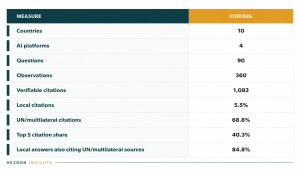
10 African countries · 4 AI platforms · 90 production questions · 1,083 verifiable citations
Only 5.5% of citations came from organisations based in the African country being discussed.
When people ask AI about a humanitarian crisis in Africa, the answer may describe a local reality using evidence that mostly comes from outside the country concerned.
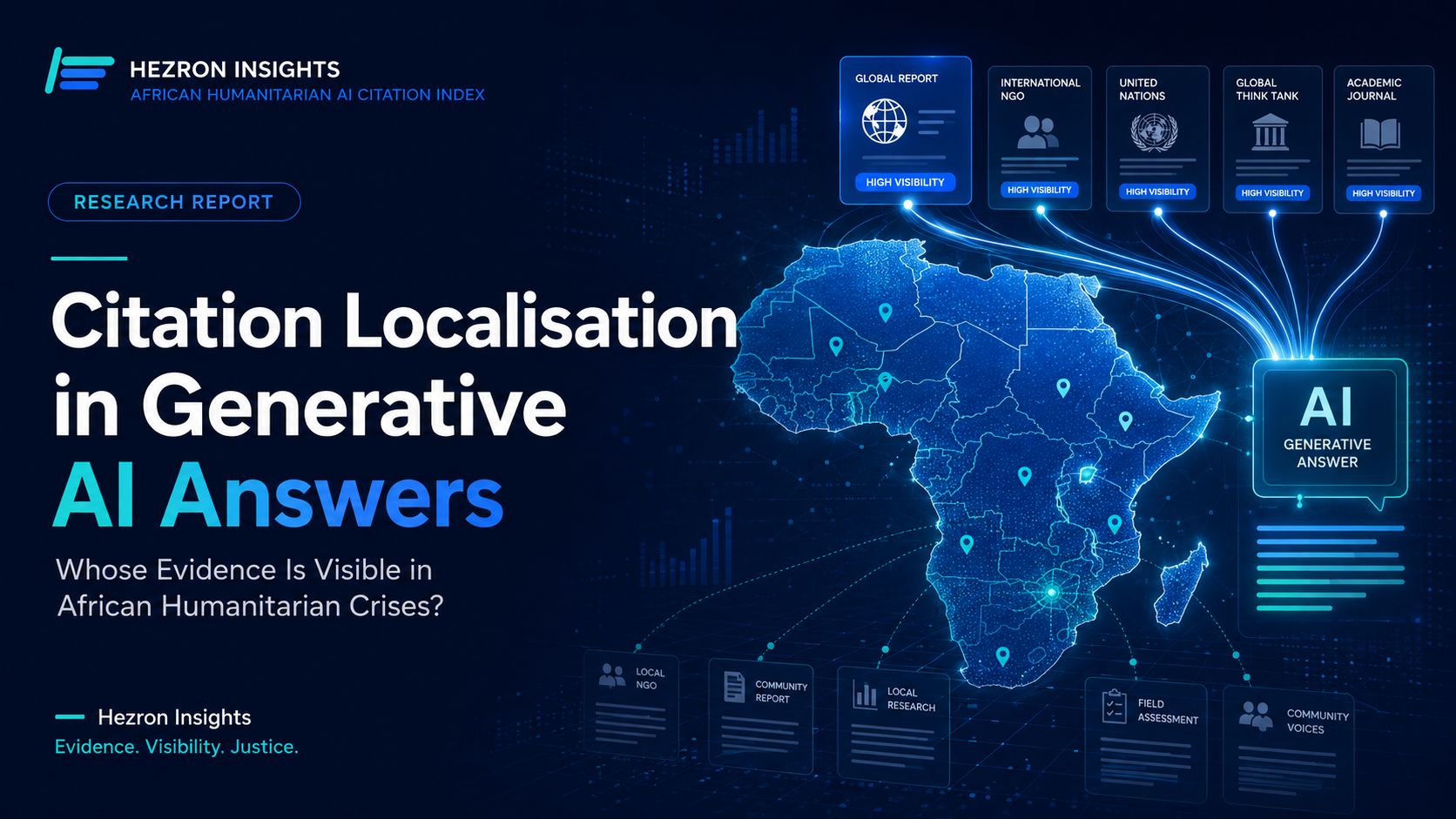
The African Humanitarian AI Citation Index (AHACI) examines whose knowledge becomes visible when generative AI explains humanitarian crises.
Download the African Humanitarian AI Citation Index 2026 Report
Research at a Glance
What Is Citation Localisation?
This study introduces citation localisation: the degree to which an AI-generated answer about a humanitarian situation visibly attributes evidence to knowledge producers based in the affected country.
Humanitarian localisation has traditionally focused on who receives funding, who implements programmes and who participates in decisions.
Citation localisation adds another dimension: Who becomes visible as a source of knowledge when AI explains the crisis?
The measure focuses on visible attribution in AI-generated answers. It does not attempt to determine who funded, collected or contributed every piece of underlying information.
Key Findings
1. Most visible evidence came from international sources
Of the 1,083 verifiable citations, only 60 came from organisations based in the country being discussed.
By comparison, 745 citations came from UN or multilateral organisations.
The evidence layer presented to AI users was therefore strongly international.
2. Citation attention was concentrated
The five most-cited knowledge producers accounted for 40.3% of all citations, while the top ten accounted for 58.8%.
UNICEF was the most frequently cited producer, followed by UNHCR, OCHA/Humanitarian Country Team products, OCHA and the International Organisation for Migration.
These organisations produce extensive and frequently updated humanitarian information. The question is whether credible local evidence has a strong enough route into the same citation environment.
3. Kenya stood out
Local visibility varied considerably between countries.
Of the 60 country-local citations identified across the study, 31 came from Kenyan sources. Nigeria contributed nine.
The Democratic Republic of the Congo and Sudan recorded no country-local citations in the recoverable cross-platform dataset.
The study does not establish why these differences occurred. Instead, they open an important question for further research:
What makes locally produced knowledge easier to discover and cite in some African countries than in others?
4. Local evidence usually appeared alongside international sources
Of the 33 cited AI responses containing at least one country-local source, 84.8% also cited a UN or multilateral organisation.
Only one relied entirely on country-local sources.
At the same time, answers containing local evidence were less dominated by UN sources overall. This suggests that local sources can broaden the evidence mix even when international organisations remain part of the answer.
Why This Matters
Generative AI is becoming another route through which journalists, researchers, policymakers, students, humanitarian professionals and members of the public encounter information about crises.
The sources appearing in those answers can influence which organisations people discover and investigate next.
A local organisation may hold valuable knowledge about a community and still remain difficult to see if its evidence is harder to discover or attribute.
That makes citation visibility part of the wider humanitarian localisation conversation.
Localisation may increasingly need to ask not only who delivers aid or receives funding, but whose evidence becomes visible when people ask AI to explain a crisis.
Methodology
AHACI began with a 1,000-question bank covering ten African countries, ten humanitarian themes and ten question types.
The first randomised batch contained 100 questions. Ten were used to refine and freeze the research protocol and were excluded from the production analysis.
The remaining 90 questions were submitted independently to ChatGPT, Gemini, DeepSeek and Perplexity on 23 August 2026, producing 360 platform-question observations.
The recoverable corpus contained 1,083 answer-linked citations.
Each citation was classified by knowledge producer, publisher type, geographic base, country-local status, African-based status, UN/multilateral status and whether the cited URL directly hosted the original source or acted as an intermediary.
Important Limitations
The study measures visible citations, not the complete internal retrieval process of AI systems.
Source-level recovery was incomplete for some platforms, particularly Gemini and Perplexity, so the pooled findings describe the recoverable citation corpus rather than an equal-weight comparison of all four platforms.
All questions were asked in English, which may influence source visibility in multilingual information environments.
The study also does not establish how many suitable local sources were available for every question. The 5.5% finding should therefore not be interpreted as proof of algorithmic bias against African sources.
A complete analysis of all 90 ChatGPT production questions nevertheless showed a similar pattern: 7.2% country-local citations and 70.9% UN/multilateral citations.
The Main Takeaway
AHACI points to an emerging dimension of humanitarian localisation: knowledge visibility.
The goal is not an arbitrary quota of local citations. It is an information environment in which credible local evidence can be discovered, attributed and considered alongside established international sources.
As AI increasingly helps people understand humanitarian crises, one question becomes harder to ignore: Who gets to explain them?
Download the Research
African Humanitarian AI Citation Index 2026
A visual report presenting the headline findings, country patterns and implications for humanitarian localisation and AI visibility.
Full Research Paper
Citation Localisation in Generative AI Answers: Whose Evidence Is Visible in African Humanitarian Crises?
Read the full methodology, analysis, limitations, discussion and references.
Read the Full Research Paper (PDF)
Suggested citation for this Research
Ochiel, H. (2026). Citation Localisation in Generative AI Answers: Whose Evidence Is Visible in African Humanitarian Crises? Hezron Insights, Nairobi, Kenya.
Research page:
When AI Explains African Humanitarian Crises, Whose Knowledge Becomes Visible?
About the Researcher
Hezron Ochiel is an award-winning strategic communications and public relations professional, researcher and founder of Hezron Insights. His work examines how artificial intelligence, search and digital publishing are changing institutional visibility, authority and access to information, with particular interest in African organisations and knowledge visibility.