

An analysis of 1,083 citations across four AI platforms shows how humanitarian source attribution was concentrated among a small number of major publishers.
By Hezron Ochiel
When ChatGPT, Gemini, DeepSeek and Perplexity answered questions about humanitarian crises across ten African countries, they cited 183 knowledge producers.
Five coded producer entries accounted for 40.3% of the 1,083 citations examined. The twenty most frequently cited received 71.3%, leaving the remaining 163 to share 28.7%.
UNICEF led with 136 citations, followed by UNHCR with 100.
A separate statistical calculation suggested that the distribution was equivalent in concentration to approximately 22 equally weighted producers, although 183 appeared in the dataset.
These findings come from the African Humanitarian AI Citation Index (AHACI), a study examining which sources receive visible credit when AI platforms explain humanitarian crises affecting African countries.
How concentrated were the citations?
AHACI identified 183 producer entries in its recovered citation records. These represented organisations or separately coded information products credited in AI-generated answers.
The distribution was heavily concentrated at the top.
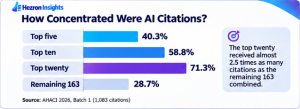
The top twenty received almost two and a half times as many citations as the remaining 163 combined.
AHACI also used the Herfindahl–Hirschman Index (HHI), a statistical measure of concentration, to examine the distribution.
The calculation involves squaring each producer’s share of citations and adding the results. Taking the reciprocal produces the effective number of equally weighted producers.
Effective number = 1 ÷ Σ(citation share²)
The reported calculation yielded an effective number of approximately 22.
In other words, the distribution was as concentrated as one in which 22 producers received equal shares, despite the presence of 183 identified entries.
This measure describes citation distribution. It does not assess the quality of the evidence produced by individual organisations.
The exact calculation depends on how producer entries were coded and how citations were allocated among them. Reproducing the result requires the complete producer-level dataset.
Who received the most citations?
UNICEF was the most frequently cited producer, with 136 citations. UNHCR followed with 100.
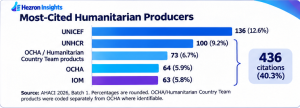
Source: AHACI 2026, Batch 1. Percentages are rounded. OCHA/Humanitarian Country Team products were coded separately from OCHA where identifiable. The five entries are not five institutionally independent organisations.
UNICEF and UNHCR together accounted for 236 citations, approximately 21.8% of the dataset.
Across the broader classification, UN agencies and other multilateral organisations accounted for 745 citations, representing 68.8%.
Universities and research institutions accounted for approximately 10%, international NGOs 6.2%, and international media 3.9%.
The prominence of UN agencies is understandable. They have extensive humanitarian reporting responsibilities and publish information covering multiple countries and emergencies.
UNICEF produces material on child protection, nutrition and humanitarian needs. UNHCR reports on displacement and refugee protection, while OCHA coordinates and reports on humanitarian situations.
Their publishing mandates may help explain their prominence, although AHACI did not test that explanation.
The study recorded which producers were cited. It did not measure their total publication output or compare every cited document with all potentially relevant alternatives.
Local sources were also unevenly represented
Country-local producers accounted for 60 of the 1,083 citations, representing 5.5%.
Those citations were attributed to 35 publishers based in the countries being discussed.
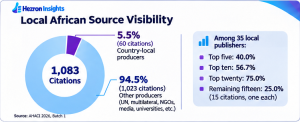
Kenya Red Cross Society led with eleven citations, followed by The Star newspaper with five.
Nigeria’s National Emergency Management Agency and the Ethiopian Human Rights Commission recorded three citations each.
The fifteen publishers outside the top twenty collectively received fifteen citations. Since each appeared at least once, each received one citation.
The reported concentration calculation for country-local sources yielded an effective number of approximately 16.7 equally weighted publishers, compared with 35 identified publishers.
This calculation concerns only country-local citations and should not be treated as directly equivalent to the overall concentration measure.
The geographical findings, including Kenya’s comparatively strong local representation, are examined in my earlier article, AI Rarely Cites Local Sources When Explaining African Humanitarian Crises.
Who produced the information behind the citations?
The publisher credited in an AI-generated answer is not necessarily the organisation that originally collected the information.
A humanitarian situation report published by an international agency, for example, may draw on assessments conducted by local organisations or government institutions.
When an AI platform cites the international report, the original contributors may not receive direct attribution in the answer.
AHACI recorded the publisher named in each recovered citation. It did not trace the information back through every organisation involved in its production.
A citation to an international organisation therefore cannot be taken as proof that local knowledge was absent from the underlying report.
A separate provenance study would be needed to establish how often local evidence reaches AI-generated answers through intermediary publications without its original producer receiving visible credit.
Does the concentration indicate bias?
The results do not establish algorithmic bias or deliberate exclusion.
Humanitarian organisations differ in their geographical coverage, publishing frequency and responsibilities. An agency producing regular reports across several countries may have more opportunities to be cited than a smaller institution publishing specialised research.
AHACI did not establish the full range of relevant sources available for each question or determine whether an alternative source would have provided more accurate information.
Equal citation shares would not necessarily represent a better outcome.
The observed concentration warrants further investigation, particularly into how source availability, retrieval processes and citation selection affect which publishers appear in AI-generated answers.
How the study was conducted
AHACI examined citations generated by ChatGPT, Gemini, DeepSeek and Perplexity in response to humanitarian questions about Burkina Faso, Chad, the Democratic Republic of the Congo, Ethiopia, Kenya, Mozambique, Nigeria, Somalia, South Sudan and Sudan.
The research began with a bank of 1,000 questions. A batch of 100 was selected, with ten used for pilot testing and 90 retained for the main study.
Each production question was submitted independently to the four platforms on 23 August 2026, producing 360 platform-question observations.
The questions addressed conflict, displacement, food insecurity, health emergencies, water and sanitation, climate hazards and humanitarian response.
The resulting dataset contained 1,083 recoverable answer-linked citations, classified by producer and source characteristics.
All questions were asked in English. Citation recovery was incomplete for some platforms, meaning the pooled results reflect unequal contributions from the four systems.
The analysis captures citations visible in recovered answers during one collection period. It does not establish whether the same distribution would occur with different questions, languages or collection dates.
The full methodology and principal findings are available in the African Humanitarian AI Citation Index 2026 research report.
What the findings mean for African evidence visibility
The humanitarian sector has long examined the participation and recognition of locally based organisations. AI-generated information adds another dimension to that discussion: which institutions receive visible credit when humanitarian evidence is presented to users.
In Citation Localisation: The Next Humanitarian Frontier, published by Global Policy Journal, I examined the relationship between source attribution and humanitarian localisation.
I later explored practical measures for improving local evidence visibility in How Humanitarian Actors Can Help Local Knowledge Get Found, published by the Humanitarian Practice Network.
The new concentration analysis provides a baseline for examining whether citation patterns change across countries, humanitarian subjects, AI platforms and collection periods.
It also identifies an area requiring closer study: the relationship between organisations that produce evidence and those receiving credit when AI systems cite it.
In this AHACI sample, 163 of the 183 identified producer entries shared just 28.7% of recovered citations.
The finding gives researchers a starting point for examining how citation visibility is distributed and whether African evidence producers receive recognition for their contributions.
Research reference
Ochiel, H. (2026). African Humanitarian AI Citation Index (AHACI): Whose Evidence Is Visible in African Humanitarian Crises? Hezron Insights, Nairobi, Kenya.
This article draws on AHACI Batch 1 research conducted on 23 August 2026. The findings are observational. The reported effective producer numbers require reproduction using the underlying producer-level citation counts.
About the author
Hezron Ochiel is a strategic communication professional, researcher and founder of Hezron Insights. His work examines AI visibility, digital authority, research communication and the representation of African knowledge in emerging information systems.