
When people talk about promoting content on social media, the first thing that comes to mind is massive reach. Many imagine that once they start running ads, their content will finally take off and attract likes, shares, and comments with ease.
I used to think the same way.
Months ago, my LinkedIn account would generate at least one viral post every week. A single post could attract as many as 13,000 likes, not to mention hundreds of comments and reposts. It was like I had cracked the code.

I could predict which posts would perform well.
Then one day, LinkedIn offered me a one-month free Premium trial with advertising credits to promote my content. It felt like the perfect chance to test how paid promotion could boost my reach.
It was an opportunity I could not resist. It would help me reach new audiences, see who viewed my profile, and build stronger connections through direct messages.
For a few weeks, everything worked well. My posts continued to perform better, the numbers looked impressive, and I had discovered the secret to growth.
Then something unexpected happened.
Weeks after the promotion ended, I noticed my organic engagement began to drop. My posts no longer perform as they used to. What once went viral every week is now struggling, and today, I can land one every 3 months.
When fewer people see your organic posts, engagement begins to decline. With fewer clicks, comments, and shares, your page’s overall visibility drops, leading to fewer conversions, fewer leads, and ultimately fewer customers.
At first, I thought the algorithm had changed. But after studying it closely and comparing my metrics with those of other creators, I realized the problem was not LinkedIn itself. It was how the system had started classifying my account.
That experience led me to a six-month study on how adverts and paid promotions affect social media accounts.
In this 104th edition of Hezron Insights, I share what I discovered after studying how paid promotions secretly change how your content performs.
What began as a simple LinkedIn experiment gradually revealed something much bigger about modern digital visibility systems.
The issue increasingly concerns how algorithms classify creators, interpret audience behaviour, evaluate the quality of engagement, and determine who receives sustained organic visibility across digital platforms.
Similar patterns are increasingly appearing across LinkedIn’s creator ecosystem, where many professionals are experiencing declining visibility despite large audiences. I explored this broader platform shift in my article on why some LinkedIn creators are losing reach and engagement.
The illusion of paid growth
When you first promote a post, you’re confident it will perform well. Your reach increases, your metrics improve, and of course, you achieve your marketing goals.
It seems like the easiest way to achieve success without hard work.
But behind the scenes, something begins to shift. The algorithm starts to interpret your profile or page differently. It no longer sees you as a community builder but as a paying advertiser.
From that moment on, your organic posts start to act differently. They are shown to new audiences, appear less often to loyal followers, and gradually lose the natural engagement that once seemed guaranteed.
I gradually began describing this pattern as:
Paid Reach Dependency Cycle — Hezron Ochiel
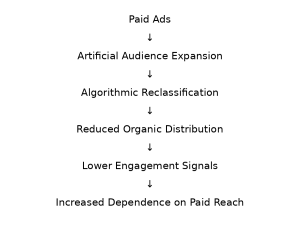
The cycle begins when paid promotion rapidly expands audience exposure. Audience quality gradually shifts, engagement consistency weakens, and platforms begin redistributing content differently over time.
As Search Engine Journal explains in its guide to social media algorithms, paid activity changes how algorithms interpret your content and audience signals. It may bring quick visibility, but it often introduces unpredictability in long-term engagement.
Paid reach and organic reach operate differently.
Paid visibility purchases temporary exposure.
Organic visibility depends more heavily on trust, audience relationships, engagement quality, topical authority, and behavioural consistency.
That distinction is becoming increasingly important in the age of AI-driven discoverability.
In simple terms, once you start paying, the system expects continued investment before it delivers consistent reach.
Why engagement starts to decline
Every social media channel operates on a simple rule: keep users on the platform for as long as possible. Paid posts provide precise data such as budgets and targeting preferences, and that is what the algorithm learns to optimise for.
When you start promoting content, you change how the algorithm perceives you. It begins to categorise your account differently, viewing it through the lens of revenue potential.
Once the system learns that you can pay, your unpaid content begins to behave differently. This happens as part of the optimisation process that shapes content distribution.
Recent academic research supports this observation. In a 2022 study titled Personality-Driven Social Multimedia Content Recommendation, researchers Yang and colleagues noted that “global media buying platforms such as Facebook Ads constantly reduce the reach of branded organic posts, pushing brands to spend more on paid media ads.”
But some marketing researchers argue that the connection between ads and engagement drop is often overstated.
Illia Sandyriev, in his article The Truth About Social Media Advertising: Debunking the Organic Reach Suppression Myth (2025), explains that “paid advertising does not suppress organic reach, this is a myth.” He suggests that organic reach has been declining across platforms due to algorithm changes, content saturation, and audience fatigue rather than paid activity.
This view is echoed by Advids Media, which argues that “paid ads are rented eyeballs, visibility evaporates when you stop paying.” In other words, ads do not always damage your reach, but they create a dependency that can make organic engagement appear weaker once the paid exposure ends.
Both perspectives are valuable as they remind us that the real issue is how we maintain authenticity, posting patterns, and audience quality after running ads.
What happens across the channels
1. Meta platforms (Facebook and Instagram)
Meta’s algorithm separates content into two paths: paid and unpaid. Over time, unpaid content loses visibility because the system begins to expect continuous ad activity.
Meta insists that this is not suppression, but the results tell a different story.
2. X (formerly Twitter)
X behaves differently, but the outcome feels familiar. When you start promoting tweets, your content is tested with random audiences rather than loyal followers, making engagement unpredictable.
Engagement on X depends on natural loops such as replies, quotes, and conversations. When those loops are disrupted by paid targeting, organic visibility drops sharply.
3. YouTube
When you run ads on YouTube, your channel begins to act like an advertiser’s page. The algorithm starts prioritising conversions and watch time over discovery.
4. TikTok
TikTok’s feed thrives on genuine engagement speed. Paid ads create artificial momentum that confuses the algorithm. Over time, it separates your audience into two groups, paid and organic viewers, which weakens the performance of unpaid videos.
5. LinkedIn
LinkedIn is built around relationships and trust.
The platform increasingly prioritises expertise, educational value, authority, authentic interaction, and professional relevance.
This shift closely mirrors broader changes happening across Google Search, AI Overviews, ChatGPT, Perplexity, SEO, GEO, and AI-driven discovery systems.
When you start promoting posts or running campaigns, the system reclassifies your content as brand material rather than personal storytelling.
This slight shift changes everything. Instead of showing your content to peers who genuinely engage with you, LinkedIn distributes it to campaign networks that rarely interact.
Other reasons why engagement declines
Many people assume platforms deliberately penalise paid users, but the reality is more complex. What happens is a chain reaction involving both user behaviour and algorithm learning patterns.
Modern algorithms continuously learn from interaction quality, engagement consistency, audience behaviour, visibility patterns, and content relevance.
Paid campaigns reshape those behavioural signals over time, causing organic distribution patterns to gradually shift.
1. Audience quality changes – Paid ads attract large numbers of followers who may not genuinely care about your content. Their lack of engagement lowers your organic reach.
2. Algorithm reclassification – Once you start paying, the platform tags your profile as a business account and changes how it distributes your content.
3. Content tone mismatch – Ad content often feels robotic, while organic posts are conversational. This inconsistency can weaken your connection with the audience.
4. Engagement fatigue – Frequent promotions make your audience scroll faster when they see your posts, signalling reduced interest.
Best practices to balance paid and organic
Here are practical ways to protect your organic reach:
- Separate organic and promotional spaces
If possible, create separate accounts for organic engagement and for advertising. This helps maintain clear audience signals and preserves the authenticity of your interactions.
According to Forbes Communications Council, “Paid social should enhance what already works organically, not replace it.”
- Alternate between paid and unpaid periods
After completing a paid campaign, give your account time to recover. A three-to-four-week cooling period helps the algorithm reset and allows you to rebuild organic momentum. - Preserve your natural tone
Do not let ad language spill into your everyday posts. A HubSpot study found that conversational posts attract up to sixty percent more engagement than structured brand messages. - Rebuild your community
If your page feels quiet, reignite your connections. Host polls, ask questions, spotlight followers, and share real stories. Algorithms reward genuine human interaction. - Track your data carefully
Use tools like Hootsuite or Buffer to compare organic and paid performance separately. Search Engine Journal notes that “the strongest brands treat paid and organic as complementary channels rather than competing forces.”
How to recover a struggling account
If you notice your organic engagement falling after running ads, here is what can help:
1. Pause ad campaigns for at least a month to allow your signals to normalise.
2. Review your followers and remove inactive or irrelevant ones.
3. Repost older content that once performed well to retrain the algorithm.
4. Reintroduce ads gradually, keeping them separate from your storytelling posts.
5. Engage directly with your audience through replies, comments, and personal messages.
Why Digital PR Is Becoming More Important
One of the biggest lessons from this experiment is that creators and organisations can no longer depend entirely on platform algorithms for visibility.
Social platforms can reduce organic reach, reshape distribution patterns, alter engagement systems, and change visibility rules at any time.
This explains why Digital PR is becoming increasingly important.
Strong Digital PR helps organisations build searchable authority, backlinks, media mentions, discoverability, and a trusted digital footprint beyond social media alone.
In my article on how AI search is reshaping Digital PR and SEO, I explained how organisations increasingly need searchable authority rather than temporary attention.
Final thoughts
Advertising remains a powerful visibility tool when used strategically.
Long-term digital growth increasingly depends on trust, discoverability, authority, meaningful audience relationships, and consistent positioning of expertise.
The creators and organisations that adapt early to this shift may sustain visibility longer.
They may increasingly shape how expertise, influence, and trust are discovered in the AI era.
Hezron Ochiel is a strategic communications and public relations professional with over 15 years of experience in media, digital communication, and reputation strategy. He serves as the Deputy Corporate Communications Manager at the government-owned Kenya Medical Training College (KMTC) and is the founder of Hezron Insights, where he writes about AI visibility, Digital PR, SEO, GEO, and digital authority. His work has appeared on platforms including Reuters, The New Humanitarian, and The Standard.