

By Hezron Ochiel
Why every professional needs a mentor for career growth
You may have worked for years, collected the degrees, earned the awards, and proven your abilities time and time again. Yet, even with a solid track record, there will always be areas where your perspective is limited. There will always be experiences you have not yet lived and challenges you cannot fully anticipate until they are directly in front of you. That is why, however accomplished you are, you still need a mentor.
A mentor is not there to replace your expertise or diminish your achievements. Their value lies in seeing what you cannot yet see, warning you of the potholes that experience has taught them to avoid, and introducing you to doors you did not even know existed. A mentor builds your capacity while speeding up your growth.

The clear signs you need a career mentor
We often think of mentorship as something for those at the start of their careers, yet the truth is that the need for mentorship can be even greater once you have reached mid-career or senior levels. This is because at those stages, people are less likely to challenge you, and blind spots grow quietly.
Here are some common signs:
-
- You have hit a growth ceiling and cannot pinpoint why. Your skills are sharp, yet progress has slowed.
- You have the expertise, but opportunities are not appearing. Sometimes the problem is not your ability but the absence of a strategic connector.
- Your wins feel repetitive. You are achieving, but it no longer excites you. This is often a signal that growth has plateaued.
- You second-guess major decisions. Leadership and entrepreneurship demand choices that carry weight. Without a sounding board, doubt creeps in.
A University of Phoenix study revealed that 34 percent of professionals believe a lack of mentorship has held them back. The absence of a mentor does not just slow progress. It limits your perspective and, eventually, your confidence.
The transformational value of mentorship in professional development
The difference between talent that stagnates and talent that soars is often a trusted guide. Let us break down the core benefits:
1. Avoid mistakes before they happen
Mistakes are part of growth, but some are avoidable. Mentors can warn you of challenges you do not see coming. For example, a senior leader may advise you not to take a tempting project because they can foresee the political or operational traps behind it, insights you might only discover months later at a heavy cost.
2. Challenge your thinking to refine decisions
A mentor’s role is to encourage and stretch your thinking. They may ask uncomfortable questions, push you to justify your choices, and force you to see the situation from multiple angles. This intellectual challenge sharpens judgment and strategic thinking.
3. Expand your network beyond your reach
Networking alone can open doors, but a mentor can accelerate it. They introduce you to circles of influence, decision-makers, and opportunities that might otherwise remain inaccessible. Many leadership promotions and board appointments happen through trusted recommendations rather than open applications.
4. Align ambition with wisdom
Ambition is powerful, but without guidance, it can lead to burnout, strained relationships, or wasted effort. A mentor tempers drive with foresight, helping you time your moves for maximum impact.
Meta-analyses of over 100 studies have found that mentorship improves not only promotions and pay but also confidence, problem-solving skills, and long-term career satisfaction.
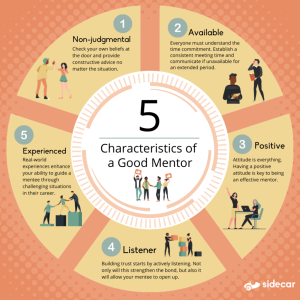
What makes a great mentor: qualities to look for
Choosing the wrong mentor can be as limiting as having none at all. An effective mentor should:
-
- Inspire action, not just admiration.
- Have walked the path you aspire to and gone beyond it.
- Offer unfiltered but constructive feedback.
- Listen attentively but speak with authority when needed.
Good mentors understand that their job is to empower you, not to create dependency. They want you to eventually operate confidently without needing them, while still valuing the relationship for mutual learning.
Modern mentorship: trends shaping the future
The landscape of mentorship has evolved far beyond the traditional one-on-one senior-to-junior model.
Reverse mentoring
Younger professionals guide senior leaders on topics like digital transformation, emerging consumer behavior, and diversity. This approach bridges generational gaps and keeps leadership relevant.
Group mentoring
Mentoring circles, where several mentees meet with one or more mentors, create a community of shared learning and multiple perspectives.
Transformative mentoring
This focuses on building values, confidence, and resilience, not just technical skills. It is especially valuable for leaders in high-stakes industries where personal character is as important as expertise.
Real-world examples of mentorship in action
-
- Sheryl Sandberg (COO, Meta) credits her mentor Larry Summers for pushing her to take opportunities she might have overlooked, including her first major leadership role.
- Richard Branson has often spoken about the role of Sir Freddie Laker, who mentored him through the launch of Virgin Atlantic, warning him about industry politics and guiding him through early crises.
- Oprah Winfrey openly acknowledges Maya Angelou’s mentorship as a source of both personal wisdom and professional clarity.
These examples show that even global figures rely on mentorship not just for tactical advice, but for emotional grounding and long-term perspective.
How to find and approach the right mentor
Finding the right mentor is part clarity, part initiative.
a.) Define what you need – Are you seeking strategic vision, industry connections, or leadership resilience?
b.) Search within and beyond your network – LinkedIn, professional associations, alumni groups, and conferences are good starting points.
c.) Make a targeted approach – Be specific about why you admire them and what you hope to learn.
d.) Start small – Ask for a single conversation before proposing an ongoing mentorship.
e.) Build mutual respect – Share progress, act on advice, and bring value to the relationship.
Mentorship vs. Going it alone
Working without a mentor is like navigating an unfamiliar city without a map. You might eventually reach your destination, but you will take longer, face unnecessary detours, and risk missing key opportunities along the way.
I saw this firsthand when writing my first book. While the act of starting was entirely my own decision, a “Chak a Chaka” moment, the guidance from those who had published before made the process faster, more focused, and less stressful. They anticipated challenges I had not even considered and offered solutions before they became problems.
The role of mentorship in leadership development
In leadership, stakes are higher and mistakes more costly. Mentors provide a safe space for leaders to test ideas, confront weaknesses, and refine vision before taking action in public view.
Research from the Center for Creative Leadership shows that leaders with mentors are more likely to be rated highly effective by their teams and peers. This is because mentorship not only builds skill but also strengthens empathy, adaptability, and decision-making under pressure.
Practical tips to maximize mentorship
1. Set clear expectations from the start on both sides.
2. Prepare for every meeting with questions, updates, and decisions that need guidance.
3. Act on the advice you receive. Mentors are motivated when they see you implementing their input.
4. Be willing to receive tough feedback without defensiveness.
5. Pay it forward by mentoring others when you are ready.
The compounding effect of long-term mentorship
The benefits of mentorship are not always immediate. Over time, the cumulative effect of better decisions, broader networks, and refined skills leads to exponential career growth. Many executives look back decades later and identify key turning points that came directly from a mentor’s guidance.
Long-term mentors also witness your evolution, which makes their advice even more targeted and impactful because they understand your history, strengths, and recurring challenges.
Final thoughts
A mentor does not make you less capable. They make you unstoppable. They offer a higher vantage point, guiding you through the fog and reminding you of your potential when challenges cloud your confidence.
When you choose between walking alone and learning from someone who has already navigated the road ahead, remember this. Success without mentorship is possible, but it is slower, lonelier, and more costly. With the right mentor, you move further, faster, and with greater clarity.
The writer is a Strategic Communications Expert, a best-selling author, and the Founder of Hezron Insights.