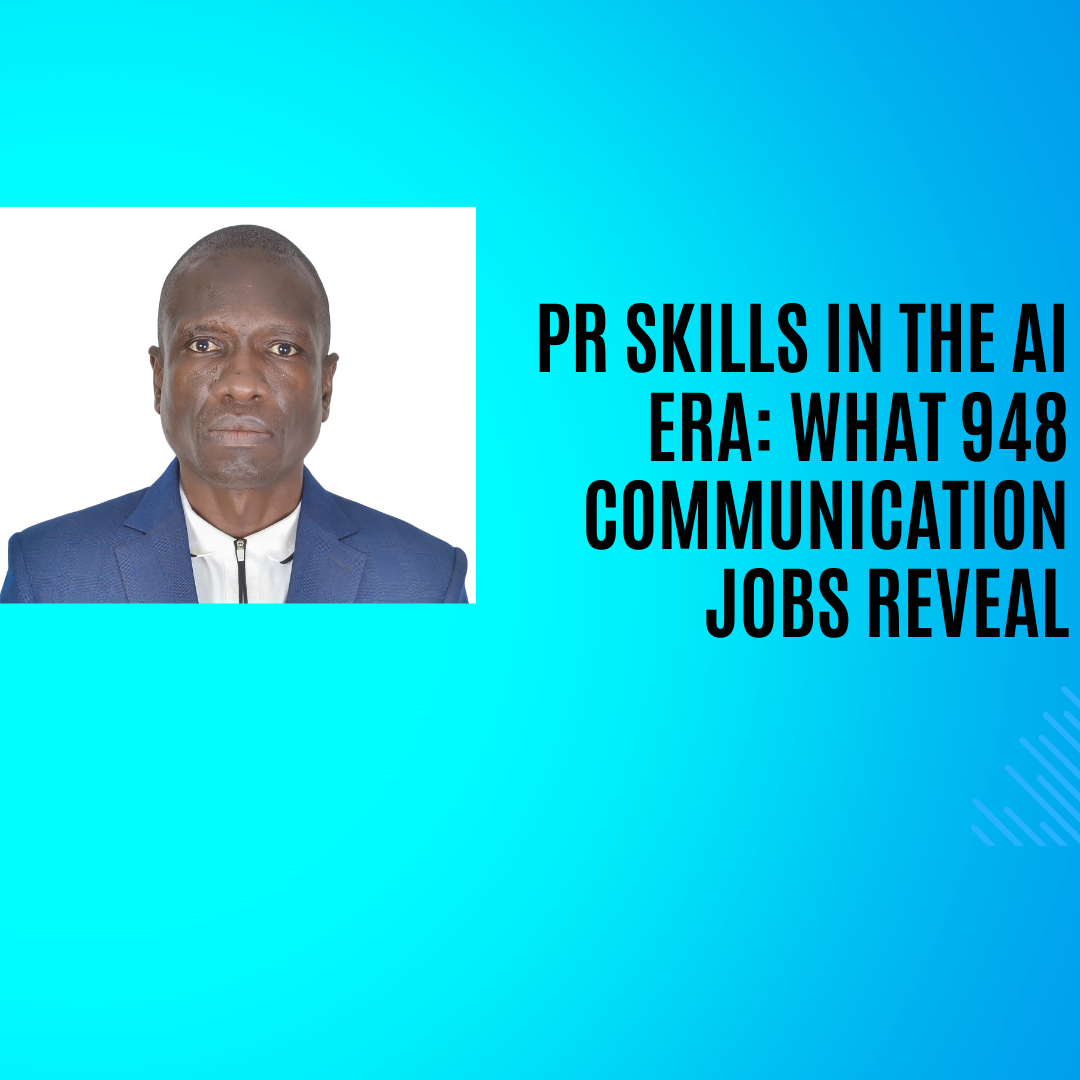
I Analysed 948 Communication Jobs. A New PR Skillset Is Taking Shape
By Hezron Ochiel
Artificial intelligence dominates many conversations about the future of communication.
I wanted to know what employers were actually asking communication professionals to know.
So, I analysed 948 communication-related job advertisements drawn from a dataset of 123,849 LinkedIn job postings.
The findings were revealing.
Writing and editing appeared in 64.2% of the jobs. Leadership and collaboration appeared in 46.3%, while strategic communication appeared in 40.4%.
Search and discoverability appeared in 11.8%.
AI and automation appeared in just 4.5%.
Then one finding caught my attention.
Search was mentioned in 25% of roles classified as content and editorial, compared with only 1.5% of roles classified as public relations and public affairs.
That does not mean content sits outside PR. It shows how employers were labelling and distributing search-related responsibilities across different communication job titles.
For a profession built around reputation, visibility and public understanding, that difference is worth examining.
The findings point to a communication profession that still depends heavily on writing, strategy and relationships. Digital capabilities such as analytics, search and AI are becoming part of the same professional toolkit.
I call this emerging profile the Digital-Authority Professional.
What I analysed
The original dataset contained job advertisements listed between 24 March and 19 April 2024.
From those advertisements, I identified 948 communication-related positions.
For analysis, the jobs were grouped into five categories based mainly on their titles:
- Content and editorial communication
- Corporate and strategic communication
- Public relations and public affairs
- Marketing and brand communication
- Internal and change communication
These categories helped me compare how employers described different communication roles. They should not be read as rigid professional boundaries.
Content creation, for example, is also an important part of public relations. A job carrying a title such as Content Writer or Content Editor was simply analysed separately from one advertised as PR Manager or Public Affairs Officer.
This distinction becomes important when interpreting the findings.
I then examined the jobs across 14 skill areas, including writing, strategy, stakeholder engagement, social media, analytics, search and AI.
The timing matters.
These advertisements were published in early 2024, when many organisations were still working out how generative AI would fit into communication work.
The data, therefore, gives us a useful early AIbaseline.
It is also heavily weighted towards the United States, so it should not be treated as a complete picture of communication jobs around the world.
Writing remains the strongest skill
Writing and editing appeared in 607 of the 948 advertisements.
That is 64.2%.
| Skill | Share of jobs |
| Writing and editing | 64.2% |
| Leadership and collaboration | 46.3% |
| Strategic communication and messaging | 40.4% |
| Social media | 39.6% |
| Research and audience insight | 37.3% |
| Analytics and measurement | 32.7% |
| Stakeholder and relationship management | 32.2% |
| Search and discoverability | 11.8% |
| AI and automation | 4.5% |
Employers were still looking for people who could write, think strategically, understand audiences and work well with others.
The newer digital skills were building around that foundation.
Writing now travels further
Communication professionals write for websites, reports, speeches, social platforms and executive communication.
That content may reach people directly, but it can also be crawled by Google or retrieved and summarised by an AI system.
This gives communication teams a wider responsibility.
They need to think about how organisational information is written, structured, attributed and published.
Good writing helps people understand an organisation. Clear and credible digital content also makes it easier for search engines and AI systems to understand what that organisation knows and represents.
I explore this relationship further in my Ultimate Guide to AI Search, Brand Reputation and Public Relations in Africa.
Search reveals an important gap for PR
Search and discoverability appeared in 11.8% of all the communication jobs I analysed.
The deeper breakdown is more interesting.
Among roles classified as content and editorial communication, search appeared in 25% of advertisements.
Among roles classified as public relations and public affairs, it appeared in just 1.5% of roles.
That comparison needs to be understood carefully.
Content work is part of modern PR practice. The categories in this analysis describe how the jobs were advertised and classified, not where professional boundaries should be drawn.
The finding therefore tells us something about how employers appear to allocate search responsibility.
Search was much more visible in jobs carrying content and editorial titles than in jobs explicitly carrying PR and public affairs titles.
That difference matters.
PR professionals help organisations manage reputation, earn attention and shape public understanding. Search increasingly influences all three.
Someone researching an organisation may start with Google, its website, media coverage or an AI assistant.
What they find can shape their first impression long before they speak to anyone from the organisation.
Search has therefore become part of the reputation environment.
This raises a practical question for the profession: Should search and discoverability remain primarily associated with content and marketing roles, given that they can also influence reputation?
This is why I have argued that communication teams should pay attention to search visibility and AI citability alongside conventional PR metrics. I discuss this further in What PR Teams Should Measure in 2026.
AI appeared in 4.5% of the jobs
Only 43 of the 948 advertisements explicitly mentioned AI and automation.
That represents 4.5% of the sample.
The jobs were advertised in March and April 2024, so the figure gives us a useful starting point rather than a picture of the market today.
It raises an obvious question: What would the same analysis show in 2026?
We may now see more employers asking for generative AI, automation and responsible AI use.
That comparison would help show how quickly AI has moved from experimentation into formal communication job requirements.
The Digital Authority Skills Model
The bigger story appears when the skills are viewed together.
Employers were looking for a mix of communication craft, relationships, digital distribution and data capability.
That pattern led me to what I call the Digital Authority Skills Model.
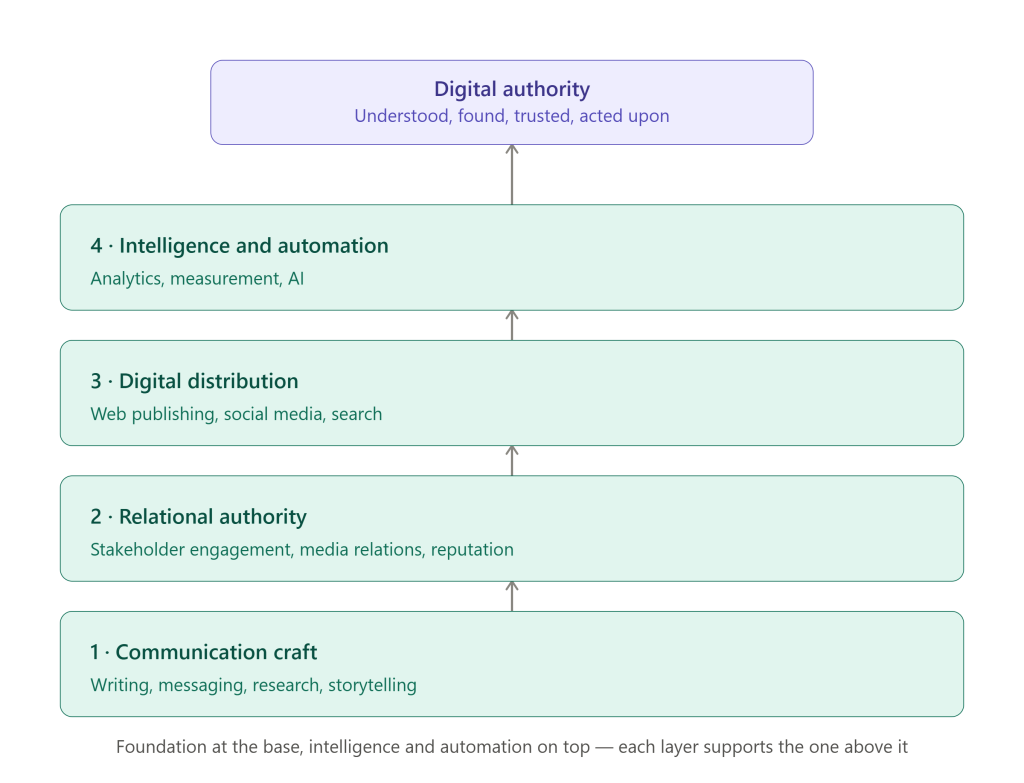
Digital authority is an organisation’s ability to be understood, found, trusted and acted upon by people and increasingly by AI systems.
The model has four layers.
1. Communication Craft
Writing, messaging, research and storytelling help an organisation explain itself clearly.
2. Relational Authority
Stakeholder engagement, media relations and reputation help build trust with the people who matter.
3. Digital Distribution
Web publishing, social media and search help information travel and be found.
4. Intelligence and Automation
Analytics, measurement and AI help communication teams understand performance and make better decisions.
Together, these layers describe the kind of communication professional organisations increasingly need.
That is what I mean by the Digital-Authority Professional.
What this means for communication professionals
The findings point towards a T-shaped professional profile.
Develop deep expertise in one area of communication, then build enough knowledge of related areas to understand how they affect your work.
A PR professional does not need to become a data scientist.
But understanding how search, analytics and AI influence reputation and visibility is becoming increasingly useful.
The communication professional still needs strong judgement.
They also need to understand how information is now found, measured and recommended.
The challenge inside many organisations
Digital authority is often spread across different teams.
PR may manage reputation, marketing may manage campaigns, IT may manage the website, while specialists handle search or analytics.
The public sees one organisation.
Search engines and AI systems also pull signals from across that wider digital footprint.
Communication leaders therefore need to understand how these systems shape what people find, see and believe about the organisation.
They do not need to control everything. They need stronger coordination around reputation, organisational knowledge and discoverability.
What should universities teach now?
Communication education should continue to strengthen writing, ethics, research, and strategic thinking.
Students also need practical exposure to digital publishing, analytics, search and responsible AI use.
One assignment could bring these skills together by asking students to research an issue, develop a communication response, publish it digitally, and measure its performance.
That is closer to the work many communication professionals increasingly encounter.
Africa needs its own evidence
This study cannot tell us what African employers are asking communication professionals to know.
The data is heavily weighted towards the United States.
That leaves an important gap.
We need African evidence on which communication skills employers value, how quickly search and AI are entering job descriptions, and whether universities are preparing graduates for those changes.
I have already found a related gap in AI visibility.
In an exploratory test of ten public relations questions across three AI tools, no African PR source was visibly credited in the sampled responses.
I documented the findings in I Tested 10 PR Questions Across Three AI Tools. No African PR Source Was Visibly Credited.
The labour-market question deserves the same attention.
A future African Communication Skills Index could give universities, employers and practitioners locally grounded evidence about how the profession is changing.
A new PR skillset is taking shape
The 948 advertisements capture communication work at an important point in the growth of generative AI.
Writing remained the strongest skill. Strategy, leadership, research and relationships were prominent. Search was unevenly distributed, while AI was beginning to enter formal job descriptions.
The search findings also tell us something about how employers organise communication work.
Skills connected to discoverability were far more visible in jobs carrying content and editorial titles than in jobs explicitly labelled PR and public affairs, even though content and search can both contribute to reputation.
That is an organisational distinction worth watching.
Taken together, the findings point to a broader role for communication professionals.
The Digital-Authority Professional understands communication, reputation, distribution, measurement and the growing role of AI.
This gives PR an important opportunity.
Communication professionals can help organisations become clear enough to understand, credible enough to trust, structured enough to discover, useful enough to cite, and authoritative enough to recommend.
That is becoming part of the job of modern PR.
Hezron Ochiel is an award-winning strategic communications and public relations professional with over 15 years of experience in media, digital communication, and reputation strategy. He serves as the Deputy Corporate Communications Manager at the government-owned Kenya Medical Training College (KMTC) and is the founder of Hezron Insights, where he writes about AI visibility, Digital PR, SEO, GEO, and digital authority. His work has appeared on platforms including Reuters, The New Humanitarian, and The Standard.