
By Hezron Ochiel
Years ago, a professional photographer visiting my village was something people took notice of.
There were few cameras, fewer trained photographers and even fewer people who knew how to use them well.
Today, almost everyone carries a camera in their pocket.
The smartphone changed photography by making image capture widely accessible.
I saw that shift firsthand during my years as a print journalist. There was a time when a photographer was essential to almost every assignment. As smartphone cameras improved, journalists increasingly began to gather stories and take photographs using the same device.
One professional photographer I know recalls earning around Ksh100,000 over a busy weekend before smartphone photography became widespread. His income later declined significantly.
His experience reflected a wider shift in the industry.
The technology changed where professional expertise mattered most.
What smartphones made easier
The biggest change was access.
Taking good photographs once required specialist equipment, technical knowledge and considerable investment.
Smartphones lowered that barrier. People could capture important moments themselves, reducing the need to hire someone simply because they owned a camera.
That changed the economics of basic photography.
It also raised a harder question for professionals: What value do I provide beyond access to the tool?
The same question now applies across communication as AI makes writing, design, research and content production easier to access.
The value moved higher
For professional photographers, expertise increasingly lies in the decisions surrounding the image.
A strong photographer knows where to stand, how to use light, what moment to capture and how a series of images should tell a story.
These skills take experience to develop.
A similar shift is happening across the communication profession. In my analysis of 948 communication jobs, employers were increasingly asking for digital, data, AI, measurement and strategic capabilities alongside traditional communication strengths.
As technical execution becomes easier, strategic thinking and informed decisions become more important.
Why visual judgement matters more
One of the most important lessons from journalism is that a strong photograph does more than record what happened.
It tells the reader where to look and helps them understand the emotion, scale or significance of a moment.
A camera can capture light.
The photographer decides what the image means.
This connects with a wider principle I have written about in audience-centred communication: tools are most useful when they help meet a real audience need.
For photography, the stronger question is whether an image helps the audience understand, feel or remember something.
That is where storytelling matters.
When technology makes the basic task easier
The smartphone revolution offers a useful lesson for today’s communication professionals.
Smartphones made image capture easier. AI is now doing something similar with writing, summarising, editing, image creation and information retrieval.
As production becomes easier, more attention moves towards:
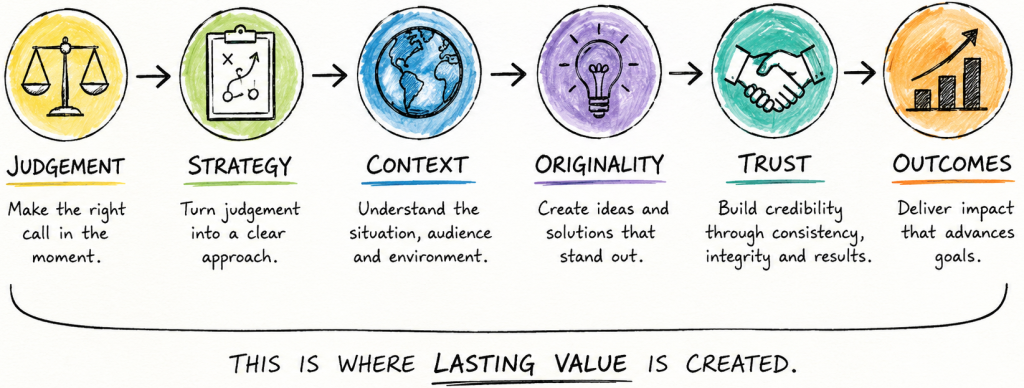
This is also why I argue in What PR Teams Should Measure in 2026 that communication teams should pay attention to how their work changes: what people understand, trust, or do afterwards.
Photography follows the same principle.
Clients may have thousands of images. Expertise lies in knowing which ones matter and how they support the communication objective.
What professional photographers can still own
Specialisation gives photographers a stronger position.
A photographer who develops deep expertise in an area such as documentary, corporate or sports photography builds something that is harder to copy: context, experience and an understanding of what each assignment requires.
Understanding how an image will eventually be used also improves the decisions made behind the camera.
A corporate photographer, for example, should understand how photographs may support media coverage, websites, campaigns and institutional storytelling.
That places photography inside the wider communication strategy.
The lesson goes beyond photography
When I first reflected on this issue in 2016, smartphones were driving the disruption.
Today, AI is raising similar questions across communication.
Writers, designers, journalists and marketers are thinking more carefully about what they contribute when basic production becomes easier.
Photography offers an early example of what happens when technology makes a professional tool widely accessible.
The strongest areas of expertise lie in context, originality, trust, experience, and strategic understanding.
What I would tell photographers today
Three things matter most: Specialise. Strengthen your visual judgement. Understand the communication outcome your client needs.
Learn to see what others miss and tell stronger stories through images.
Then make that expertise visible to the people you want to work with.
Professional photography still has a future because organisations and individuals continue to need strong visual stories and reliable creative decisions.
When technology makes the tool easier to use, the value of professional judgement rises.
Photography learned that lesson early.
AI is now bringing the same question to the rest of the communication profession.
Hezron Ochiel is an award-winning strategic communications and public relations professional with over 15 years of experience in media, digital communication, and reputation strategy. He serves as the Deputy Corporate Communications Manager at the government-owned Kenya Medical Training College (KMTC) and is the founder of Hezron Insights, where he writes about AI visibility, Digital PR, SEO, GEO, and digital authority. His work has appeared on platforms including Reuters, The New Humanitarian, and The Standard.