
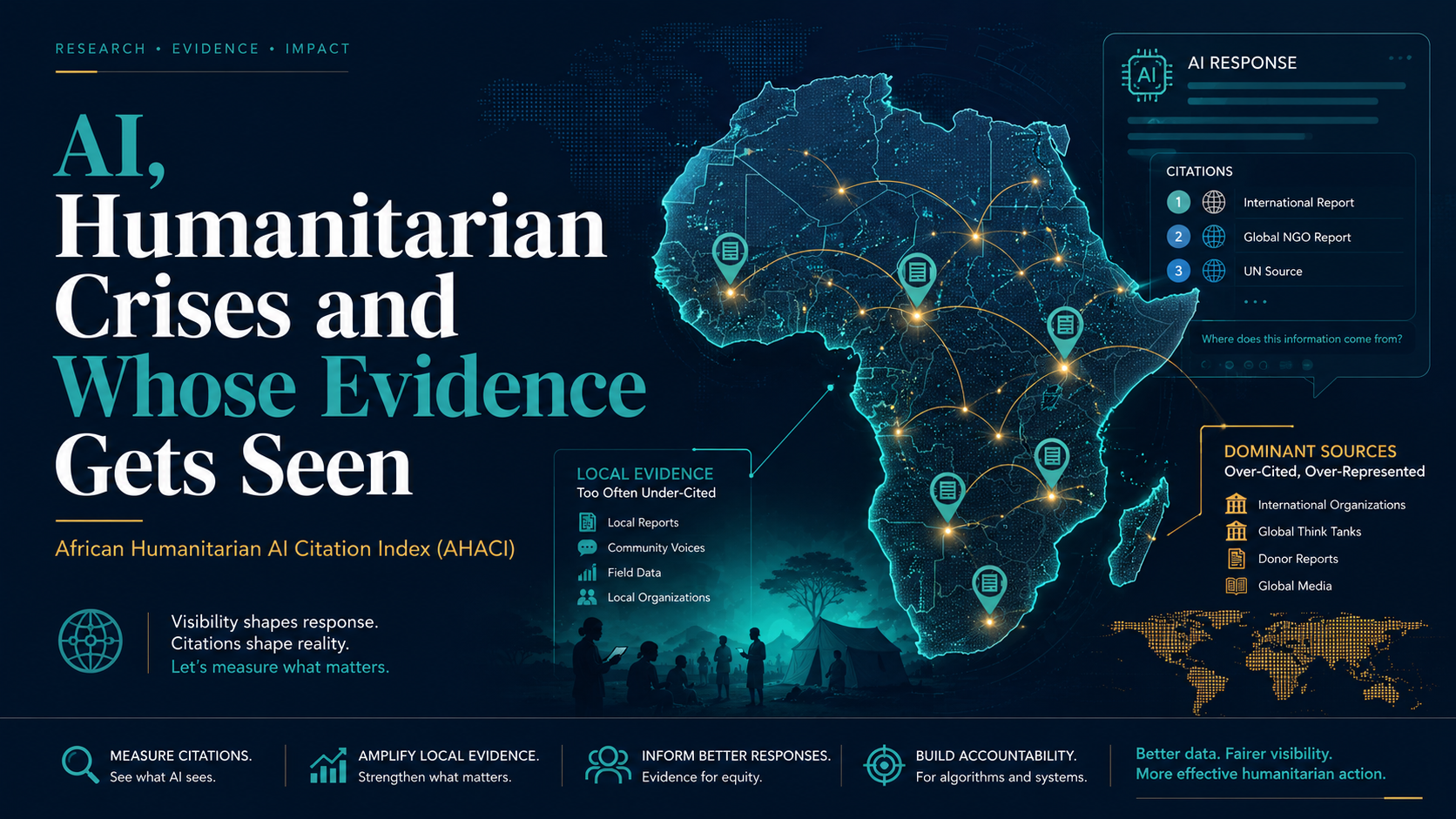
A ten-country study of 1,083 AI citations found just 5.5% came from sources in the affected country, compared with 68.8% from UN and multilateral organisations.
By Judith Akoth
When people ask AI about a humanitarian crisis in Africa, the answer may describe a local reality using evidence that mostly comes from outside the country concerned.
That is one of the clearest findings from the African Humanitarian AI Citation Index (AHACI), a ten-country study examining sources cited by ChatGPT, Gemini, DeepSeek and Perplexity when answering humanitarian questions about Africa.
Across 1,083 verifiable citations, only 5.5% came from organisations based in the country being discussed.
Nearly seven in ten citations, or 68.8%, came from the United Nations or other multilateral organisations.
“The crisis may be local, but the visible authority explaining it to AI users is usually international,” said Hezron Ochiel, founder of HezronInsights.com and researcher behind the study.
The finding raises an increasingly important question: When AI explains a humanitarian crisis, whose knowledge becomes visible?
Kenya stands apart
The study found large differences between countries.
Of the 60 country-local citations identified across the ten-country dataset, 31 came from Kenyan sources.
Kenya therefore accounted for more than half of all local citations identified in the study.
That makes Kenya an important case for understanding the conditions that may help nationally produced evidence become visible in AI-generated answers.
Nigeria also recorded relatively stronger local visibility, with nine local citations among 71 verifiable citations.
Other countries recorded much lower levels.
In the Democratic Republic of the Congo, the study identified 100 verifiable citations, and none came from a source based in the country.
Sudan also recorded no country-local citations in its recoverable set.
Somalia recorded just one local citation among 115, while Ethiopia recorded four among 191 and South Sudan four among 170.
The study does not establish why these differences occurred.
They raise questions about language, digital publishing, search visibility and AI content readiness, institutional authority and how easily local information can be discovered and attributed when AI systems generate answers.
A small group dominates AI citation visibility
Local sources were scarce. Citation attention was also concentrated among a relatively small group of organisations.
The five most-cited knowledge producers accounted for 40.3% of all verifiable citations.
The top ten accounted for 58.8%.
UNICEF was the most frequently cited organisation, followed by UNHCR, OCHA/Humanitarian Country Teams, OCHA and the International Organisation for Migration.
Local evidence usually appeared alongside international sources.
Among AI responses containing at least one country-local source, 84.8% also cited a UN or multilateral organisation.
Only one response relied exclusively on country-local sources.
This suggests that local evidence often broadens the range of sources visible in an answer while established international institutions continue to provide much of the evidentiary foundation.
Humanitarian localisation now has a visibility question
Humanitarian localisation already asks who receives funding, who delivers programmes, whose voices influence decisions and who participates in shaping the response.
AI adds another question: Whose knowledge becomes visible when AI becomes an entry point to crisis information?
For journalists, researchers, policymakers, humanitarian workers and the public, the first sources surfaced by AI can shape which reports, institutions and organisations they investigate next.
Citation visibility therefore becomes part of the wider conversation about whose evidence is seen and whose expertise is recognised.
What the findings do and do not show
AHACI measures the sources users were visibly shown during the research.
It does not determine why an AI system selected a particular source, and it cannot establish how many suitable local sources were available for every question.
The study also measures citation visibility rather than source quality. A low share of country-local citations does not mean international sources were inappropriate or that local sources were necessarily better.
The findings should therefore be read as a map of visible citation patterns, rather than proof that AI systems are deliberately biased against African sources.
A separate analysis of ChatGPT, the only platform with complete source-level citation capture across all 90 production questions, produced a similar pattern.
In that complete dataset, 7.2% of citations came from sources based in the affected country, while 70.9% came from UN or multilateral organisations.
The similarity matters because it suggests the wider pattern remains visible even when the analysis is restricted to a platform with complete source capture.
What this means for African institutions
The findings raise a practical issue for African media organisations, research institutions, humanitarian organisations and public agencies.
Credible information also needs to be accessible, searchable, clearly attributed and easy to discover.
As AI becomes another route people use to find information, the visibility of African knowledge may increasingly depend on how effectively institutions publish and organise their evidence online.
That makes digital publishing more than a communication function.
It becomes part of how institutional knowledge enters search, research and AI-generated answers.
“For years, we have asked whether organisations are visible in the media and in search,” Ochiel said. “AI now gives us another place to look. When people ask AI for answers, is credible African knowledge showing up?”
How the study was conducted
The first AHACI batch contained 100 independently randomised questions covering ten African countries, ten humanitarian themes and ten question types.
Ten questions were used to refine the research protocol.
The remaining 90 production questions were submitted independently to ChatGPT, Gemini, DeepSeek and Perplexity, generating 360 AI responses.
The questions covered conflict and civilian protection, displacement, food insecurity and malnutrition, health emergencies, water and sanitation, climate shocks, humanitarian access, protection of women and children, livelihoods and humanitarian response.
Across the 360 responses, we recovered source-level citation status for 255 observations, producing the 1,083 verifiable answer-linked citations analysed in the study.
All questions were asked in English, an important limitation when interpreting findings from Francophone, Lusophone and other multilingual contexts.
The research manuscript has been prepared for journal submission and has not yet been peer-reviewed.
As AI becomes part of how people discover and understand crises, citation is becoming another form of visibility. For African institutions, the emerging question is whether credible local knowledge is published in ways that allow it to be found, attributed and surfaced when people turn to AI for answers.
Judith Akoth is a Corporate Communications Specialist at the Technical University of Kenya.