A study of 244 organisational websites shows why AI-search readiness also depends on the clarity, consistency and integrity of the information organisations publish.
Kenyan organisations are publishing actively online.
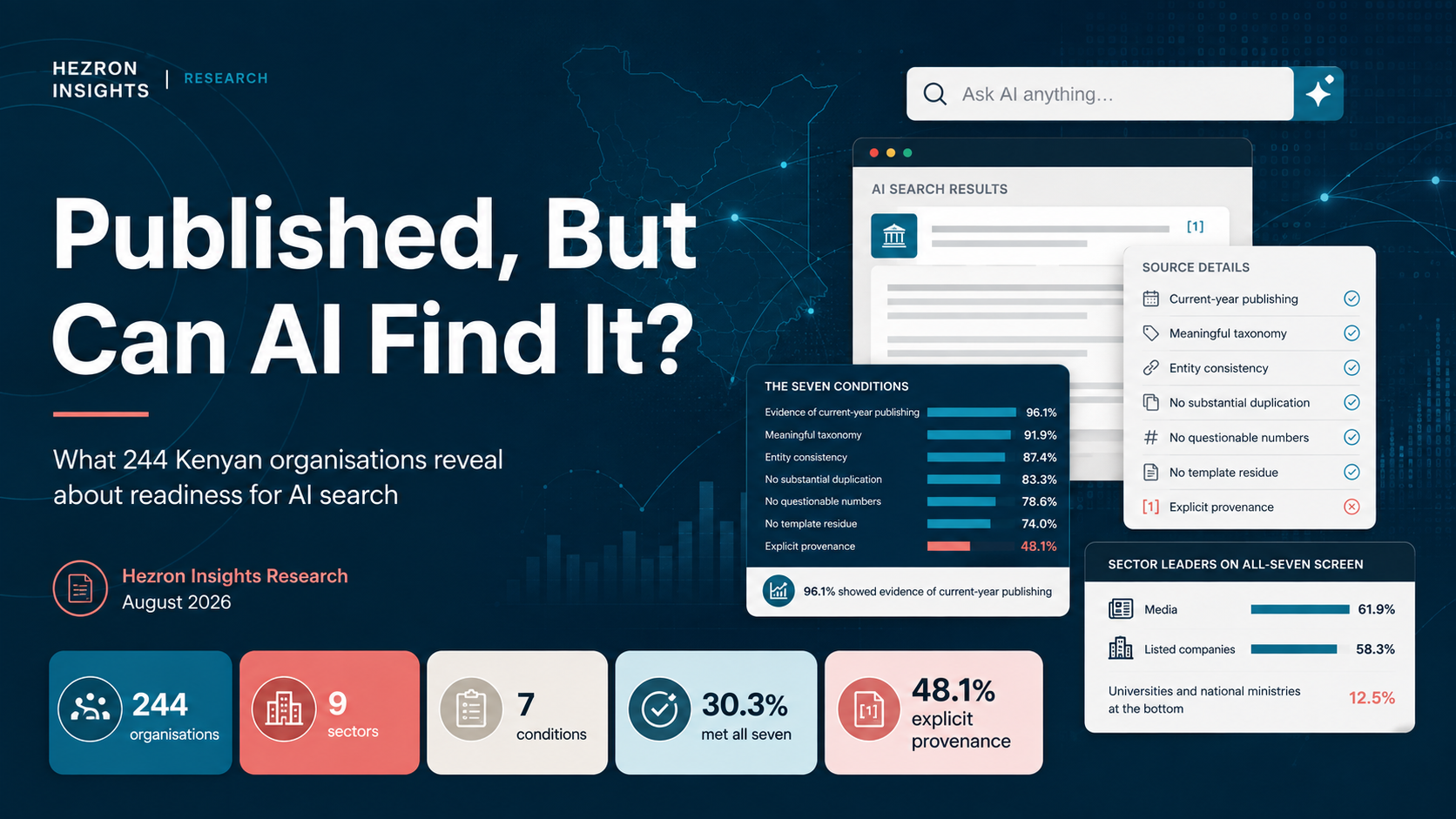
Among organisations with a verifiable latest-content date, 96.1% showed evidence of publishing in 2026.
Yet 74 of the 199 organisations with verifiable 2026 content — 37.2% — showed at least one high-confidence content risk.
That is one of the clearest findings from my analysis of 244 organisational websites across nine Kenyan sectors.
The finding raises an important question for communication teams: what do search engines and AI systems encounter after content has been published?
244 organisations, one important gap
The study covered universities, national ministries, government agencies, county governments, financial institutions, media organisations, health organisations, listed companies and PBOs/NGOs.
Seven source conditions were assessed: meaningful taxonomy, explicit provenance, absence of template residue, numerical integrity, control of substantial duplication, entity consistency and evidence of current-year publishing.
Publishing activity emerged as the strongest signal.
Among determinate cases, 91.9% had meaningful taxonomy and 87.4% showed entity consistency.
The weakest measured condition was explicit provenance, at 48.1%.
Provenance depends partly on publishing context. A ministry may appropriately identify a responsible department, while clinical or editorial content may benefit from an identifiable reviewer or author.
The underlying question is whether people and machines can understand who stands behind important information.
Publishing activity can coexist with content risks
The risks identified in the study included weak or mixed taxonomy, significant template residue, confirmed numerical conflicts, substantial duplication, material entity inconsistencies and outdated content.
An active website can therefore contain current information alongside older or conflicting material.
A new article may sit beside an outdated statistic. A service page may have competing versions. Development content, demo information or duplicated pages may remain accessible long after publication.
These issues matter increasingly as search and AI systems retrieve information from different pages and use it to construct answers.
Only 30.3% met all seven conditions
Among 198 organisations with determinate observations across all seven conditions, 60 — 30.3% — met every condition simultaneously.
Publishing conventions differ across organisational environments, so the analysis was repeated without explicit provenance.
Under that sensitivity analysis, 99 of 203 organisations — 48.8% — met the remaining six conditions.
The 30.3% figure is best understood as a simultaneous-condition screen. It is not a national AI-readiness score and does not show whether an AI platform will retrieve, rank or cite a particular website.
Sector patterns varied
Media organisations and listed companies recorded the strongest strict all-seven results in the audited sample. Universities and national ministries recorded the lowest.
These comparisons are descriptive because the sectors were assembled using different sampling approaches. They should not be interpreted as national rankings of entire sectors.
The patterns still point to meaningful differences in publishing practices, attribution and information governance.
What this means for communication teams
AI-search preparation begins with the quality of the information organisations already publish.
Communication and digital teams can focus on four priorities: clear organisational identity, useful information structure, accountable provenance, and disciplined management of statistics, duplicate pages and outdated content.
The study brings these elements together in a practical pathway:
Entity clarity → Useful structure → Identifiable provenance → Factual integrity → Duplication control → Current publishing evidence → Retrieval → Citation → Answer absorption
The research examines the source-side conditions at the beginning of this pathway.
Retrieval, citation and answer absorption require direct testing across generative-search platforms. That is an important next stage of the research.
The central lesson is simple: Publishing puts information online. Its structure, provenance, consistency and integrity shape what people, search engines and AI systems have available to interpret.
Download the full PDF report here.
Download the academic manuscript here.