By Hezron Ochiel
For years, organisations have worked to make their websites easier to find on Google.
AI search adds another question: Is your website easy for AI systems to understand, verify and potentially cite?
My analysis of Engagemii’s Answer Engine Optimisation (AEO) Index data covering nearly one million websites suggests this remains a challenge for many organisations.
Of the 999,538 websites represented in the score-distribution file, only 423 reached the highest 9–10 band, classified in the dataset as “AI-Ready.”
That is about 0.04%, or roughly one in every 2,363 websites.
The number is striking. The more useful lesson appears when we look at the wider distribution.
Nearly 96% of websites sit in the middle
The dataset groups websites into five score bands:
| AEO score | Classification | Websites |
| 0–2 | Not Discoverable | 3,397 |
| 3–4 | Needs Attention | 536,632 |
| 5–6 | Needs Work | 421,514 |
| 7–8 | Getting There | 37,572 |
| 9–10 | AI-Ready | 423 |
About 95.9% of the websites scored between 3 and 6, placing them in the two middle categories that Engagemii labels “Needs Attention” and “Needs Work.”
Most organisations already have websites, content and some form of digital presence. The bigger question is whether the information they publish is clear enough to understand, reliable enough to verify and structured well enough to support AI-driven discovery.
Even technology websites have work to do
I also compared the industry averages.
Technology websites recorded an average AEO score of 4.6 out of 10 across 242,742 sites.
Healthcare averaged 5.1, e-commerce 5.0, education 4.8 and media and entertainment 4.7.
Fashion and apparel recorded 5.6, although its sample contained only 1,474 websites, so comparisons should be made carefully.
The technology result is particularly interesting because it comes from a much larger sample.
A strong digital presence does not automatically mean a website is well structured for AI discovery.
For Public Relations and communication teams, this matters because an organisation may already have a strong website, active social media channels and good search visibility while still having gaps in how clearly it presents its identity, expertise and evidence.
I explored this relationship further in How AI Search Is Reshaping Digital PR and SEO, where I examined how trusted mentions, structured content and consistent digital information contribute to authority.
From being found to being cited
The data led me to a simple way of thinking about AI visibility:
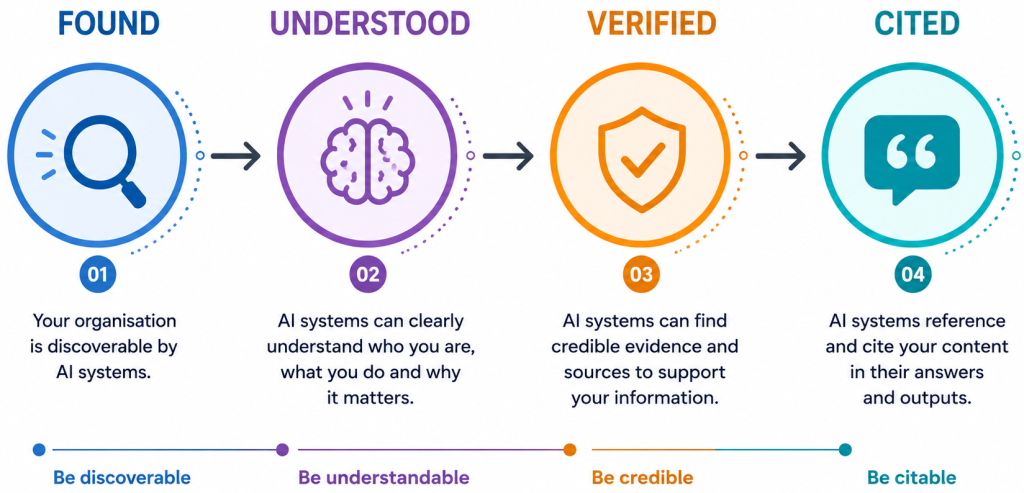
A website can be found without being clearly understood.
Information can be understood without being easy to verify.
And information can be understood and verified without necessarily being cited by an AI system.
This progression gives communication teams a practical way to think about AI readiness. Visibility gets an organisation into the information environment. Clarity helps machines understand it. Evidence supports verification. Citation is one possible outcome.
The key question then becomes: What happens after your organisation is found?
Can a machine identify who you are?
Can it connect important information to credible authors and sources?
Can it find evidence supporting your claims?
Does information about the organisation remain reasonably consistent across the wider web?
These questions connect AI readiness with the changing measurement challenge I explored in What PR Teams Should Measure in 2026.
What might stronger AI readiness look like?
Imagine two organisations.
Both have websites, publish articles and appear on social media.
The first has a short About page. Its articles have no clear authors. Important claims have few supporting sources. Leadership information is outdated, and descriptions of the organisation vary across platforms.
The second clearly explains who the organisation is and what it does. Important content has named authors. Research and statistics link to sources. Leadership information is current, and key organisational facts remain consistent across its website and other credible digital sources.
The second organisation has created a stronger information environment around itself.
This shows why AI readiness involves both technical and communication work.
A five-minute AI-readiness check
You can test some of this without specialised software.
Open your organisation’s website and ask five questions:
1. Can I understand who you are within one page?
Is the organisation clearly named and described?
2. Can I identify who created the information?
Are important articles connected to credible authors?
3. Can I verify your claims?
Are statistics, research findings and important claims supported by evidence?
4. Does the same organisation appear consistently across the web?
Do your website, media coverage, professional profiles and other credible sources tell roughly the same story?
5. Is important information structured clearly?
Can someone quickly find your services, leadership information, evidence, definitions and answers?
These questions provide a practical starting point for communication teams reviewing their organisations for AI visibility.
Why this matters for PR teams
Imagine a university whose website says it has 20 campuses. Its LinkedIn page says 18, while an older news article says 16.
Its leadership page has not been updated in three years, and important research reports appear online without clear authors or summaries.
Which version should someone trust?
Communication teams influence much of the information that answers that question.
They manage organisational descriptions, executive profiles, research stories, media relations, website content and institutional facts. They also influence whether important claims are supported, expert voices are visible and credible external sources reinforce the organisation’s story.
This places AI visibility firmly within conversations about PR, reputation and digital authority.
For a broader look at this relationship, I explored how AI-generated answers can influence organisational reputation in The Ultimate Guide to AI Search, Brand Reputation, and Public Relations in Africa.
Technical factors help machines access and interpret information. Communication helps determine whether that information is clear, credible and worth using.
What does “AI-Ready” really mean?
This analysis has an important limitation.
“AI-Ready” is Engagemii’s classification, rather than a universal industry standard.
Its score measures websites against signals Engagemii selected. A high score should therefore not be treated as a guarantee that ChatGPT, Google AI Overviews, Claude or Perplexity will cite a website.
The accompanying dataset files also contain slightly different totals depending on the aggregation. For the percentages in this article, I used the 999,538 websites contained in the score-distribution file.
That distinction matters because AI visibility measurement is still developing.
Africa has an evidence gap
The dataset does not provide enough evidence to conclude whether African websites are more or less AI-ready than websites elsewhere. Kenya, for example, is not represented in the supplied country-level aggregate.
That leaves an important evidence gap for Africa.
As more people use AI systems to discover organisations, products, experts and services, we need better evidence about how African institutions appear in these environments.
This connects with a wider communication question I have explored before: how audiences actually find and verify institutional information.
Future research should examine whether African organisations can be found, understood, verified and cited, alongside traditional measures such as search visibility.
For communication professionals, this is an important shift.
For years, digital visibility largely meant making sure people could find you.
AI systems are changing what visibility requires.
Being found is the beginning. Being understood, verified and cited may increasingly determine who becomes visible in the AI age.
Hezron Ochiel is an award-winning strategic communications and public relations professional with over 15 years of experience in media, digital communication and reputation strategy. He serves as the Deputy Corporate Communications Manager at the government-owned Kenya Medical Training College (KMTC) and is the founder of Hezron Insights, where he writes about AI visibility, Digital PR, SEO, GEO and digital authority. His work has appeared on platforms including Reuters, The New Humanitarian and The Standard.