By Hezron Ochiel
Three weeks ago, I stood before a room full of managers leading a discussion on personal branding.
Like many professional development sessions, we began with familiar topics. We explored reputation, networking, leadership, and the growing importance of digital visibility.
When the conversation turned to LinkedIn, I asked a simple question.
“How many of you have a LinkedIn account?”
Almost every hand went up.
I followed with another question.
“How many of you regularly post or use LinkedIn to demonstrate your expertise?”
Only a few hands remained in the air.
As our discussion continued, it became clear that many participants still viewed LinkedIn as a place to upload a CV, connect with colleagues, celebrate a promotion, or prepare for the next job opportunity. Few recognised that it had evolved into a platform where people can demonstrate what they know long before an opportunity appears.
Then one manager shared a story that changed the direction of the conversation.
A few weeks earlier, she had decided to refresh her LinkedIn profile. She updated her work experience, added new skills, rewrote her professional summary, and started sharing lessons from her work.
She was not looking for another job. She simply wanted her profile to reflect the professional she had become.
A few days later, she received an unexpected phone call.
A recruiter invited her to discuss a consultancy opportunity in neighbouring Tanzania.
The opportunity had not come through a job application, a referral, or someone within her network. Someone had searched for expertise that matched the assignment, discovered her LinkedIn profile, reviewed the knowledge she had been sharing, and decided she was the right person to contact.
As she finished her story, the room fell silent.
Our conversation was no longer about LinkedIn profiles. It had become a discussion about a much bigger question.
How do opportunities find people before those people begin looking for opportunities?
That question stayed with me long after the training ended because it reflects a change that is reshaping the professional world. Increasingly, organisations are discovering people through the knowledge they make visible rather than waiting for them to submit an application.
A few days later, on 11 June 2026, LinkedIn announced the expansion of its Creator Marketplace. The update introduced new ways for brands to discover professional creators based on their expertise, audience, and industry relevance, rather than relying primarily on popularity.
Many people viewed the announcement as another platform update.
I saw something much bigger.
The new features reflected a trend that has been unfolding for several years. Career opportunities, consultancy assignments, and business collaborations are increasingly influenced by expertise that people can discover, evaluate, and trust online.
That is why I believe we are entering what I call the Expertise Economy.
The Expertise Economy is an emerging environment in which people and organisations earn trust, influence, and opportunity by consistently sharing knowledge that demonstrates their expertise and the value they create.
June 11, 2026, Was Bigger Than Most People Realised
LinkedIn’s announcement attracted immediate reactions from several leading creators and industry observers.
LinkedIn creator Chris Donnelly, who attended the launch event, described creator discovery as “the bottleneck on LinkedIn.” He explained that brands wanted to work with creators but lacked an efficient way to identify the right professionals.
Creator strategist Sam Corrao-Clanon reached a similar conclusion, describing Creator Marketplace as a tool that helps brands discover credible voices whose expertise aligns with their needs.
Industry analysts writing for Digiday argued that LinkedIn is positioning itself as the leading platform for B2B creator discovery.
Viewed together, these observations reveal something much larger than a new product feature.
Major technology companies eventually reveal where they believe the future is heading.
Google did this when it transformed search from a directory of websites into an answer engine. Microsoft accelerated the trend by embedding generative AI into Bing and Microsoft 365.
LinkedIn is now making its own statement about the future of professional discovery.
The expansion of Creator Marketplace suggests that organisations are placing greater value on professionals who consistently teach, explain complex ideas, and share practical knowledge that helps other people.
For many years, online influence was often measured through audience size. Follower counts, engagement rates, and reach became common indicators of success.
That definition is expanding.
Increasingly, organisations want to understand the quality of a person’s thinking, the credibility of their ideas, and the value they contribute through their work.
This extends well beyond LinkedIn.
Employers want to understand how candidates think before inviting them for an interview. Conference organisers look for speakers whose published work demonstrates expertise. Journalists search for experts who can explain complex issues clearly, accurately, and with confidence.
As a result, professional knowledge is becoming easier to evaluate through the digital evidence people leave behind. Articles, presentations, interviews, research papers, newsletters, and professional profiles give organisations a richer picture of someone’s expertise than a CV alone could provide.
The World Has Started Searching for People Differently
For many years, recruitment followed a familiar pattern – employers advertised vacancies, candidates submitted applications, and recruiters reviewed CVs to identify the strongest applicants.
As application volumes increased, many organisations adopted Applicant Tracking Systems (ATS) to sort CVs and identify candidates whose qualifications matched specific job requirements.
The technology improved efficiency, but it also attracted widespread criticism because qualified candidates could be filtered out when their CVs failed to match the keywords or formatting the system expected.
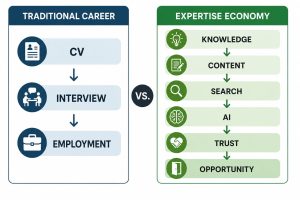
Recruitment is now entering another stage of evolution.
Instead of relying solely on applications, employers increasingly seek evidence of expertise through professional profiles, published work, digital portfolios, and online contributions.
Platforms such as LinkedIn, together with AI-powered search systems, are helping organisations discover experts long before a vacancy is advertised.
The way professionals are discovered is changing. The way professionals build visibility must change with it.
The Largest Change Since Google
When Google became the world’s dominant search engine, it changed how organisations thought about visibility.
A website quickly became an essential business asset, and search engine optimisation helped organisations become easier to discover. Those that consistently published useful information attracted more visitors, built stronger reputations, and created new business opportunities.
Artificial intelligence is expanding that transformation.
Search is no longer focused only on websites. It is increasingly helping people discover the experts behind those websites.
Modern search engines do much more than match keywords. They evaluate expertise, authority, credibility, consistency, citations, and reputation to identify the sources most likely to provide reliable answers.
That change has placed professionals inside the search ecosystem.
Your published work has become part of your professional identity. Articles, presentations, interviews, research papers, newsletters, podcasts, and thoughtful LinkedIn posts all contribute to a digital footprint that people and AI systems can evaluate.
Long before someone schedules a meeting, downloads your CV, or asks for your business card, they may already have formed an opinion about your expertise through what they found online.
That makes discoverability one of the most valuable career assets in today’s professional world. It also represents one of the biggest changes in career development since the internet became part of everyday life.
Welcome to the Expertise Economy
Every period in history rewards something society values most.
The Industrial Economy rewarded manufacturing. The Information Economy rewarded access to knowledge. The Digital Economy rewarded connectivity.
The next stage is rewarding something different.
It rewards people and organisations that consistently solve problems by sharing knowledge others can trust and apply.
That is the foundation of the Expertise Economy.
Understanding this change helps explain why knowledge has become one of today’s most valuable professional assets. Experience creates the greatest value when other people can discover it, learn from it, and use it to make better decisions.
Many experienced professionals carry remarkable insights that never leave meeting rooms, notebooks, or private conversations. Those ideas begin creating a much wider impact once they are documented and shared.
Every publication becomes evidence of how you think, solve problems, and contribute to your profession. Eventually, that evidence forms a body of work that strengthens your credibility and makes your expertise easier to discover.
As more people benefit from your work, confidence in your expertise grows. That confidence leads to recommendations, and recommendations create new opportunities.
This explains why content is taking on a completely different role.
An article is no longer just an article.
A presentation is no longer just a presentation.
A LinkedIn post is no longer just a social update.
Each contribution becomes another piece of evidence that helps people and AI systems understand what you know and whether your expertise can be trusted.
Unlike a conversation that disappears when the meeting ends, published knowledge continues working long after it is created. It remains available whenever someone searches for answers, making your professional reputation stronger with every meaningful contribution.
Authority grows much the same way as long-term investing does.
One contribution may seem small on its own. Hundreds of valuable contributions create something much more powerful.
They create trust that compounds over time.
The Four Signals That Build Professional Authority
While researching AI Search, Digital PR, and professional visibility, one pattern recurred across industries.
Strong professional authority is rarely built through titles alone.
It develops through four connected signals that reinforce one another over time.
The first signal is knowledge.
Knowledge comes from education, experience, research, and practice. It provides the foundation for expertise, but it remains invisible until it is shared.
The second signal is evidence.
Published work gives people something they can evaluate. Articles, case studies, presentations, interviews, books, newsletters, and research demonstrate how you think instead of simply telling people what you have done.
The third signal is discoverability.
Even the best ideas cannot create opportunities if nobody can find them. Search engines, AI systems, LinkedIn, professional communities, and digital publications have become the pathways through which expertise is discovered.
The fourth signal is trust.
Trust develops as people repeatedly experience the value of your work. It transforms visibility into recommendations, partnerships, career opportunities, and long-term influence.
These four signals are interconnected.
Knowledge creates evidence. Evidence improves discoverability. Discoverability creates opportunities for people to evaluate your work.
Positive experiences strengthen trust.
As trust grows, your authority becomes stronger.
Professionals who understand this process early on will continue to build an advantage that becomes increasingly difficult for others to replicate.
The Expertise Authority Flywheel
Authority does not grow in a straight line. It grows through a cycle in which knowledge becomes visible, visible knowledge builds trust, trust creates recommendations, and recommendations open new opportunities.
The process can be understood this way:
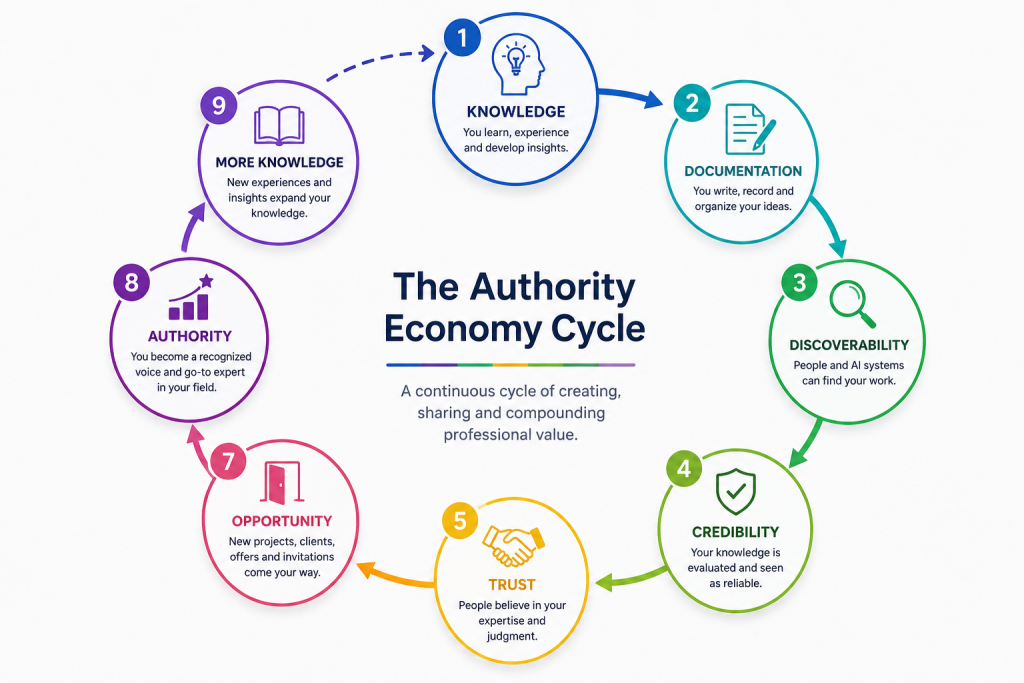
Each opportunity creates a new experience. That experience creates new lessons. When those lessons are documented and shared, the cycle begins again. Over time, this creates a body of work that strengthens professional reputation and makes expertise easier to find, trust, and recommend.
Five Actions You Can Take Today
Building digital trust does not require dramatic changes.
It begins with small, consistent actions that become more valuable over time.
1. Publish what you know
Turn your experience into articles, newsletters, presentations, or LinkedIn posts.
Knowledge has its greatest impact when others can learn from it.
2. Build a Searchable Body of Work
One article may introduce your expertise.
A consistent collection of thoughtful articles, presentations, newsletters, interviews, and research creates something much more valuable. It becomes a library of knowledge that people can continue discovering for years.
Over time, that library tells a far richer story about your expertise than any single CV ever could.
3. Answer the Questions People Are Already Asking
The most valuable content begins with your audience’s needs.
Think about the questions people ask repeatedly in your profession. Consider the challenges your clients, colleagues, students, or industry continue to face.
When your work helps people solve real problems, it naturally earns attention, trust, and recommendations.
4. Create Evidence Consistently
Expertise grows through experience.
Authority grows through evidence.
Every article, presentation, podcast, or newsletter provides another opportunity for people to understand how you think and the value you bring to your profession.
Consistency matters more than perfection.
A growing body of useful work will always create more long-term value than a handful of exceptional publications separated by long periods of silence.
5. Think Beyond Today’s Audience
Many of the people who will benefit from your work have not discovered you yet.
A guide you publish today may help a future employer evaluate your expertise. A presentation could lead to a speaking invitation months later. An article might introduce you to a client you have never met.
Published knowledge continues creating opportunities long after the work itself is finished.
 A Different Way to Think About LinkedIn
Many people still think of LinkedIn as a professional networking platform.
That description is becoming too small.
LinkedIn is evolving into one of the world’s largest search engines for professional expertise.
Every profile introduces the person behind the work. Every thoughtful comment and professional conversation adds another layer of evidence that helps people understand what you know.
The expansion of Creator Marketplace reflects this evolution.
LinkedIn is making it easier for organisations to discover professionals who consistently educate others, contribute meaningful ideas, and demonstrate expertise through the knowledge they share.
As artificial intelligence becomes more deeply integrated into professional search, organisations will increasingly rely on digital evidence to identify experts, evaluate credibility, and find trusted voices.
Building expertise has always mattered.
Making that expertise visible has now become just as important.
What This Means for Every Professional
The rise of the Expertise Economy is changing the way careers are built.
Personal branding is becoming less about attracting attention and more about creating value.
People build stronger professional reputations by helping others understand complex ideas, solve practical problems, and make better decisions.
That is why documenting your experience matters.
Articles, research papers, podcasts, interviews, and LinkedIn posts transform experience into knowledge that other people can discover and apply.
As your body of work grows, so does the confidence people place in your expertise.
Trust encourages recommendations. Recommendations create opportunities.
Ultimately, those opportunities strengthen your professional authority.
The strongest personal brands are rarely remembered because they speak the loudest.
They are remembered for consistently making other people smarter.
Related Articles
- Why Some LinkedIn Creators Are Losing Reach and Engagement – Explore the factors behind declining visibility on LinkedIn and practical strategies for building a sustainable creator presence.
- How the Gig Economy Helps Unemployed Youths Find Work – Learn how digital platforms and the growing gig economy are creating new
pathways to employment and income generation for young professionals.
Final Thoughts
The Expertise Economy is already reshaping how professionals are discovered.
For many years, a CV has been used to introduce people to employers. Today, published work often introduces professionals long before anyone asks for their CV. As artificial intelligence becomes part of professional search, it may soon be among the first systems to evaluate expertise before a recruiter, client, journalist, conference organiser, or business partner reaches out.
This evolution is giving every article, presentation, research paper, interview, and LinkedIn post a much greater purpose. Each publication adds another piece of evidence that shows how you think, what you know, and how you help others solve meaningful problems.
LinkedIn’s Creator Marketplace reflects this broader transformation. It shows that organisations are placing greater value on professionals who make their knowledge visible, demonstrate their expertise, and build trust through consistent contributions.
The professionals who will thrive in this environment are those who continue to teach, document their experience, and create knowledge that remains useful long after publication. Their work becomes easier to discover, their expertise becomes easier to trust, and new opportunities follow naturally.
That is the promise of the Expertise Economy. People who consistently create value through knowledge become easier to find, recommend, and remember.
The future will belong to professionals whose expertise is easy to discover, easy to trust, and impossible to ignore.
Hezron Ochiel is a strategic communications and public relations professional with over 15 years of experience in media, digital communication, and reputation strategy. He serves as the Deputy Corporate Communications Manager at the government-owned Kenya Medical Training College (KMTC) and is the founder of Hezron Insights, where he writes about AI visibility, Digital PR, SEO, GEO, and digital authority. His work has appeared on platforms including Reuters, The New Humanitarian, and The Standard.