

Use a practical 40-observation audit and companion Excel tracker to assess how ChatGPT, Gemini, DeepSeek and Perplexity represent, cite and recommend your organisation.
By Hezron Ochiel
An AI answer can name your organisation and still describe its work incorrectly. It may use an old leadership title, miss a recent study or point to a source that does not support the claim. Seeing your name in an answer is only the beginning of the assessment.
Try asking ChatGPT, Gemini, DeepSeek and Perplexity which organisations do credible work in your field. Leave your organisation’s name out of the question.
Does it appear? If it does, is the description accurate?
Look at the sources, too. Does the answer cite your original research? Are your experts linked to the work they have done? Would the platform recommend your organisation when someone asks for relevant expertise or services?
These are different tests, and they can produce different results.
An organisation may be mentioned without its evidence being cited. Even when a citation appears, the linked page may not support the claim.
A useful audit examines those distinctions instead of reducing visibility to one score.
As I discussed in my earlier article on AI search, brand reputation and public relations in Africa, organisations need to examine the information that AI platforms present to audiences, particularly when those answers become a first point of contact.
What an AI visibility and citation audit should tell you
An AI visibility and citation audit records how AI platforms describe your organisation, which sources they use and what needs to be checked or improved.
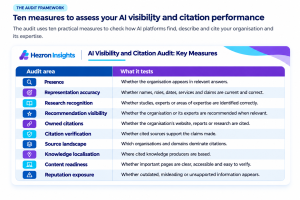
Report the measures separately. A high mention rate can conceal inaccurate descriptions or weak evidence.
Use a companion audit tracker
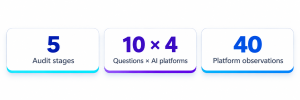
The companion AI Visibility and Citation Audit and Growth Tracker uses ten questions across four platforms: ChatGPT, Gemini, DeepSeek and Perplexity. That produces 40 platform observations.
The workbook also includes citation checks, source classification, peer comparisons, reputation risks, content reviews, SEO and website-recovery actions, outreach and repeat testing.
The companion Excel tracker is a reusable template, not a set of completed AI-test results.
Here is a hypothetical example.
You ask which organisations have published research on AI citations in Africa. An answer names your organisation but cites only a third-party summary.
If the question is eligible for presence and research recognition, record presence as 1. Check the attribution before scoring research recognition. If the question is eligible for owned citations and none appears, record 0.
Then open the third-party source and check whether it supports the claim.
Enter results only after running the tests. Otherwise, the baseline will not reflect observed answers.
Use a companion audit tracker
Free Excel Download: AI Visibility and Citation Audit Tracker
Download the companion Excel workbook to record AI-generated answers, assess visibility and citation accuracy, identify reputation risks and track improvements over time.
Stage 1: Design the audit
Start with real audience questions
The questions determine what the audit can tell you.
Asking “What do you know about Organisation X?” can reveal basic errors, but it does not show whether someone unfamiliar with your name would discover you.
Use questions drawn from what your audiences actually need to know:
- Which organisations conduct research on this issue?
- What original studies have examined this problem?
- Who are credible experts on this subject?
- Which organisations provide services or advice in this area?
- What evidence is available on this issue?
- Which organisations would you recommend consulting?
Choose ten questions that cover distinct needs.
A research institution, for example, might want to test discovery, recognition of its published studies, expert identification, services and recommendations.
Before testing, decide which measures apply to each question. A request for experts may be relevant to recommendations; a general question about available evidence may not be.
Do not count an inapplicable question as a failure.
Run the same questions across four platforms
Ask the same ten questions on all four platforms to obtain 40 observations.
Keep the wording as consistent as possible. Save the question, platform, test date, search settings, model or version when available, answer text and citation URLs.
Those details matter when comparing results from different platforms or testing rounds.
Stage 2: Measure visibility
1. Presence
First, establish whether the organisation is named in relevant answers.
AI Presence Rate = Eligible answers containing an organisational mention ÷ Total eligible answers
Only include answers where the question reasonably permits the organisation to appear. That may be all 40 answers or a smaller set identified before testing.
2. Representation accuracy
Check accuracy only when the organisation appears.
Compare names, leadership roles, dates, locations, services, programmes, relationships and research claims with reliable current sources.
Representation Accuracy Rate = Accurate mentions ÷ Mentions assessed for accuracy
Leave accuracy blank when the organisation is absent. Use 0 only when a mention was assessed and found inaccurate.
A common failure is an outdated leadership attribution: an answer can identify an expert correctly but assign them a role they no longer hold.
The check must use dated, authoritative institutional records rather than relying on whether the person’s name is familiar.
The same applies to discontinued programmes and services that remain visible on old webpages.
3. Research and expertise recognition
If your organisation publishes research, check whether AI answers correctly connect it to relevant studies, reports, datasets or areas of expertise.
Research Identification Rate = Eligible research/expertise answers containing a correct identification ÷ Total eligible research/expertise answers
A mention does not automatically count as recognition of the organisation’s research.
4. Recommendation visibility
Test recommendations with questions that genuinely call for advice about organisations or experts to consult.
Do not use a generic research question as a recommendation test unless that expectation was defined in advance.
Recommendation Presence Rate = Eligible recommendation answers in which the organisation appears ÷ Total eligible recommendation answers
You can also record where the organisation appears in a recommendation list.
If comparable peers recur while yours does not, examine the source evidence before drawing conclusions.
Stage 3: Audit the evidence
5. Measure owned citations
Check whether answers cite material produced or controlled by your organisation, including webpages, reports and original research.
Owned Citation Rate = Eligible answers containing at least one owned citation ÷ Total eligible answers
Owned Citation Share = Owned citations ÷ All relevant verifiable citations logged
The rate counts answers that include at least one owned citation; the share measures owned citations within the relevant verifiable citation pool.
An organisation can be mentioned frequently while its original evidence is rarely cited.
6. Verify citations at claim level
Open each cited page and compare the relevant claim with the source.
Check that the page is accessible, current and actually supports what the answer says.
Note whether the source produced the evidence or merely summarised another publisher’s work.
Where one answer makes several cited claims, use a separate citation-log entry for each claim you verify.
Verified Claim Rate = Cited claims supported by their destination source ÷ Cited claims eligible for verification
If no cited claim exists, leave the verification field blank.
Blank means not assessed or not applicable. Zero means the claim was assessed and failed verification.
7. Map the source landscape
The audit should show which publishers shape answers in your field.
Classify relevant citations by source type, such as government, university or academic institution, multilateral organisation, NGO, media organisation, professional body, commercial organisation and owned organisational source.
Record recurring publishers or domains as well.
My African Humanitarian AI Citation Index illustrates why this matters.
Across 1,083 verifiable citations about humanitarian crises in ten African countries, 5.5% came from organisations based in the country being discussed, while UN and multilateral organisations accounted for 68.8%.
The study did not establish deliberate exclusion. It showed a highly concentrated source landscape.
For an organisational audit, it matters which sources are used when your own evidence is absent.
8. Examine knowledge localisation
For work tied to particular countries or regions, classify where cited knowledge producers are based.
In an African context, useful categories may include country-local, other African and international.
Local sources are not automatically better, and international sources are not necessarily inappropriate.
The classification shows the geographic distribution of the knowledge producers behind an answer.
Stage 4: Diagnose the organisation
9. Review content readiness
When AI answers overlook a study your organisation has published, inspect the page where that study appears.
Check whether:
- The title makes the subject clear.
- Authorship is visible.
- The organisation is clearly identified as the producer.
- The publication date can be found easily.
- The methodology is explained where relevant.
- Key findings are available in HTML rather than only inside a PDF.
- The page has a stable URL.
- Relevant pages on the website link to it.
- Credible external sites reference it.
- Organisational names and entities are used consistently.
- Metadata and structured information are present where appropriate.
These improvements cannot guarantee a citation. They make the material easier to discover and verify.
This is also where digital publishing and communication strategy meet. In my article on how AI search is reshaping digital PR and SEO, I discuss how research publishing, media references and website quality contribute to an organisation’s wider digital presence.
10. Check reputation exposure
Repeated errors about leadership, services, statistics or research can affect reputation.
Log incorrect affiliations, discontinued programmes presented as current, misattributed research, unsupported negative claims and cases where old third-party descriptions displace authoritative material.
For each significant issue, record the platform, evidence, severity, correction source, responsible person, action and review date.
Compare with selected peers
Select two or three comparable organisations and run the same questions under comparable conditions.
Compare presence, accuracy, research recognition, recommendations and citations.
Peer results require their own observations; they cannot be inferred from your organisation’s 40 answers.
Where a peer performs better, look for concrete differences such as accessible research pages, current expert profiles or stronger independent references.
Use search data to prioritise
Google Search Console can help you decide what to investigate first.
Look for relevant non-branded searches where your pages already earn impressions.
If those pages perform in search but related AI answers omit your organisation, review how clearly the pages present evidence and how other sources refer to them.
Check indexing exclusions, broken URLs, lost backlinks, weak internal links, outdated profiles and research that is difficult to use because it exists only in poorly described files.
Stage 5: Act and repeat
Turn findings into action
Group the work according to the problem found:
Correct. Update inaccurate or outdated information.
Strengthen. Improve useful evidence that is difficult to discover, interpret or verify.
Create. Publish authoritative information where a genuine evidence gap exists.
Distribute. Take strong existing evidence to relevant media, professional publications, partners, research networks and other credible third parties.
Give each priority an owner and a review date.
Distribution deserves particular attention when the organisation already has useful research that few relevant audiences encounter.
I documented one practical example in Research Media Outreach in Africa: How One AI Study Earned Cross-Border and Multilingual Coverage. The article explains how an original research project was communicated to audiences across multiple markets and languages.
That experience is relevant to research visibility, although media coverage alone does not prove that an AI platform will cite a publication.
Keep the implementation plan manageable
A 90-day plan can be useful, but set the order from the evidence.
Address serious inaccuracies first, improve weak or missing source material next, and then focus on distribution and retesting.
Repeat the audit
Retest with the same questions and settings where possible.
Compare each measure on its own:
- AI Presence Rate
- Representation Accuracy Rate
- Research Identification Rate
- Recommendation Presence Rate
- Owned Citation Rate
- Owned Citation Share
- Verified Claim Rate
- Source mix and localisation
- Reputation issues
Avoid collapsing these results into an overall authority score.
Increased mentions could coincide with poorer accuracy; fewer mentions could still be accompanied by more citations to original research.
This follows the broader argument I made in What PR Teams Should Measure in 2026: communication performance should be examined through evidence of what has changed, rather than relying exclusively on activity and exposure figures.
What the audit cannot prove
This audit captures public-facing answers during a defined testing period.
It cannot reveal private training data or hidden ranking mechanisms, explain exactly why a platform selected a source, or establish deliberate exclusion.
Answers may also vary between runs.
Forty observations provide a repeatable starting point, not a representative measure of everything AI platforms say.
Document the conditions and interpret changes cautiously.
Your first AI visibility audit: ten questions, four platforms
Write ten questions your audiences might ask and test each on ChatGPT, Gemini, DeepSeek and Perplexity.
Record the 40 answers, applying each measure only to eligible questions.
Check cited claims, identify the source producers and review the organisation’s most important evidence pages.
Then select three manageable actions from what the audit reveals.
Correct an important error, improve one overlooked piece of evidence and strengthen distribution where credible audiences and publishers are likely to encounter the work.
Assign responsibility and a review date before testing again.
The value of the exercise is a defensible record of how your organisation appears in AI answers, where the evidence comes from and what you can improve.
The companion AI Visibility and Citation Audit and Growth Tracker provides the observation log, citation checks and repeat-testing fields for this process. Use it to preserve your first baseline and review changes over time.
About the Author
Hezron Ochiel is a strategic communication expert, researcher and founder of Hezron Insights. He serves as Assistant Director, Corporate Communication at Kenya Medical Training College (KMTC), and is a recipient of the Public Relations Society of Kenya (PRSK) Moran Award.
With over 15 years of experience in strategic communication, public relations and journalism, his work focuses on AI visibility, digital authority, institutional reputation and the representation of African knowledge in AI-generated information.
He is the lead researcher behind the African Humanitarian AI Citation Index (AHACI) and the author of The Findability Advantage: How to Make Expertise Visible, Verifiable and Trusted in the Age of AI.