

By Hezron Ochiel
Recently, I took part in a panel discussion at the Africa No Filter Summit in Nairobi. We talked about how stories, culture, and creativity shape how Africa is seen by the world. Africa No Filter works to change narrow, outdated narratives by sharing stories of progress, innovation, and opportunity.
One simple idea guided the discussion – development is shaped by policies, funding, infrastructure, and perception. How people see a place influences how they engage with, invest in, and support it. When Africa is mostly described through stories of poverty, conflict, and crisis, these stories limit imagination, weaken trust, and reduce belief in what is possible.
This idea applies across many settings. In societies, organisations, and workplaces, stories shape behaviour long before decisions are made. The words people hear and repeat help them understand risk, opportunity, belonging, and power. Over time, repeated stories begin to feel normal and unquestionable.
This article explains how communication can move from helping people understand to shaping how people think and act. It explores this pattern across history, media, digital platforms, and everyday workplaces. Understanding how this happens matters because progress begins with what people are encouraged to believe.
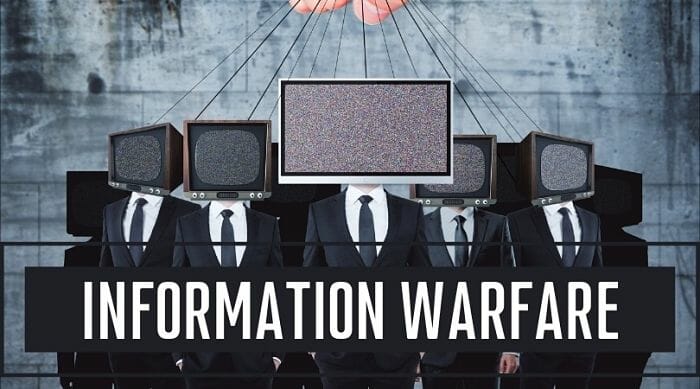
What Is Weaponised Communication?
Weaponised communication is the deliberate use of language to shape perception, suppress questioning, and influence behaviour in ways that serve power rather than shared understanding. In these situations, winning an argument or protecting authority takes priority over mutual understanding. Complex issues are simplified into emotional triggers that discourage reflection and reward quick reactions. Obedience is rewarded, while questioning is subtly or openly discouraged.
Cognitive linguist George Lakoff has long argued that language does more than describe reality: It frames it. The words chosen determine what people notice, what they ignore, and what feels acceptable. When framing is used ethically, it clarifies meaning. When used unethically, it narrows thinking and limits choice.
At its core, weaponised communication is not only about lies. It often relies on partial truths, selective emphasis, and repetition. The danger lies in how these elements combine to create fear, confusion, or silence.
The Ochiel Communication Influence Ladder
I describe communication influence in five stages:
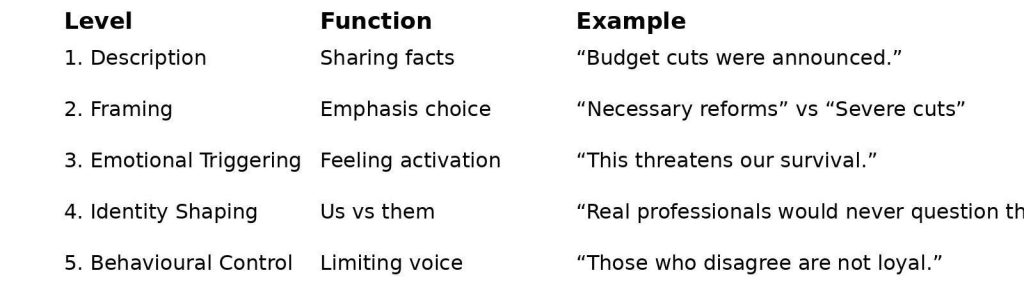
Most ethical communication operates at Levels 1–2. Weaponised communication operates at Levels 3–5.
How media conglomerates shape global perception
A small number of media conglomerates shape much of the world’s news flow. International agencies such as Reuters, Associated Press, AFP, BBC, and CNN guide what enters the global conversation and what remains outside public attention. This influence operates through several communication processes that work quietly in the background. Agenda setting directs attention by repeating certain topics until they appear central to public life. Framing presents issues through particular interpretive lenses that guide how situations are understood. Gatekeeping determines which stories pass through editorial filters into public view. Ownership concentration means fewer institutions shape larger information streams, increasing the power of selected narratives.
These processes are closely connected to agenda-setting theory, which explains how the media shape what people pay attention to in public life. Issues that receive repeated coverage begin to seem more important to audiences, gradually influencing public priorities, discussions, and policy focus.
When coverage of a region continually emphasizes crisis, instability, or corruption, global audiences begin linking that place with risk. These perceptions extend beyond news consumption into economic and political behaviour. Foreign direct investment, tourism decisions, diplomatic engagement, and development funding often follow the picture formed through media exposure. Communication, therefore, plays a role in shaping how the world responds to places and people.
Health emergencies show this pattern clearly. During crises, media emphasis on panic rather than recovery influences how countries are viewed internationally. During the Ebola outbreak, international coverage frequently centered on fear and chaos and gave limited attention to local health innovation and community resilience. Investors, travelers, and policymakers responded to the dominant storyline that traveled across borders, and those perceptions shaped economic and diplomatic actions. The stories that receive the most visibility often guide real-world outcomes long after headlines fade.
A historical pattern that keeps repeating
The weaponisation of communication did not begin with social media or modern politics. It is as old as organised power.
Ancient empires understood that controlling stories was as important as controlling territory. Roman leaders regularly referred to opposing groups as barbarians. This framing reduced empathy and made violence easier to justify. Historian Mary Beard observes that Roman propaganda worked precisely because it felt ordinary. It was repeated in speeches, inscriptions, and rituals until it became common sense.
Once a group is described as dangerous or inferior often enough, harsh treatment begins to feel reasonable.
Religion, authority, and silence
Throughout history, religious and ideological language has been used to discourage dissent. Words such as heresy, betrayal, or moral failure were deployed to shut down debate. The message was clear: Questioning authority was framed as a threat to social order rather than a search for truth.
This pattern reveals an important lesson. Weaponised communication thrives where questioning is treated as disloyalty instead of curiosity.

Colonial communication
Colonial systems relied heavily on language to legitimise domination. Indigenous communities were described as backward or uncivilised. Exploitation was reframed as development. Scholar Ngũgĩ wa Thiong’o has written extensively about how language was used to erase identity and weaken resistance. When people are taught to see themselves through a distorted lens, maintaining control becomes easier.
The twentieth century: when propaganda became systematic
The twentieth century marked a turning point. Communication was no longer improvised. It became engineered.
Nazi Germany and manufactured reality
Few examples are as stark as Nazi propaganda. Long before mass violence occurred, language was used to dehumanise Jewish people. They were portrayed as threats, parasites, or enemies of progress. Philosopher Hannah Arendt later warned that when lies are repeated consistently and alternatives are suppressed, people lose their ability to distinguish truth from fiction.
Her insight remains deeply relevant today. When truth becomes unstable, power quickly moves in to fill the gap.
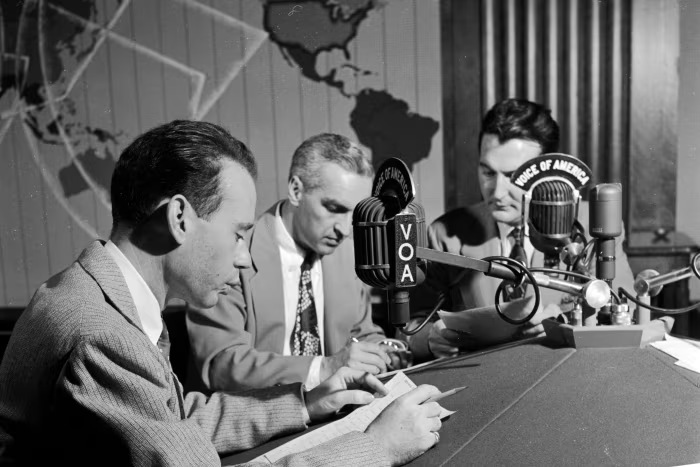
Cold War messaging
During the Cold War, communication became a tool of psychological warfare. Governments framed the world as a constant threat. Fear was normalized, loyalty was demanded, and questioning official narratives became suspicious behaviour.
In this environment, communication was less about accuracy and more about alignment.
The digital era: speed, scale, and emotional reward
Digital platforms did not invent weaponised communication, but they significantly amplified its reach, speed, and impact.
Social media systems are designed to reward engagement. Content that triggers strong emotion travels further and faster. Anger, fear, and outrage outperform calm explanation. Former Facebook employee Frances Haugen revealed that platform algorithms often amplify harmful narratives because they keep users active.
This creates a structural problem for both public discourse and organisational communication. Weaponised messages spread faster than careful ones, while correction lags behind impact.
Modern disinformation spreads by sharing small pieces like screenshots without context and repeated unverified claims until they start to feel true.
Once a narrative takes hold, reversing it requires far more effort than creating it.

How weaponised communication appears in workplaces
The most overlooked form of weaponised communication appears in offices, meetings, and everyday institutional processes, where it often hides behind normal work language and accepted routines.
5 signs communication is being weaponised
1. Questions are discouraged.
2. Emotional language replaces evidence.
3. One version of events dominates.
4. Information is selectively shared.
5. Speaking up carries a subtle risk.
In organisations, weaponised communication appears through:
1. Gaslighting
Gaslighting happens when someone repeatedly denies another person’s experience, using phrases like “That never happened” or “You are imagining things,” which gradually weaken confidence and stability. Over time, the affected person begins to doubt their memory, judgment, and ability to speak with certainty.
2. Strategic silence
Weaponised communication can appear through silence when important information is withheld and decisions are made without explanation. Questions remain unanswered, and the lack of clarity creates control rather than cooperation within teams.
3. Public shaming and narrative control
Public correction delivered in a way that embarrasses discourages learning and participation. Labeling someone as difficult or negative steadily reduces their influence, and once a narrative takes hold, perception begins to outweigh facts.
4. Selective documentation
Only specific emails, messages, or mistakes are recorded while others are overlooked, leading to a paper trail that reinforces power and isolates individuals. With time, official records drift away from the full and accurate story.
5. Moving goalposts
Expectations shift without warning, creating situations where earlier approval turns into later criticism. This constant change leaves individuals unsettled and struggling to keep pace, slowly draining confidence and energy.
A modern, everyday example
Consider a workplace where leadership repeatedly speaks about transparency and teamwork. Meetings are held, and updates are shared. At the same time, critical decisions are made elsewhere, and affected staff learn about them after the fact. Questions are met with vague responses. Those who persist are described as resistant or uncooperative.
No insults or threats are used, yet communication becomes a tool of control. The language speaks of inclusion while daily practice enforces silence, which is how weaponised communication often operates in modern institutions.

Why weaponised communication works
Weaponised communication succeeds because it aligns with human psychology. It simplifies complexity and offers certainty in uncertain situations. Communication theorist Marshall McLuhan famously noted that the medium shapes how messages are received. In fast-moving environments, speed often replaces reflection.
Repeated messages begin to feel true, authority discourages questioning, and emotional framing slowly overrides careful analysis.
The cost of weaponised communication
The damage caused by weaponised communication is cumulative and often long-lasting.
In societies, weaponised communication fuels division and mistrust. In organisations, it produces disengagement, burnout, and silence.
Research by Harvard professor Amy Edmondson on psychological safety shows that teams perform best when people feel safe to speak. When communication is used as a weapon, that safety disappears.
As a result, decision-making suffers, talented people disengage or leave, and institutions gradually weaken.
How to recognise weaponised communication early
Certain warning signals appear repeatedly across settings where questions are discouraged rather than welcomed, and fear takes the place of explanation. Labels begin to replace dialogue, one version of events dominates despite the available evidence, and speaking up gradually becomes risky.
When communication narrows understanding instead of expanding it, caution is warranted.
What ethical communication looks like in practice
Ethical communication creates clarity and accountability by explaining decisions, acknowledging uncertainty, and separating people from problems.
Mistakes are corrected without humiliation, challenge is welcomed as part of improvement, and leaders remain attentive to silence, hesitation, and withdrawal, echoing Peter Drucker’s insight that the most important part of communication lies in what is not said.
A framework for ethical institutional communication
Ethical communication in institutions grows from deliberate choices about how information, responsibility, and influence are handled. Communication shapes culture over time, and culture, in turn, shapes trust, engagement, and performance. The following principles describe how leaders can use language to strengthen understanding, psychological safety, and accountability across teams and systems.
1. Clarity before persuasion
Communication begins with clarity. People need to understand what is happening, why it matters, what is known, and what remains to be examined. When information is clear, confusion decreases, speculation is reduced, and people can make informed contributions. Clarity signals respect and strengthens credibility. Over time, clear communication builds trust because people feel included in the flow of information that affects their work and decisions.
2. Transparency in uncertainty
As clarity builds understanding, transparency builds confidence. Complex environments such as healthcare, education, and public institutions involve changing information and evolving decisions. Openly acknowledging uncertainty helps people prepare realistically and stay aligned with unfolding developments. When leaders share what is still being learned and what may influence outcomes, they create an atmosphere of honesty that strengthens institutional trust and reduces anxiety driven by assumptions.
3. Challenge welcomed
Trust deepens when dialogue is active. Communication environments where questions and thoughtful feedback are encouraged support learning and collective responsibility. When people know their voices are heard, they share concerns earlier, propose ideas more freely, and engage more fully in improvement efforts. This openness supports psychological safety, strengthens accountability, and allows better decisions to emerge through shared insight.
4. Emotion acknowledged
As dialogue grows, attention to human experience sustains connection. Work involves pressure, change, and responsibility, all of which carry emotional weight. Recognizing feelings such as uncertainty, fatigue, or concern allows people to feel seen and understood. Emotional acknowledgment supports engagement, strengthens relationships, and helps teams navigate demanding periods with steadier focus and cooperation.
5. Silence treated as data
Communication also includes what remains unspoken. Periods of hesitation, reduced participation, or quiet withdrawal offer important signals about team climate and emerging concerns. Leaders who notice these patterns gain early insight into issues that may otherwise grow unnoticed. Treating silence as feedback supports engagement, risk awareness, and organisational health. Listening to what is not said completes the communication cycle.
These principles strengthen institutional trust, psychological safety, and accountability.
The restorative power of words
While language can be weaponised, it can also be restorative. Words not only shape fear or obedience. They also shape belief, confidence, and the willingness to act. Research in psychology consistently shows that encouragement influences motivation and resilience, often more quickly than incentives or instructions.
Words shape how people see themselves, sometimes within seconds. They can plant belief or doubt with equal speed. Encouraging language can lift tired minds, steady shaken confidence, and reopen possibilities that seemed closed.
This effect is visible in many well-documented lives. Barack Obama has spoken about mentors who consistently affirmed his ability to bring people together, reinforcing a leadership identity he later grew into.
Serena Williams has frequently credited her father’s repeated verbal reinforcement for shaping her confidence long before public success followed.
Michael Jordan’s response to early rejection was similarly shaped by language that reframed failure as a signal to work harder rather than quit.
These examples illustrate an essential truth. The same communication tools that can be used to dominate, silence, or distort reality can also be used to restore belief and unlock potential. In teams and organisations, encouraging language builds trust, increases effort, and creates a sense of emotional safety. When people feel seen and supported through words, they are more willing to learn, contribute, and recover after setbacks.
Understanding this dual power of language matters. It reminds us that communication is never neutral. It always moves people somewhere, either toward fear and withdrawal or toward confidence and engagement.
Why this conversation matters now
We live in an environment saturated with messages, where words travel instantly, narratives harden quickly, and screenshots often outlive explanations. Understanding how communication can be weaponised has become a practical skill that protects individuals, strengthens institutions, and preserves trust.
Key ideas from this article
The following insights capture the core lessons explored throughout this article and serve as clear reference points for readers, writers, and practitioners:
- Weaponised communication emerges when language is used to dominate, silence, or control, instead of informing, clarifying, and supporting shared understanding.
- Across history, power has consistently relied on language to shape perception before action follows.
- Modern digital systems accelerate the spread of emotionally charged narratives, allowing harmful framing to travel faster than verification.
- In workplaces, weaponised communication often appears subtle through gaslighting, strategic silence, public shaming, and narrative control.
- Language carries dual power. Words can harm and divide, and they can also restore belief, build trust, and create psychological safety.
Final reflection
History offers a consistent lesson across societies, institutions, and workplaces, showing that harm often begins with language that prepares the ground, shapes perception, and gradually normalises what follows. Words influence how people see themselves, how they see others, and how much courage they feel to speak or remain silent, carrying real weight in everyday interactions. When used carelessly, language creates confusion, intimidation, and isolation, and when used with intention, it restores belief, rebuilds trust, and creates space for honest engagement.
Understanding the weaponisation of communication calls for attentiveness, where people notice moments when words narrow understanding, fear takes the place of explanation, and silence begins to feel safer than dialogue. Recognising the restorative power of language also reminds leaders and institutions of responsibility, since words shape how teams respond to pressure, how individuals recover from setbacks, and how organisations find their way back to integrity.
The challenge of our time lies in choosing communication that reflects ethics, clarity, and respect, because such choices protect dignity and strengthen trust. Recognising this responsibility marks the first step toward using communication as a force for understanding and shared progress.
Sources that informed this article
This article draws on widely recognised work in communication, psychology, and political theory, including contributions from George Lakoff, Hannah Arendt, Ngũgĩ wa Thiong’o, Amy Edmondson, Robin Stern, Simon Sinek, Frances Haugen, and Marshall McLuhan.
The writer is a Strategic Communications Expert with KMTC, a best-selling author, and the Co-founder of Hezron Insights. His work focuses on leadership, resilience, and storytelling, reaching audiences across Africa and beyond.