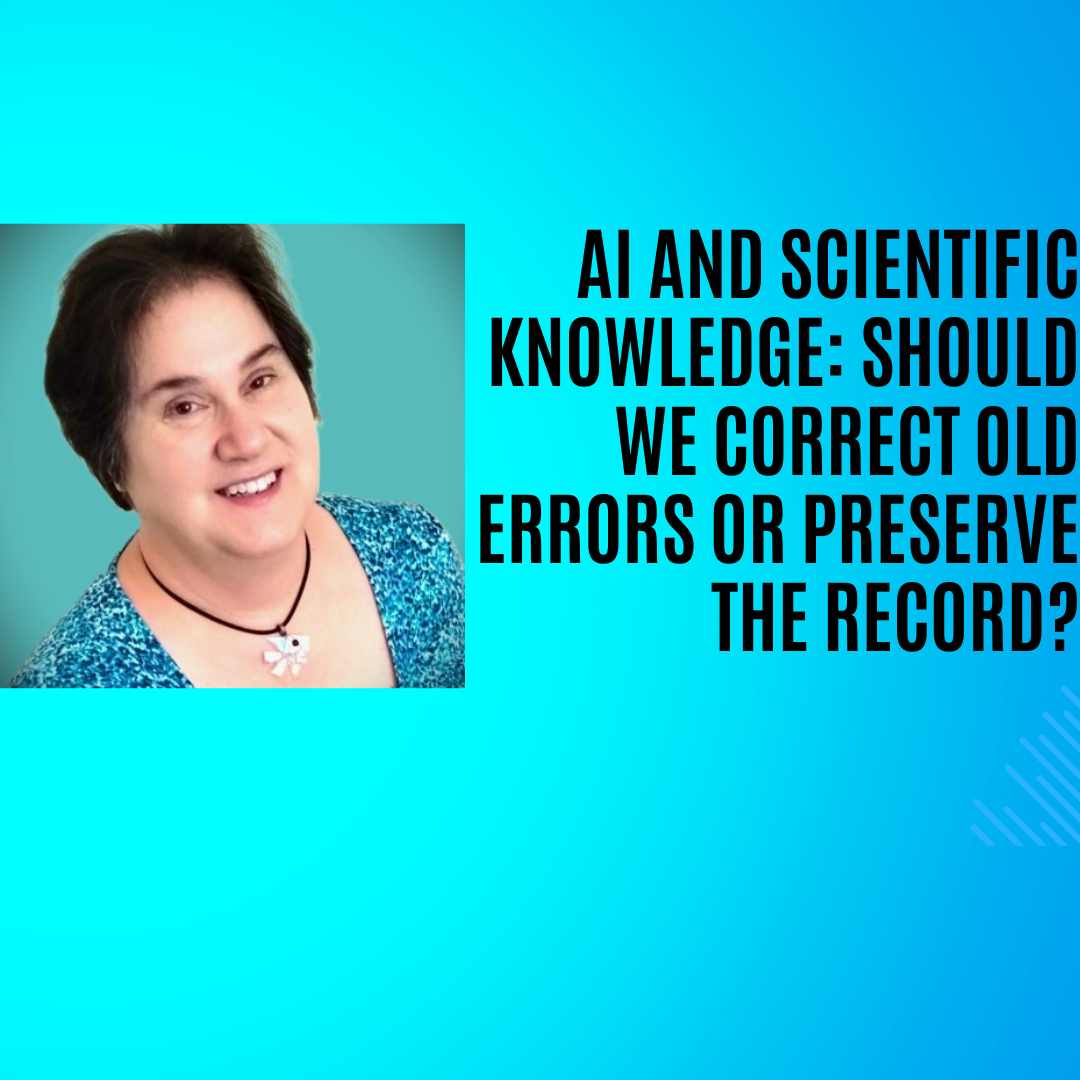
By Francesca Bordas
Editor’s note: This essay begins with an imagined scene from 2099. The future institutions, technologies and practices described in that scene are speculative. They explore a question that already matters today: when new evidence changes what we know, how should we preserve and correct the scientific record?
Imagine a research library in 2099.
A scientist opens a chemistry handbook first published 200 years earlier. The original words and figures remain exactly as they appeared when the book was printed.
Beside them sits another layer of information. A dated note explains that later research revised a particular value, why the understanding changed and where the newer evidence can be found.
The old knowledge remains visible, now with the context needed to understand it.
That imagined future raises a question we already need to consider: When science discovers that an old source contains an error, should we rewrite the record or preserve it and show how knowledge changed?
Scientific knowledge has always changed
Science grows through correction.
Measurements become more precise as instruments improve, and new evidence sometimes changes conclusions that once appeared settled.
An old scientific handbook may still contain useful information decades later. Some figures may also prove incomplete or inaccurate because later researchers have stronger methods.
The value of the old source extends beyond the accuracy of every number. It can show what scientists knew at a particular moment, how they measured the world and where the limits of their knowledge stood.
A historical scientific record therefore carries two kinds of value: the information itself and the story of how that knowledge developed.
This is also why research communication needs context. Readers need to understand where evidence came from and how confidently to interpret it, an issue explored further in Bridging the Gap Between Research and the Public: A Practical Guide for Journalists and Communication Specialists.
AI is adding a new dimension
Artificial intelligence is making it possible to examine scientific literature at a scale that would be difficult for individual researchers.
In March 2026, researchers reported ReactionSeek, a system combining large language models with cheminformatics tools to extract and standardise information from scientific literature. Tested on the century-spanning Organic Syntheses collection, it achieved more than 95% precision and recall for key reaction parameters.
Other 2026 research explored AI-assisted systems that can extract chemical procedures, identify missing information and flag ambiguities that make experiments difficult to reproduce.
These developments point to a wider possibility. As AI systems become better at comparing large bodies of scientific information, they may help researchers identify inconsistencies and gaps that have remained buried in the literature.
That creates an opportunity to strengthen scientific knowledge and raises an important question about how to record any corrections.
I explored a related issue of AI accountability in AI Did Not Slow Down. It Was Forced To. As AI becomes more capable, responsibility for how these systems are used becomes increasingly important.
The same principle applies when AI begins influencing how scientific records are interpreted.
Correction should preserve the record
My view is simple: When later evidence changes an old scientific claim, preserve the original record and attach the correction.
Imagine a scientific book states a value that later research shows is inaccurate.
A digital version could keep the original statement and add a clearly visible annotation such as:
Subsequent research has revised or clarified this information. This annotation was added on [date] following review of newer evidence. The original statement remains for historical context. See the supporting research or authoritative reference source for the current understanding.
The correction should identify when the change was made, what changed, why it changed, and the source supporting the updated information.
That kind of system is increasingly relevant as AI makes it possible to examine scientific literature at a much greater scale. In 2026, ReactionSeek demonstrated how large language models and cheminformatics tools could mine and standardise information across a century of organic chemistry literature.
Researchers have also shown how AI-assisted chemputation can help identify ambiguities and missing details in published experimental procedures.
This approach creates a visible history of how scientific knowledge evolved.
Why the original record matters
An incorrect value from an old source can reveal more than the value itself.
It may show the limits of the instruments available at the time, the methods researchers were using or the assumptions that shaped their interpretation.
Replacing the old value without explanation removes some of that history. Future researchers may see the latest answer without seeing the path that led to it.
Scientific correction should improve the record’s accuracy while preserving the path through which knowledge developed.
A layered approach to scientific knowledge
Digital publishing makes this increasingly possible.
Scientific records could be treated as layers:
Original record → dated correction → supporting evidence → current understanding
The original publication remains intact, and later knowledge is attached with dates and sources showing when understanding changed.
Researchers could then distinguish what was known at publication from what is accepted today, while also tracing the information’s provenance.
AI makes provenance more important
AI systems increasingly depend on large bodies of existing information.
A scientific value may appear authoritative simply because it has been copied repeatedly. A record that shows its history provides richer information about where the claim came from, when it changed, and what evidence supported the change.
This raises a wider question in the age of AI: How do we keep knowledge accurate while preserving the context that explains where it came from?
The issue extends beyond science because AI systems increasingly retrieve, combine and summarise information produced by institutions, researchers and other knowledge sources.
In The Ultimate Guide to AI Search, Brand Reputation, and Public Relations in Africa, Hezron Ochiel explores how published information becomes part of a wider knowledge environment that AI systems can discover and interpret.
For science, that makes versioning, attribution and transparency increasingly important.
What future researchers should be able to see
Return to that imagined library in 2099.
The researcher looking at the old chemistry handbook should be able to see the historical record alongside the latest scientific understanding.
The original source shows what people knew then. The annotation shows what we know now, and the evidence between them explains how understanding changed.
That approach also encourages scientific humility because some of the knowledge we consider settled today may be refined by researchers who come after us.
Preserving the history of correction makes that process visible.
The scientific record is a continuing conversation
Science advances because later generations question, test and improve what came before.
AI may give researchers powerful new tools for finding inconsistencies across enormous bodies of scientific literature. As those capabilities grow, we will need equally thoughtful ways of recording the corrections they help uncover.
My proposal is simple: preserve the original source, document the correction and make the supporting evidence visible.
We can correct knowledge without erasing its history.
The scientific record then becomes more than a collection of current answers. It becomes a transparent record of how humanity learned.
Francesca Bordas is a writer and emerging commentator on artificial intelligence, digital innovation and the future of society. Her work explores how evolving technologies may influence healthcare, work, and everyday life, while encouraging thoughtful discussion of the opportunities and ethical questions they raise.