
Why Universities Have a Student Attention Problem, Not a Communication Problem

By Hezron Ochiel
One finding from the Kenya Medical Training College (KMTC) Communication Audit completely changed how I think about institutional communication.
For a long time, I believed that once a university published information on email, the notice board, the website, or social media, communication had occurred.
Universities around the world pump resources into communication so that students receive timely information.
Those efforts naturally lead to an important question. What happens if students cannot find that information when they need it?
The answer begins with discoverability. The reality is that communication creates value when students can easily find, understand, and use information through the channels they already know and trust. Helping students discover that kind of information is therefore an essential part of effective university communication.
Even with proper communication channels and messaging, the data showed that some students still miss important deadlines, ask questions already answered in official notices, and turn to class WhatsApp groups to verify information shared through institutional channels.
That finding prompted me to rethink what effective communication really means.
Universities communicate with students through a range of platforms, including email, websites, student portals, notices, and social media. These messages are intended to inform, guide, and support learners. Their value depends on whether students can find the information when they need it.
This naturally leads to another question: how do students find institutional information? The answer lies in discoverability. Information creates value only after people discover it through the channels they already use and trust. When that journey breaks down, communication loses its ability to inform decisions, shape behaviour, and support learning.
Understanding discoverability also helps explain why this happens. Today’s students live in a crowded digital environment where friends, lecturers, learning platforms, social media, messaging apps, search engines, and artificial intelligence all compete for their attention. Each institutional announcement enters that environment and must earn attention before it can create value.
These observations inspired the KMTC Communication Audit, which explored how students and staff receive, interpret, share, and act on institutional communication. While the study focused on KMTC, its findings reflect a challenge facing organisations across the globe.
That challenge raises an important question: Are we communicating where our audiences already are, or are we expecting them to come where we are?
This guide explores that question.
Drawing on evidence from the audit, it explains why some communication channels consistently earn attention while others struggle.
It also demonstrates how organisations can build communication systems that are clear, trusted, searchable, and prepared for a future where search engines and artificial intelligence increasingly shape how people discover information.
This guide is built on a simple idea: effective communication begins with discoverability.
Institutions create greater impact when people can easily find, trust, and act on the information they need. This reduces confusion, improves the student experience, strengthens trust, and builds a digital reputation that continues creating value long after content has been published.

Universities don’t have a communication problem. They have a student attention problem
Communication has changed significantly with the growth of digital technologies.
A university can send thousands of emails within seconds, share the same message on social platforms, and upload it to a student portal before the day begins. The systems work exactly as they were designed.
Students, however, are navigating a very different environment. Before attending the first lecture, many have scrolled through social media to watch short videos, replied to buzzing messages on WhatsApp, and searched for information online. By the end of the day, students may have encountered hundreds of messages competing for their attention.
This reality shapes the way universities should think about communication. Students are already navigating a crowded digital environment with various digital platforms. University communication enters that same environment and must earn attention before it can inform, guide, or influence decisions.
The institutions that succeed in this complex environment are those that make important information easy to discover, understand, and act on.
The KMTC Communication Audit revealed a pattern that deserves attention. Students preferred certain communication channels over others, demonstrating that communication habits have evolved alongside digital technology.
Social media emerged as the strongest channel for meeting information needs, with 66.7% of respondents reporting that WhatsApp, X, Instagram, and Facebook largely met their communication needs. Face-to-face communication followed at 62.1%, while print media (44.8%) and electronic tools such as email and SMS (44.4%) continued to support different communication needs across the institution.
These findings suggest that students do not rely on a single communication channel. Instead, they move between different platforms depending on the type of information they require and the situation in which they need it.
The findings point to something even more important than channel preference – students create their own information journeys.
Consider how an examination timetable moves across a campus. The academic office publishes it; a class representative downloads it; someone shares it in a WhatsApp group; another student posts it on their social media status; and classmates begin discussing examination dates long before many have visited the university website. The information remains exactly the same. What changes is the path students follow to discover it.
This observation inspired what I call the Student Attention Gap. It describes the distance between where institutions publish information and where students naturally look for it.
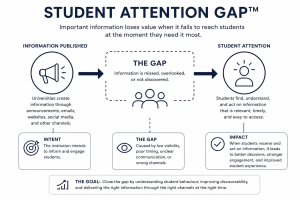
Universities communicate through official channels, while students look for information in ways that reflect their daily habits. Understanding those habits helps organisations design communication that supports the student journey from discovery to action.
Students are known to bring established communication habits into university life, relying on familiar communication channels when seeking information. This behaviour is consistent with media repertoire research, which shows that people routinely draw on a preferred set of communication channels rather than a single source. The communication audit reflects this pattern, with students using different channels for different communication needs. Recognising these habits enables universities to design communication systems that fit naturally into students’ existing information-seeking behaviours.
This helps explain why universities continue receiving the same questions even after publishing detailed notices. Publishing information is only one part of the communication process. Students still need to discover the message, understand what it means, confirm it when necessary, and use it at the right time. When that journey is interrupted at any stage, communication loses much of its intended impact.
Closing the Student Attention Gap begins with a simple change in thinking. Communication teams should spend as much time understanding audience behaviour as they spend developing communication materials.
One question should guide every communication strategy: Where will students first see this message?
The answer influences everything that follows, including the communication channel, language, format, timing, and the likelihood that students will act on the information. Universities that answer this question well communicate more effectively because they design their communication around student behaviour rather than institutional routine.
The lesson extends well beyond higher education. Hospitals, government departments, businesses, and development organisations all face the same challenge. People discover information through the places they already trust and use. Organisations that understand those patterns communicate more effectively, strengthen trust, and create information that remains visible in an increasingly search-driven and AI-powered world.
The Student Information Journey
One of the biggest assumptions universities make is that communication begins when a notice is published. The audit led me to see it differently.
From a student’s perspective, communication begins the moment information is discovered. That discovery may happen through a class WhatsApp group, a conversation with a friend, a lecturer, or an official university announcement. The starting point varies from one student to another, yet the journey that follows is remarkably similar.
As I reflected on the findings, I realised that students usually do not move directly from discovering information to taking action. Instead, they pass through a series of small but important steps before making a decision. Each stage answers a different question, and different communication channels support different parts of that journey.
Understanding that journey helps explain why some messages lead to action while others are overlooked. It also shows why effective communication depends not only on what institutions publish, but also on how easily students can discover, understand, trust, and act on the information they receive.
I call this The Student Information Journey.
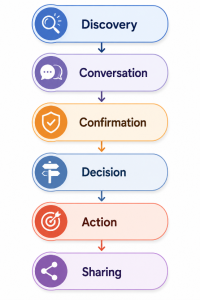
The journey begins with discovery.
Discovery is the first stage of the student information journey. It begins when students encounter new information through the channels they use most. Capturing attention is the primary goal at this stage, as students must first become aware of the information before deciding what to do next.
The next stage is conversation.
Students naturally discuss important information with other students. They ask questions, compare understanding, and seek reassurance before making decisions. A single notice often becomes hundreds of conversations across multiple platforms.
Many universities overlook this stage.
They assume communication ends when the message is published. Yet students continue to communicate long after the institution has finished.
The third stage is confirmation.
Once students understand that information is important, they look for an official source. They visit the university website, check the student portal, read their email, or contact their head of department to confirm the information.
This explains why official communication channels remain essential.
Students trust them because they provide certainty.
The fourth stage is decision.
Students now know what the information means and decide what to do next. They may submit an application, register for examinations, pay fees, or prepare for clinical placement.
In this case, communication has achieved its purpose by guiding behaviour.
The journey continues with action.
Students complete the required task.
A communication strategy succeeds when students understand the message well enough to take the intended action without unnecessary confusion or repeated clarification.
The final stage is sharing.
Students do not always keep useful information to themselves. They forward messages to classmates, answer questions from friends, and explain it to other students who may have missed the original communication.
This final stage is often overlooked.
It may also be the most valuable.
Students become communication partners.
Every helpful conversation extends the reach of the original message and strengthens communication across the institution.
The KMTC Communication Audit reinforces this understanding. Earlier findings showed that students rely on different communication channels for different purposes, making communication most effective when those channels work together. A connected communication system supports students throughout their information journey instead of treating each platform as a separate activity.
This understanding is captured in the Student Information Journey™. Communication is most effective when it is designed around the way students look for, understand, and use information. As students move from discovery to conversation, confirmation, decision, action, and sharing, they build confidence in the information they receive and help it reach others.
Planning communication around this journey helps information move smoothly from discovery to action. That process improves understanding, strengthens trust, and enables students to make informed decisions when they need information most.

Five communication mistakes universities continue to make
The communication audit also highlighted habits that undermine effective communication across many institutions.
These habits are easy to overlook because they often become part of everyday work. Consequently, they reduce student engagement, create confusion, increase enquiries, and weaken trust in official communication.
Understanding these challenges gives universities an opportunity to strengthen every message they send.
Mistake 1: Measuring communication by what is sent
Many communication reports begin with numbers.
How many emails were sent? How many posters were printed? How many social media posts were published?
These figures show activity but say very little about results.
Universities invest significant effort in communicating with students, yet important information still fails to reach many of the people it is intended to serve.
A stronger question should be, how many students understood the message?
Communication achieves its purpose when people receive information, understand it, and take the intended action. An effective communication strategy should therefore measure outcomes alongside activities.
The audit reflected this principle by examining how students received and responded to communication rather than simply counting communication channels.
Mistake 2: Expecting one channel to do everything
A communication channel serves a different purpose. A website provides detailed information, social media creates awareness and encourages conversation, email provides an official record, and face-to-face communication builds understanding and trust.
Students naturally move between these channels throughout the day as they search for, discuss, confirm, and act on information. Communication becomes more effective when institutions design these channels as a single, interconnected system, allowing one channel to reinforce another.
As students encounter the same message at different stages of their information journey, understanding grows, confidence increases, and they become more likely to take the intended action.
Mistake 3: Publishing information too late
Students often begin searching for information long before universities publish it.
They ask classmates, search the class WhatsApp group for class timetables, and discuss accommodation before official communication is released.
By the time the college publishes the announcement, students may already be relying on unofficial information.
Communication becomes more effective when universities anticipate these questions and answer them well in advance.
This simple strategy reduces uncertainty and gives official communication the opportunity to shape the conversation before rumours fill the gap.
Mistake 4: Treating students as receivers instead of partners
Communication flows in two directions. Through everyday conversations, students help interpret, validate, and circulate information among their peers. These interactions become part of the university’s communication system and influence how information spreads across the institution.
Students also play an active role in moving information from one person to another. As they ask questions, confirm details, and share what they have learned, they help others discover and understand institutional information.
Recognising this role enables universities to strengthen communication by treating students as communication partners and creating opportunities for continuous feedback. This is one of the most important lessons from the KMTC Communication Audit.
Mistake 5: Thinking communication ends after an announcement
Many universities treat communication as a single event. An announcement is published, and the work is considered complete.
Communication continues long after that first announcement. Students discuss the information, ask questions, confirm details, and share updates with classmates as they make sense of what they have learned.
Understanding this journey helps communication teams stay connected with their audiences. They monitor questions, publish clarifications, update frequently asked questions, and respond to emerging concerns as they arise.
These follow-up interactions deepen understanding, strengthen confidence in official communication, and encourage students to rely on trusted institutional sources. Over time, communication develops into an ongoing relationship that supports learning, builds trust, and keeps students informed throughout their journey.
One lesson connects every mistake
These communication challenges share a common root. Universities focus on publishing information, while students focus on finding it. Their journeys often begin in different places, shaping how information is discovered, understood, and used.
The institutions that communicate most effectively understand how students discover, discuss, confirm, and apply information throughout the day. They design communication around those behaviours, making it easier for students to find reliable information when they need it.
The same principle applies well beyond higher education. Hospitals communicate with patients, government agencies communicate with citizens, and businesses communicate with customers. Communication becomes more effective when organisations understand how people look for information before deciding where and how to share it.
Every announcement is building your university’s future reputation
Many universities see communication as a daily responsibility. A notice is published to inform students, a news story is published to capture an event, and a speech is uploaded on the website after a ceremony. Once the message has been shared, attention naturally turns to the next assignment.
That approach reflected a time when communication had a short lifespan. Printed notices disappeared within days, newspapers were replaced by the next edition, and public attention gradually moved on.
Digital communication has changed that reality.
An article published on a university website becomes part of the institution’s digital record. Research stories, partnership announcements, graduation speeches, student achievements, and community outreach activities remain accessible long after the event has passed. People continue to discover them months, and sometimes years, later.
This matters because many important relationships now begin with an online search. Prospective students want to understand campus life. Parents look for confidence that their children are joining a credible institution. Researchers explore opportunities for collaboration, development partners assess potential investments, journalists search for expert sources, and employers seek evidence of graduate quality.
For many of them, the journey begins in the same place: an online search. Their first impression is often formed before they visit the campus. It begins with the information they discover.
This expands the role of institutional communication. It continues to inform today’s students while introducing future students, researchers, employers, policymakers, journalists, and development partners to the university. A single article can answer an immediate question today and continue to strengthen an institution’s reputation for years to come.
The importance of this digital record continues to grow as search behaviour evolves. People still use traditional search engines, and many now ask questions through artificial intelligence platforms. Instead of browsing multiple websites, they expect one clear, reliable answer.
Those answers are drawn from information organisations have already published. Artificial intelligence does not create institutional reputation. It discovers existing evidence, organises it, and presents it in ways that help people make decisions. The quality of those responses depends on the quality, credibility, and usefulness of the digital information universities have built over time.
This is why communication has become a strategic institutional asset. Articles expand a university’s digital footprint, research stories demonstrate expertise, partnership announcements build credibility, and student success stories showcase institutional impact. Collectively, they create a lasting digital record of the university’s knowledge, achievements, and contributions to society.
Although the KMTC Communication Audit examined how students receive institutional communication, its findings point to a broader lesson. Organisations that consistently publish useful, timely, and trustworthy information strengthen communication today while creating valuable digital knowledge for the future.
This idea also reflects a broader change that I have explored in my work on AI Search, Digital Public Relations, and the Expertise Economy. Discoverability shapes credibility, credibility strengthens trust, and trust creates opportunity. Universities are becoming part of that transformation.
The role of communication teams continues to expand. They document institutional knowledge, preserve institutional memory, strengthen reputation, and create the digital trust that future students, partners, search engines, and artificial intelligence systems rely on to understand the university.
That responsibility calls for a different mindset. Communication should answer real questions, solve genuine problems, and contribute meaningful knowledge that remains valuable long after publication.
Universities that embrace this approach become trusted sources of knowledge, strengthen their digital reputation, and increase their discoverability in search engines and artificial intelligence systems. Communication builds visibility, preserves institutional knowledge, and creates lasting value for its stakeholders. It is one of the university’s most valuable long-term assets.
The communication agenda for the next decade
Every generation of university leaders faces defining priorities. In the past, expanding access to higher education required investment in classrooms, libraries, laboratories, and hostels to support growing student populations. Those investments strengthened the physical environment for learning.
Today, universities are also investing in information flow. Students need to find the right information at the right time through the channels they already use. Meeting that need shapes the quality of the student experience from admission to graduation.
This responsibility extends across the organisation. Student services depend on clear communication, academic administration relies on timely information, and institutional reputation grows through consistent engagement with students and other stakeholders. Communication, therefore, becomes an essential part of service delivery.
The communication audit reinforces this message. Students cannot attend examinations, report for clinical placements, apply for accommodation, register for graduation, or access support services without accurate and timely information. When communication works well, students navigate university life with greater confidence, institutions operate more efficiently, and trust continues to grow.
Looking ahead, I believe five priorities will shape the future of university communication. They draw on the lessons from the KMTC Communication Audit and reflect the growing importance of discoverability, digital communication, institutional reputation, and artificial intelligence in higher education.
1. Build communication around student behaviour.
Students already have established communication habits before they join the university. Institutions achieve better results when they understand those habits and design communication around them. An effective communication strategy should begin with one question: How do our students naturally discover information?
Understanding that answer makes all communication decisions stronger.
2. Treat communication as a student service.
Students should never struggle to find important information.
Clear communication saves time, reduces anxiety, improves participation, and creates a better learning experience. Well-designed information helps students move confidently from one stage of university life to the next.
Communication, therefore, deserves the same attention given to teaching, student welfare, and academic support.
3. Build institutional knowledge every day.
Universities produce enormous amounts of valuable knowledge through research, community outreach, student innovation, industry partnerships, and academic achievement.
Many of these stories attract attention for a short time before gradually fading from view.
Their value extends far beyond the day they are published. Research findings, partnership announcements, student success stories, and community initiatives all contribute to the university’s growing digital knowledge base.
As that body of knowledge expands, it helps students, researchers, employers, development partners, journalists, policymakers, search engines, and artificial intelligence systems understand what the institution stands for.
Knowledge becomes one of a university’s greatest strategic assets when it is consistently documented, organised, and shared.
The stronger the digital record becomes, the easier it is for people to discover the institution, trust its expertise, and recognise its contribution to society.
4. Prepare for a future shaped by search and artificial intelligence.
The way people discover information continues to evolve.
Prospective students search online before applying, parents compare institutions using digital information, researchers explore opportunities for collaboration, and artificial intelligence is becoming another pathway for learning about universities.
This makes the quality of institutional content more important than ever.
Universities that consistently publish useful, well-structured, and trustworthy information strengthen their visibility across search engines, artificial intelligence platforms, and other digital channels where discovery begins.
For communication teams, this means thinking beyond the immediate announcement.
Articles, research stories, partnership updates, and student achievements all become part of the university’s digital evidence.
Ultimately, that growing body of knowledge strengthens the reputation, improves discoverability, and helps future students and other university partners understand the institution with greater confidence.
5. Measure communication by its impact.
Many universities evaluate communication by counting activities such as the number of notices published, news stories written, or social media posts made. These measures show what was produced, but they provide only part of the picture.
A stronger approach examines the results communication creates. Did students receive the information? Did they understand it? Did they act on it? Did enquiries decrease, participation improve, and trust grow?
Answers to these questions reveal whether communication is achieving its purpose. They also provide university leaders with valuable evidence for continuous improvement, helping communication become more responsive, student-centred, and effective over time.
One lesson brings everything together
The KMTC Communication Audit began with a straightforward objective: to understand how information flows across one of Kenya’s largest health training institutions. As the findings emerged, they revealed a broader lesson about the future of institutional communication.
Students were doing more than choosing communication channels. Their behaviour showed how people discover, understand, trust, and act on information in a digital world. The journey begins with attention, grows through understanding, leads to action, and develops into experience. Positive experiences strengthen trust, and trust shapes institutional reputation.
This journey starts with a single message: Universities that understand it will be better prepared for the future. They will communicate with purpose, listen carefully to their students, answer real questions, and build a growing body of knowledge that serves today’s learners and future generations.
The audit also demonstrates that communication belongs at the heart of institutional strategy. It supports student success, strengthens reputation, improves service delivery, and creates the digital evidence that students, researchers, employers, development partners, policymakers, search engines, and artificial intelligence systems use to understand a university.
One lesson stands above the rest – student attention is one of the most valuable resources any university can earn. Institutions that understand how attention leads to discovery, trust, and meaningful action will strengthen the student experience and help shape the future of higher education communication across Africa.
Final thoughts
When I began conducting the KMTC Communication Audit, my goal was to understand which communication channels students preferred. As I explored the findings, I came to appreciate a broader lesson about how communication works in a digital world.
The audit revealed that information follows people through the channels they already use and trust. Communication becomes more effective when institutions understand how their audiences discover, discuss, confirm, and use information in everyday life. That lesson extends beyond universities to any organisation seeking to build trust, strengthen relationships, and improve service delivery.
The findings also point to an important opportunity for higher education. Universities generate knowledge every day through teaching, research, innovation, partnerships, and community service. When these stories are documented and shared consistently, they become part of the institution’s digital knowledge base. Eventually, that knowledge strengthens discoverability, builds credibility, and helps students, researchers, employers, development partners, policymakers, search engines, and artificial intelligence systems understand the university.
The central lesson is that effective communication begins with understanding how people find and use information. Universities that embrace this principle strengthen the student experience, build lasting trust, and create a digital reputation that continues generating value long after publication.
Communication is one of the university’s greatest strategic assets. It connects knowledge with people, turns information into action, and helps institutions remain visible, trusted, and discoverable in an increasingly digital world.
References
Fombrun, C. J., & Van Riel, C. B. M. (2004). Fame and Fortune: How Successful Companies Build Winning Reputations. Pearson Education.
Google. (2024). The Future of Search: How AI Is Transforming Information Discovery. Google.
Grunig, J. E. (Ed.). (1992). Excellence in Public Relations and Communication Management. Lawrence Erlbaum Associates.
Hargie, O., & Tourish, D. (2009). Auditing Organizational Communication: A Handbook of Research, Theory and Practice. Routledge.
Kuh, G. D. (2009). What student affairs professionals need to know about student engagement. Journal of College Student Development, 50(6), 683–706.
Ledingham, J. A. (2003). Explicating relationship management as a general theory of public relations. Journal of Public Relations Research, 15(2), 181–198.
McLuhan, M. (1964). Understanding Media: The Extensions of Man. McGraw-Hill.
Ochiel, H. (2024). Communication Audit at Kenya Medical Training College. Unpublished master’s thesis, Daystar University.
Pew Research Center. (2024). Social Media Use in 2024. https://www.pewresearch.org/
Rogers, E. M. (2003). Diffusion of Innovations (5th ed.). Free Press.
Simon, H. A. (1971). Designing organizations for an information-rich world. In M. Greenberger (Ed.), Computers, Communications, and the Public Interest (pp. 37–72). Johns Hopkins University Press.
Trowler, V. (2010). Student Engagement Literature Review. Higher Education Academy.
Hezron Ochiel is a strategic communications and public relations professional with over 15 years of experience in media, digital communication, and reputation strategy. He serves as the Deputy Corporate Communications Manager at the government-owned Kenya Medical Training College (KMTC) and is the founder of Hezron Insights, where he writes about AI visibility, Digital PR, SEO, GEO, and digital authority. His work has appeared on platforms including Reuters, The New Humanitarian, and The Standard.