
A 2025 PR reality check for communicators, leaders, and organisations
By Hezron Ochiel
In November 2024, I published an article titled “Top 13 PR Trends to Watch in 2025: Insights for the Future of Public Relations.”
At the time, I was trying to make sense of where public relations was going and what communicators needed to prepare for.
A year and a half later, I went back to ask a simple question: how much of what I had predicted actually happened?
Most of the predictions came true, which was encouraging. The real surprise was how much bigger one trend had become than I expected: AI search.
That became the most important lesson from the audit. AI is no longer just helping communicators work faster. It is now influencing how people discover brands, experts, institutions, products, and ideas.
For public relations, that changes the conversation.
This is why I wanted the audit to go beyond personal reflection. I compared my predictions with industry reports, media behaviour data, and observations from my organisational communication work in Kenya.
The evidence base includes reports and insights from Cision, Muck Rack, Axios, Edelman, Meltwater, LinkedIn, and the Media Council of Kenya. I also draw from communication audits and field observations from institutional communication practice.
Taken as a whole, these sources point to a profession being reshaped by AI, fragmented media habits, shrinking newsroom capacity, declining trust, employee visibility, and pressure to prove the impact of communication.
Cision’s 2025 State of the Media Report gives a useful example. It found that 86 percent of journalists would immediately reject a pitch that was not aligned with their beat or audience. It also found that 72 percent still considered press releases the most useful PR resource, especially when supported with multimedia.
That finding matters because it shows that PR still has value when it is relevant, useful, and well targeted. Journalists need strong PR support, and they reject communication that is careless, generic, or poorly aligned with their audience.
How I audited the predictions
I used a simple scorecard.
For each prediction, I asked where it stood:
→ Fully fulfilled
→ Partially fulfilled
→ Still emerging
→ Overstated
→ Missed or underestimated
I also reviewed relevant 2026 reports to see whether each 2025 trend had matured, accelerated, or remained unresolved.
My main goal was to understand what the profession should learn from what came true, what is still taking shape, and what I did not see clearly enough.
What the audit revealed
Most of the 2025 predictions were directionally right.
AI became central to PR work, media relations became harder, storytelling gained more value, and crisis communication became more urgent. LinkedIn became more important for professional visibility, social media fragmentation intensified, and measurement became more strategic.
The biggest gap in my thinking was AI search.
In 2024, I mainly saw AI as a tool that would help PR professionals work faster. What became clearer in 2025 and the first half of 2026 is that AI is also becoming a discovery layer.
People are using AI tools to ask for summaries, recommendations, comparisons, explanations, and expert suggestions. They are also using these tools alongside Google, websites, social media, and news platforms.
Content is now part of a wider information system in which AI tools may retrieve, summarise, cite, or ignore it.
Meltwater’s research with LinkedIn sharpened this point. The study analysed 9.5 million AI citations across 16 B2B categories and found that LinkedIn was the second most-cited source by AI models, behind YouTube. Meltwater described authentic, expert-driven content as a critical driver of B2B brand visibility in AI-generated answers.
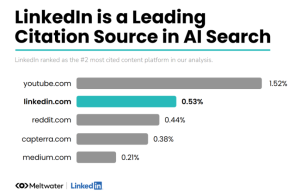
For me, that became the biggest lesson from this audit.
PR is moving from platform visibility to visibility across information systems.
2025 PR prediction audit scorecard
|
Verdict |
Predictions |
|
Fully fulfilled |
AI workflows, crisis management, media relations, storytelling, multimedia and video, social media fragmentation, LinkedIn visibility |
|
Partially fulfilled |
Trust communication, influencer communication, data-driven PR, strategic measurement |
|
Still emerging |
Employee advocacy |
|
Missed or underestimated |
AI search and its impact on PR visibility |
The scorecard gives a quick picture. The next sections explain what happened, what changed, and what PR teams should learn from each prediction.

1. AI became central to PR workflows
Verdict: Fully fulfilled
This was one of my most accurate predictions.
In the original article, I argued that generative AI would move from a buzzword into everyday PR work. That shift happened faster than many people expected.
Muck Rack data reported by Axios showed that three out of four communicators were using generative AI at work by early 2025, nearly three times as many as in March 2023. Common uses included brainstorming, first drafts, editing, and research.
Cision’s Inside PR 2026 report later showed that 91 percent of PR professionals were already using generative AI as part of their workflow. It also found that 73 percent used AI for idea generation, while 68 percent used it for writing and content refinement.
At that level of adoption, AI has become part of how many PR teams think, plan, draft, and refine content. The lesson for the PR profession is to use AI in ways that improve speed while protecting accuracy, trust, and professional judgment.
AI can help teams work faster, while credibility depends on the communicator’s ability to verify facts, understand context, and make sound decisions.
2. AI search became the trend I underestimated
Verdict: Missed or underestimated
This was the biggest gap in my 2025 prediction.
I saw AI mainly as a productivity tool and did not fully capture its growing role as a discovery tool. That distinction now matters because AI platforms are beginning to shape how people find brands, experts, institutions, products, and explanations.
Meltwater and LinkedIn’s research makes this difficult to ignore. If LinkedIn is now one of the most-cited sources in AI answers, professional visibility reaches beyond human audiences. It also influences how AI systems interpret public expertise.
PR teams therefore need to think beyond search, media, and social visibility. AI visibility is becoming part of the same conversation.
An organisation’s expertise must be easy to find, clear to understand, evidence-based, and connected to credible human voices. This is where PR, SEO, thought leadership, reputation management, and AI search begin to meet.
3. Crisis management became non-negotiable
Verdict: Fully fulfilled
Crisis management became more important in 2025 as reputation risks accelerated and grew harder to contain. Online anger, misinformation, employee leaks, customer complaints, activist audiences, and AI-generated content all made the communication environment more fragile.
In the original article, I argued that brands would need to respond with greater speed, openness, and accountability. The events and research of 2025 strengthened that argument.
Edelman’s 2025 Trust Barometer showed that 61 percent of people globally had a moderate or high sense of grievance against government, business, and the wealthy. It also reported that people with high grievance distrusted business, government, media, and NGOs.
Reuters, reporting on Edelman’s findings, noted that support for hostile actions was higher among younger respondents aged 18 to 34, with 53 percent endorsing such measures.
For PR teams, this points to a serious warning. Crisis management now requires more than preparing statements after something has gone wrong. It calls for continuous listening to public frustration, misinformation risks, community sentiment, employee concerns, and online mobilisation before they escalate into broader reputational threats.
Crisis readiness should therefore become part of everyday communication planning, not an activity reserved for moments of visible pressure.
4. Trust communication became more demanding
Verdict: Partially fulfilled
I predicted that purpose-led communication and trust would remain important. That prediction was partly fulfilled as the environment became more demanding.
Many organisations announce commitments, publish statements, and use the language of impact. Audiences now expect proof that those words match lived experience.
I have seen this in institutional communication work. In one service delivery monitoring exercise I participated in, we received 5,298 responses from 92 units. The findings showed where satisfaction was strong, where improvement was needed, and how stakeholders were experiencing services.
That kind of evidence makes communication more credible because it connects promises to real experience. Public trust grows when words are supported by action, data, openness, and accountability.

5. Media relations became harder and more important
Verdict: Fully fulfilled
I predicted that media relations would continue to matter if it became more strategic. That prediction was fulfilled.
Media relations still matters in the age of AI as careless outreach continues to lose ground. Cision’s 2025 State of the Media Report found that 86 percent of journalists would immediately reject pitches that were not aligned with their beat or audience. It also found that 72 percent of journalists still considered press releases the most useful resource PR teams could offer.
Cision’s 2026 media relations findings also showed that 66 percent of journalists relied on PR-provided content, including press releases, pitches, and media kits, for story ideas. In the same findings, 72 percent said fewer than a quarter of the pitches they received were relevant.
These findings point to an important lesson. Journalists still need accurate information, strong data, credible voices, relevant story ideas, and timely access. Media relations works best when PR teams respect journalists’ time, understand their audiences, and provide information that is useful, accurate, and well targeted.
6. Storytelling became a competitive advantage
Verdict: Fully fulfilled
I predicted that authentic storytelling would become more important. That prediction was fulfilled as AI-generated content made generic writing easier to produce and harder to value.
In that environment, human stories, real experience, credible voices, and lived examples became more important. Cision’s Inside PR 2026 report identified storytelling and content creation as the number one in-demand PR skill for 2026, selected by 59 percent of PR professionals across all levels of seniority.
Meltwater and LinkedIn’s research strengthens the same argument from another angle. If AI tools are citing expert-led professional content, credible human experience is also becoming part of digital visibility.
Many organisations still struggle to turn their work into stories people can understand, remember, and trust. They produce announcements and campaigns, and the real value often sits in the people affected, the problem being solved, and the evidence behind the outcome.
In my own work, I have seen that numbers alone do not always move people. A policy, survey, training, or institutional milestone becomes more meaningful when it is connected to people, context, and practical value.
Strong storytelling helps organisations explain their work through evidence, emotion, relevance, and real human experience.

7. Multimedia and video became essential
Verdict: Fully fulfilled
This prediction was fulfilled as audiences continued to show a stronger preference for visual, short-form, human, and platform-native content.
Kenya’s media environment reflects this shift. The Media Council of Kenya’s 2025 State of the Media Survey reported that social media had become the leading primary source of news for Kenyans at 39 percent.
That finding should make communication teams take notice. People are increasingly finding news and updates through social platforms, digital communities, and mobile-first formats, alongside traditional media.
For PR teams, the lesson is practical. A press release, statement, or poster can no longer carry the full weight of communication on its own. Modern PR needs photos, short videos, explainers, human stories, expert clips, quote cards, infographics, and platform-specific formats.
Communication should make important information easier to understand, share, remember, and trust.
8. Social media fragmentation became a major PR challenge
Verdict: Fully fulfilled
Audience attention continued to fragment across platforms, creators, video channels, messaging apps, and AI-powered discovery tools.
I have seen this pattern clearly in institutional communication. During one campus visit, I asked students how many of them followed our official social media pages. Only a few hands went up.
When I asked where they received institutional updates, some mentioned classmates, class WhatsApp groups, the student portal, and forwarded notices.
That moment revealed that students had access to official information, though their route to it was not always direct.
This is why a communication strategy should begin with audience behaviour. PR teams need to understand how people find information, who forwards it to them, which channels they trust, and what format helps them act.

9. LinkedIn became more important for professional visibility
Verdict: Fully fulfilled
This prediction was fulfilled more strongly than many expected.
LinkedIn has become a professional search engine, credibility layer, publishing platform, expert discovery tool, and reputation asset. Meltwater’s research with LinkedIn found that LinkedIn was the second most-cited source by AI models across B2B categories, after YouTube.
That finding carries an important lesson for communication professionals. Professional brand visibility is now part of reputation management.
Organisations that pay little attention to the visibility of their leaders, experts, and employees risk leaving authority untapped. Official pages, websites, and media coverage remain important, and visible experts now add another layer of credibility.
10. Employee advocacy became an authority asset
Verdict: Still emerging
This prediction was correct, and the trend is still developing.
In 2025, more organisations began to recognise employees as carriers of credibility. When institutional trust is weak, people often look for human signals. They pay attention to the people behind the organisation, the expertise they demonstrate, the clarity of their thinking, and the credibility of their public voice.
My own thinking has evolved on this point. I now believe I undervalued employee visibility by treating it mainly as an internal communication and advocacy issue. It is increasingly becoming part of AI visibility, recruitment, trust, and institutional authority.
Meltwater and LinkedIn’s findings strengthen this argument. If expert-led professional content can influence AI visibility, employee expertise becomes more than a personal branding issue. It becomes part of organisational discoverability.
This calls for a more thoughtful approach to employee advocacy. The goal is to help credible people explain what they know, document their expertise, and strengthen the organisation’s authority through human voices.
11. Influencer and creator communication became more strategic
Verdict: Partially fulfilled
This prediction was fulfilled, as many PR teams continued to learn how to use creator and influencer communication effectively.
Creators and influencers became more important in shaping public conversation, and their role now extends beyond campaign amplification. Influence has become part of reputation.
Public opinion can now be shaped by journalists, social media users, and niche experts. That changes how PR teams should think about influence.
Influencer communication should therefore move from follower counts to credibility mapping. Stronger measures include trust, relevance, audience fit, expertise, and influence within the community that matters.

12. Data-driven PR became more important
Verdict: Partially fulfilled
This prediction was fulfilled unevenly.
Many PR professionals now understand the need for data and recognise that communication must be measured beyond impressions, likes, reach, and media mentions. The bigger challenge is turning that awareness into consistent practice.
Strong PR teams use data to understand audience behaviour, media performance, sentiment, misinformation risks, search visibility, AI visibility, and campaign outcomes. Data helps them explain what communication is achieving and where the strategy needs improvement.
African organisations have a major opportunity here. In a communication audit I led in a large public institution, awareness of communication channels varied significantly. Print stood at 73.56 percent, social media at 68.97 percent, electronic channels at 51.72 percent, and face-to-face communication at 48.28 percent.
Those findings showed that no single channel was enough. Data of that kind helps communication teams move from assumptions to evidence and helps leaders understand why channel strategy should be based on audience behaviour rather than internal preference.
13. Measurement became more strategic
Verdict: Partially fulfilled
This prediction was partly fulfilled.
If data helps PR teams make better decisions, measurement helps them prove the value of those decisions.
PR teams are under growing pressure to show impact. Many still struggle to connect communication activity to organisational outcomes. The future of PR measurement will require a broader view of value, one that connects visibility, trust, reputation, audience behaviour, stakeholder action, and organisational outcomes.
This is practical. In the service delivery monitoring work mentioned earlier, 5,298 responses across 92 units helped show where stakeholders were satisfied, where service gaps existed, and where communication could support improvement.
That kind of evidence is more useful than simply reporting that messages were sent or meetings were held. PR must move from proving that communication happened to showing what communication changed.

What I got right
Looking back, the strongest predictions were around AI workflows, crisis communication, storytelling, media relations, and platform fragmentation.
These were not small shifts. They changed how PR teams should plan, write, pitch, monitor, measure, and advise leadership.
What I missed or underestimated
My biggest miss was AI search.
I understood AI as a tool that would improve PR productivity. I did not fully capture its growing role in discoverability.
I also underestimated employee and expert visibility. I saw employee advocacy as important, and I now see it as central to trust, authority, recruitment, and AI visibility.
Organisations that rely solely on official pages may become less visible in a world where people and AI tools increasingly seek credible human expertise.
What this means for African PR teams
African PR teams should not treat these trends as distant global signals. They are already visible locally.
Newsrooms are under pressure, audiences are spread across many channels, and public information now moves through WhatsApp groups, TikTok, YouTube, LinkedIn, and other digital spaces.
Younger audiences are consuming news differently, professional credibility is increasingly shaped online, AI-generated content is growing, and many institutions still struggle to measure the impact of communication.
Across all these shifts, one thing remains constant: public trust still requires proof.
The Media Council of Kenya’s 2025 State of the Media Survey gives a useful local signal, with social media becoming the leading primary source of news for Kenyans.
African communication teams need a different mindset.
Publishing on the official website and assuming the audience will come is not enough. Posting on many platforms without understanding audience behaviour is not enough. Celebrating reach without measuring trust, clarity, action, and reputation is not enough.
For African PR teams, this is an opportunity to build communication systems shaped around local trust patterns, local media behaviour, and local audience realities.
African communicators can lead by building stronger systems around crisis readiness, evidence-based storytelling, AI-literate communication, media relevance, employee visibility, expert positioning, social listening, search visibility, AI visibility, and measurement linked to organisational goals.
The future of African PR will belong to teams that understand how people discover information, who they trust, what evidence they need, and how communication influences decisions.
How PR teams should respond in 2026
The audit points to seven practical actions.
1. Build AI visibility into PR strategy
Do not treat AI search as a technical issue for SEO teams only. PR teams should help organisations become easier to find, understand, trust, and cite.
2. Strengthen expert-led content
Encourage leaders, researchers, technical staff, and specialists to publish clear, useful, evidence-based insights.
3. Make media relations more relevant
Study journalists’ beats, audiences, deadlines, and preferred formats before pitching.
4. Invest in communication audits
Understand how your audience discovers information, which sources they trust, and what influences their decisions.
5. Treat employees as credibility carriers
Support employee visibility through training, content guidance, thought leadership, and clear organisational positioning.
6. Use data to guide communication investment
Measure trust, visibility, sentiment, search performance, audience behaviour, and stakeholder action.
7. Structure content for people and AI
Use headings, data, FAQs, examples, named entities, and comparison frameworks to make content easier to understand and cite.
Frequently asked questions
1. What PR trends came true in 2025?
AI became part of everyday PR work, crisis communication became more urgent, media relations remained important, storytelling gained more value, and audiences continued to spread across many platforms and communities.
2. How is AI search changing public relations?
AI search is changing how people discover brands, experts, institutions, products, and ideas. PR teams now need to make their expertise clear, credible, easy to find, and evidence-based.
3. Why does employee visibility matter in PR?
Employee visibility matters because people trust human expertise. When leaders, specialists, researchers, and employees explain what they know, they strengthen the organisation’s credibility, reputation, recruitment, and AI visibility.
4. What should African PR teams learn from these trends?
African PR teams should build communication around local audience behaviour, trust patterns, media habits, and evidence. This means investing in communication audits, social listening, employee visibility, stronger storytelling, AI visibility, and measurement linked to organisational goals.
5. How should PR teams measure communication impact?
PR teams should move beyond activity metrics such as posts, impressions, and media mentions. Stronger measurement should show how communication affects visibility, trust, reputation, audience behaviour, stakeholder action, and organisational outcomes.
Final thought
Auditing my 2025 predictions reminded me that trend writing should come with responsibility.
It is easy to predict. Returning to review, learn, and admit where your thinking was incomplete requires more discipline.
That process matters because the old PR model is not sufficient for the environment we work in.
The profession is moving into a new phase.
PR now sits at the intersection of trust, technology, visibility, reputation, content, data, media, employee voice, and AI discovery.
For me, that is the biggest lesson from this audit.
The future of PR will be shaped by organisations that are credible, visible, trusted, useful, and easy to discover.
Hezron Ochiel is a strategic communications and public relations professional with over 15 years of experience in media, digital communication, and reputation strategy. He serves as the Deputy Corporate Communications Manager at the government-owned Kenya Medical Training College (KMTC) and is the founder of Hezron Insights, where he writes about AI visibility, Digital PR, SEO, GEO, and digital authority. His work has appeared on platforms including Reuters, The New Humanitarian, and The Standard.