By Hezron Ochiel
AI referral traffic to Shopify stores is growing fast.
According to Shopify’s Q2 2026 commerce data, AI-referred sessions to Shopify storefronts grew 197% year over year.
Organic search also grew, rising 12% from a much larger base.
Shopify found that AI-referred shoppers who landed on product pages converted about 80% better than visitors coming from organic search. In research-intensive product categories, AI-referred shoppers converted at roughly twice the rate of organic visitors.
For communication and marketing teams, the bigger lesson is that traffic volume alone does not show whether AI visibility is creating value.
What happens after AI makes your brand visible?
AI search measurement often begins with mentions, citations and referral traffic.
Those signals become more useful when we follow what happens next.
I use a simple way of looking at that journey:
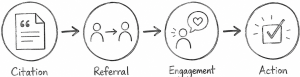 Illustration by Hezron Insights/Hezron Ochiel
Referral: Is that visibility sending people to your website?
Engagement: What do those visitors do after they arrive?
Action: Do they buy, enquire, subscribe, register or complete another meaningful action?
This connects AI visibility to stakeholder behaviour and organisational results, reflecting the wider measurement shift I explored in what PR teams should measure in 2026.
Shopify’s data gives us a practical example.
AI visitors may arrive ready to act
Shopify found that half of AI-referred sessions landed directly on product pages.
This suggests that users may now complete part of their research before they ever reach a brand’s website.
A shopper can ask an AI assistant to compare products, explain features and narrow the options before clicking through to a website. By the time they arrive, they may already have a clearer idea of what they want.
Shopify says this pattern has held consistently as AI referral traffic has grown.
That means a click from an AI platform may represent a different stage of the customer journey.
The quality of information also matters
Another Shopify finding deserves attention.
When AI systems used structured information from Shopify Catalogue to discover and recommend products, those referrals converted at twice the rate of AI visitors coming through systems relying on scraped or third-party product information.
For e-commerce businesses, this reinforces the value of clear product descriptions, specifications, attributes and other structured information.
For organisations beyond e-commerce, the broader lesson is that information which is clear, structured and easy to verify may also be easier for AI systems to understand and use.
This connects with the wider shift I have explored around Digital PR, SEO and AI visibility. Organisations increasingly need to think about how clearly they publish information, how widely it is referenced, and how easily machines can interpret it.
Organic search still matters
Shopify’s data also shows that organic search sessions grew 12% year over year and continued to send more traffic than tracked AI platforms.
Some visits influenced by AI features within search engines may still appear as organic traffic in analytics, making attribution harder and limiting what referral data alone can tell us.
I explored this challenge further in my analysis of how publishers can measure AI search visibility.
What should brands take from this?
Shopify’s findings come from ecommerce activity on its own platform, so interpret them in that context.
They still offer a useful signal: AI referrals are growing rapidly, and some of those visitors appear to arrive with strong intent.
Brands should therefore track the full journey:
Citation → Referral → Engagement → Action
Ask whether your organisation is being mentioned, whether AI platforms are sending people to your website, and what those visitors do after they arrive.
Shopify’s 197% growth figure gets attention.
The more important question is what happens after the click.
That is where AI visibility starts becoming measurable.
Hezron Ochiel is an award-winning strategic communications and public relations professional with over 15 years of experience in media, digital communication and reputation strategy. He serves as the Deputy Corporate Communications Manager at the government-owned Kenya Medical Training College (KMTC) and is the founder of Hezron Insights, where he writes about AI visibility, Digital PR, SEO, GEO and digital authority. His work has appeared on platforms including Reuters, The New Humanitarian and The Standard.