By Hezron Ochiel
African professional bodies, universities, publishers and communication experts have produced valuable public relations knowledge.
The question is whether that knowledge appears when people turn to AI for answers.
To explore this, I tested 10 common PR questions using ChatGPT, Gemini and Claude. All three tools produced useful guidance on PR strategy, stakeholder engagement, media relations, measurement, crisis communication and misinformation.
None visibly credited Hezron Insights, the Public Relations Society of Kenya, the African Public Relations Association or another clearly identifiable African PR source.
The result can be summarised simply:
10 questions tested across three AI tools → useful answers from all three → no African PR source visibly credited.
This does not prove that the tools never use African PR knowledge. It shows that no African source received visible recognition in the responses reviewed.
That distinction matters.
What the review tested
The questions reflected common information needs among communication professionals, students and organisational leaders.
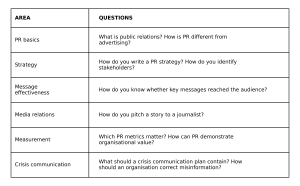
The questions were asked without naming Hezron Insights, the Public Relations Society of Kenya (PRSK), the African Public Relations Association (APRA), or another African organisation. This tested whether African sources would appear naturally when a user asked a general professional question.
For each answer, I examined the quality and structure of the response, the frameworks or organisations named, whether links or citations appeared and whether an African source received recognition.
The three tools were reviewed as user-facing answer systems rather than under identical retrieval and citation settings. ChatGPT was search-enabled and provided visible links. Gemini and Claude produced useful answers but did not consistently display the sources behind them.
The review therefore focused on what a user could actually see. Where no sources were shown, I recorded the absence of visible attribution rather than assuming that no source had been used.
Platform-level results
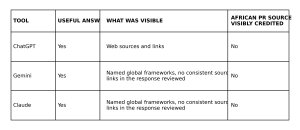
All three tools gave useful answers.
The main difference was transparency. ChatGPT displayed web sources, while Gemini and Claude relied more heavily on named frameworks and general professional guidance without consistently showing where the information came from.
Naming a framework shows its influence on the answer. It does not reveal the full set of sources used to produce it.
The main finding
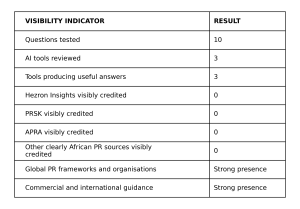
The review points to a clear gap between the quality of the answers and the recognition given to African knowledge producers.
Three patterns from the review.
1. Global frameworks gave the answers structure
The three tools repeatedly used established international models, including the Public Relations Society of America (PRSA) definition of public relations; the Research, Action Planning, Communication and Evaluation (RACE) model; the Situation, Objectives, Strategy, Tactics, Action and Control (SOSTAC) framework; the Mendelow Power-Interest Matrix; the International Association for the Measurement and Evaluation of Communication (AMEC) Integrated Evaluation Framework; and the Barcelona Principles.
These frameworks were relevant and practical. They also gave the tools an easy way to organise their answers.
Gemini structured its PR strategy guidance around research, measurable objectives, audience definition, core messages, tactics, resources and evaluation. It also used the Mendelow Matrix for stakeholder mapping and the truth-sandwich approach to correcting misinformation.
Claude referred to PRSA, the AMEC Integrated Evaluation Framework and the Barcelona Principles while connecting PR measurement to organisational outcomes.
African organisations may hold equally valuable experience, yet much of it has not been turned into named, widely referenced frameworks that can compete for the same level of recognition.
The goal is to build authority around ideas that others can clearly identify, apply and credit.
2. Answer quality was stronger than source transparency
The strongest responses appeared in areas where established guidance already exists.
PR strategy, stakeholder mapping, media pitching and crisis planning all produced clear and practical answers.
Gemini described a PR strategy as a progression from research and objectives to audiences, messages, tactics, resources and evaluation.
Claude followed a similar process while adding channel choice, budgets, contingency planning and measurement from the beginning.
The crisis-planning answers were also detailed. Both tools identified activation procedures, decision-making roles, holding statements, contact lists, designated spokespeople, monitoring and post-crisis learning as important components.
The guidance was useful, but the user could not always see which publishers, researchers or institutions had produced the underlying knowledge.
A strong answer is therefore not the same as visible source recognition.
3. The biggest opportunities appeared where judgement was required
The most interesting gaps appeared in questions about message effectiveness and organisational value.
Both Gemini and Claude recognised that communication reach is not enough.
Gemini proposed three levels: exposure, message recall and attitude shift. It also recommended checking whether media coverage carried the intended narrative and whether AI search represented the brand accurately.
Claude separated reach, message penetration, comprehension, recall, attitude change and behaviour. It described behavioural evidence as the strongest measure because it shows what people did after receiving the message.
This reinforces one practical lesson: A message can travel widely without landing as intended.
The organisational-value answers also moved beyond counting media mentions. They connected PR to trust, risk reduction, stakeholder cooperation, recruitment, investment and institutional objectives.
What remained less clear was the path from communication activity to organisational value.
A practical pathway is illustrated below.
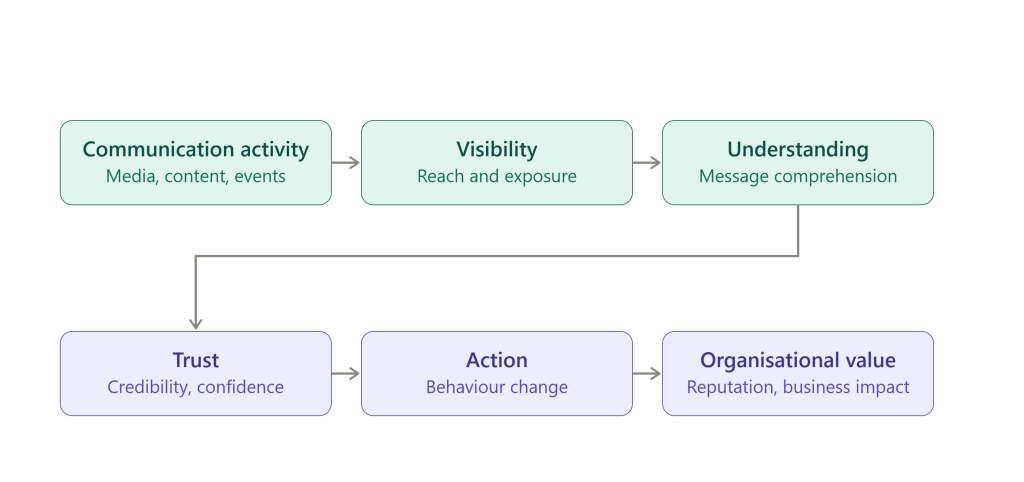
This is an area where African practitioners and researchers can contribute original evidence, case studies and frameworks grounded in local experience.
African context appeared without African attribution
Claude used a health training institution to explain stakeholder mapping and crisis planning. It referred to students, alumni, faculty, regulators, health-sector employers and communities around campuses.
That made the answer more locally relatable.
The example was not visibly connected to an African professional body, researcher, institution or published source.
This shows that African context can appear in an AI answer without strengthening the visibility of African knowledge producers.
African knowledge was easier to find when named
Separate searches produced different results.
Hezron Insights had relevant material on PR measurement, AI visibility and communication effectiveness. PRSK had professional definitions, training programmes and industry commentary. APRA had material on government communication, professional development, trust and misinformation.
The knowledge was available and became easier to retrieve after the source was named.
This reveals two levels of visibility.
Prompted visibility occurs when someone already knows the organisation or expert and searches for them directly.
Unprompted visibility occurs when the source appears naturally in response to a general question.
The three-tool review suggests that African PR knowledge has some prompted discoverability but limited unprompted visibility for the questions tested.
That matters because new audiences cannot search for a source they do not yet know.
Why African PR sources may not be appearing
Several connected factors may help explain the result.
Much professional knowledge is published as conference announcements, training programmes or event summaries. These pages show that expertise exists, but they may not provide the complete answer an AI system can easily retrieve and cite.
Useful material may also remain inside workshops, consultancy assignments and member-only programmes. This protects commercial or membership value while reducing the volume of detailed public guidance available online.
Content structure also matters. International sources often publish pages built around exact audience questions, supported by clear definitions, frameworks, templates and related resources. African organisations may discuss the same issues across speeches, reports, PDFs and event pages without bringing the knowledge together in one authoritative guide.
Global organisations also benefit from deeper content libraries and stronger digital authority. One African article may be competing against hundreds of connected pages from an established professional body, university, government or technology company.
The gap lies as much in how African knowledge is packaged, connected and made discoverable and creditable as in how much of it is produced.
What African knowledge producers should do
African professional bodies, universities and experts can begin by turning practical experience into resources built around complete audience questions.
A training, workshop or conference can become a useful public resource, such as a crisis communication guide, a PR measurement framework or a misinformation correction template grounded in an African case study.
Original evidence will be especially important. Surveys, institutional communication audits, and interviews give other publishers and AI systems a stronger reason to cite the African source rather than a general international summary.
Related resources should also be connected into a clear body of work. One article may struggle to build authority, while a group of useful pages covering the same subject can show depth and consistency.
The author and institution must be easy to identify. Publication dates, author biographies, evidence, references and related materials help establish who produced the knowledge and why the source deserves recognition.
A tighter method for future reviews
Future reviews should continue separating answer quality from source recognition.
A model may produce a strong answer without showing where the knowledge came from. The next round should therefore record the exact question, model, date, location, browsing status, visible citations, working links and African sources represented.
The same questions should also be tested under more comparable conditions, with web search or browsing enabled where available.
Three forms of testing remain useful:
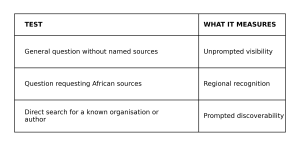
This approach makes it easier to see whether African knowledge is absent, difficult to retrieve or visible only after the source is named.
Limitations
This was an exploratory review based on 10 questions and three AI tools at a particular point in time.
The systems were not tested under identical retrieval and citation settings. ChatGPT displayed web sources, while Gemini and Claude named some frameworks and organisations without consistently showing the material influencing their answers.
The review can therefore establish whether an African source received visible recognition. It cannot fully determine which sources were used internally.
A defensible conclusion is: Across 10 common PR questions reviewed using ChatGPT, Gemini and Claude, all three tools produced useful guidance, but none visibly credited a clearly identifiable African PR organisation, publisher or expert. Relevant African material could be found when the sources were searched for directly.
It would be inaccurate to conclude that the tools never use African sources.
From knowledge to recognition
The expanded review points to one clear lesson: African PR knowledge is available, but it needs to be easier to find when people need it.
Publishing alone is not enough. The work must be easy to find, clearly credited and connected to the people and institutions that produced it.
The real test is what comes back.
Hezron Ochiel is an award-winning strategic communications and public relations professional with over 15 years of experience in media, digital communication, and reputation strategy. He serves as the Deputy Corporate Communications Manager at the government-owned Kenya Medical Training College (KMTC) and is the founder of Hezron Insights, where he writes about AI visibility, Digital PR, SEO, GEO, and digital authority. His work has appeared on platforms including Reuters, The New Humanitarian, and The Standard.