
Learn how to turn career experience into consulting, training, books and advisory services using a practical five-part framework.
By Hezron Ochiel
The business idea you are looking for may already be hiding inside the advice people keep asking you for.
Steven Bartlett offers a useful example through The Diary of a CEO, a podcast that organises private lessons from leaders, entrepreneurs and experts into public knowledge that millions of people can learn from.
Forbes ranked the British entrepreneur No. 3 on its 2026 Top Creators list, with estimated earnings of $52 million.
That figure points to something bigger than podcast popularity. It shows how organised knowledge, trust and distribution can become a serious business.
At the centre of it is one simple idea: lessons trapped inside private conversations can become valuable when they are organised and shared.
Africa has valuable knowledge that remains undocumented
Across Africa, professionals have developed valuable expertise through years of working with limited resources, changing technology, and complex stakeholder expectations.
A communication professional may know how to protect institutional trust during a crisis because they have handled pressure in real institutions, with real people, real risks and limited time to respond.
That is the kind of knowledge Africa needs to document more deliberately.
Many of these lessons are still passed through mentorship, workplace conversations and observation. Some are captured in internal reports that never reach a wider audience.
Many professionals hesitate to publish because they fear appearing self-promotional. Others work in organisations that have no clear guidance on employee visibility. Some are too busy solving problems to document what they have learned.
This leaves a growing knowledge gap.
Search results may contain plenty of general advice and very few practical examples from African environments. AI systems also depend on documented, accessible knowledge.
When African expertise remains hidden, it has little opportunity to shape professional practice, public debate, policy or the answers produced by search and AI tools.
The demand for practical knowledge is also growing as work continues to change.
The World Economic Forum reports that employers expect 39 per cent of workers’ existing core skills to change by 2030. Skills gaps are also considered the biggest barrier to organisational transformation by 63 per cent of surveyed employers.
World Bank research examining millions of job advertisements in Kenya, Nigeria, South Africa and Uganda found that nearly half required at least one digital skill.
People will increasingly need guidance from professionals who understand these evolving skills and the environments in which they must be applied.
Africa needs more professionals who can turn experience into knowledge that is documented, structured and easy to discover.
Your career has been building professional capital
Every year you spend working gives you much more than a salary. It builds professional capital.
Professional capital is the judgement, methods, relationships and practical understanding you develop through experience. It helps you know what to do, what to avoid, which questions to ask and which warning signs deserve attention.
This kind of knowledge often shows itself in simple ways.
An experienced communication officer may recognise when a small complaint is likely to become a public crisis. That judgment may feel ordinary to them, yet it can be extremely valuable to someone who has not learned how reputation risks begin.
Begin by examining the work people already bring to you.
Ask yourself:
-
- What do people keep asking me to explain?
- Which problems am I trusted to solve?
- What knowledge could save someone time, money or frustration?
Your answers may reveal the foundation of a knowledge business.
When knowledge becomes a business
Knowledge becomes a business when it serves a defined audience, solves a meaningful problem, creates a useful outcome and is packaged into a clear offer.
The audience shows you who you serve. The problem gives your expertise a purpose. The outcome explains the progress you help create. The offer presents that knowledge in a form people can use or purchase.
Think of a communication professional who knows how to conduct organisational communication audits.
That experience could begin as one useful article explaining common communication gaps. Later, it may grow into a checklist, a workshop, a consulting assignment or an advisory service that helps institutions improve how they communicate.
The same knowledge can serve people at different levels. People value the progress your knowledge helps them make.
The professional knowledge value framework
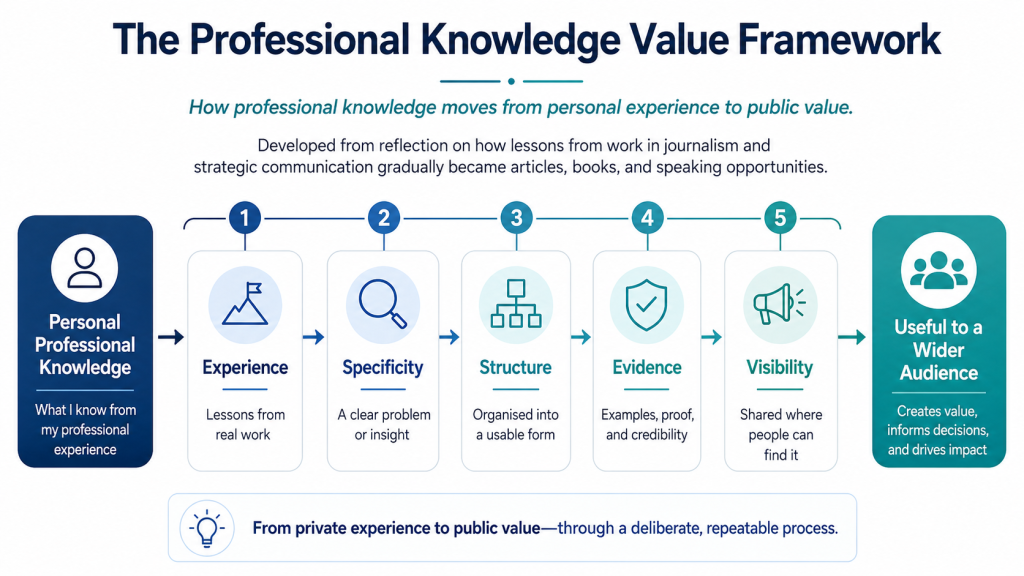
I developed the Professional Knowledge Value Framework after reflecting on how lessons from my work in journalism and strategic communication gradually became articles, books, and speaking opportunities.
The process revealed five elements that determine whether professional knowledge remains personal or becomes useful to a wider audience:
These elements support one another.
Experience gives your knowledge depth. Specificity makes it clear who the knowledge is for. Structure turns your lessons into something others can follow. Evidence gives people a reason to trust you. Visibility helps the right audience find and use your expertise.
You can visualise the framework this way:
| No. | Element | What it answers |
| 1 | Experience | What have you learned through real work? |
| 2 | Specificity | Who needs this knowledge, and what problem does it solve? |
| 3 | Structure | How can you organise it so someone else can follow it? |
| 4 | Evidence | What proves that your knowledge is grounded in reality? |
| 5 | Visibility | Where can the right people find and assess your expertise? |
1. Experience
Useful knowledge begins with genuine understanding.
You should know the problem well enough to explain it, recognise common mistakes and guide someone towards a useful outcome.
Qualifications can strengthen credibility. Practical depth comes through repeated application in real situations.
Someone who has led several communication audits understands more than the questions included in a survey. They may know how to secure management support, encourage staff participation, interpret conflicting findings and turn recommendations into action.
Those lessons provide examples, judgment, and context that general information may not offer.
2. Specificity
Broad expertise is difficult for people to understand and use.
“I teach leadership” leaves many questions unanswered.
“I help newly promoted supervisors lead former colleagues effectively” identifies a clearer audience, situation and problem.
Specificity helps people recognise when your knowledge applies to them. It also gives you a stronger foundation for developing articles, training, and services that address a real need.
A narrower problem often makes the value of your knowledge easier to recognise.
3. Structure
Experience often begins as stories, instincts and lessons.
A process, checklist, model or framework organises those lessons into something another person can follow.
You may know instinctively how to respond during a communication crisis. Turning that instinct into an assessment process gives other people a way to learn and apply it.
A useful structure shows people where to begin, which steps to follow and which mistakes to avoid.
A framework gains value when it improves understanding, decisions or action. Naming familiar advice without adding clarity will not be enough.
4. Evidence
People trust knowledge when they can see that it is grounded in reality.
Evidence may come from direct professional experience, original research, documented case studies, measurable outcomes or credible independent sources.
Explain the problem, the action taken and what changed.
Where several factors contributed to an outcome, acknowledge them. One communication activity may have supported institutional recruitment alongside media coverage, community outreach, management decisions and other interventions.
Careful attribution makes your work more credible and easier for journalists, researchers and other professionals to reference.
A framework supported by documented experience carries greater weight than one presented as an unsupported opinion.
5. Visibility
Knowledge creates greater value when the intended audience can find it.
You may publish through your website, LinkedIn profile, newsletter, book, conference presentation or professional association platform.
Visibility has become increasingly important as search and AI tools influence how people find experts.
Search Engine Land argues that credibility in the current search environment grows through legitimacy, authority and trust. Original research, expert commentary, credible media coverage and editorial citations can provide stronger authority signals than large numbers of weak backlinks.
A job title tells people where you work. Published knowledge helps them understand how you think and whether your expertise is relevant to their needs.
Visibility gives your expertise a chance to be considered.
Begin with a problem people already care about
Many professionals begin by creating a course, book or training programme. A more useful starting point is understanding the problem people already want to solve.
Speak to the audience you hope to serve.
Study the questions they ask in meetings, professional groups, online communities and search engines. Find out what they have tried, where they remain stuck and what a useful outcome would look like.
These conversations will help you turn a broad subject into a practical offer.
For example, “teaching communication measurement” may become helping communication teams move from counting media mentions to measuring trust, search visibility and stakeholder action.
That kind of clarity gives people a stronger reason to act because they can see the problem, the audience and the outcome.
Write a transformation statement
A transformation statement connects your expertise to a result.
Use this structure: I help [a specific group] move from [a defined problem] to [a useful outcome] so that they can [a wider benefit].
For example: I help communication teams move from counting media mentions to measuring trust, search visibility and stakeholder action so that they can demonstrate the value of public relations.
This statement can guide what you write about, which services you develop and which opportunities support your positioning.
It also helps you avoid spreading your attention across unrelated subjects.
Turn knowledge into an offer
Once you understand the problem, consider how much support the audience needs.
The right offer depends on how much help your audience needs. Some people only need a guide. Others need training, diagnosis or continued advice.
Your knowledge can become:
- Articles and newsletters that help people understand the problem and discover your expertise.
- Guides, books and templates that organise knowledge into a form people can use independently.
- Workshops and training that give people room to learn, ask questions and practise applying the knowledge.
- Consulting that applies your expertise to a particular client or organisation.
- Advisory services that give a client continuing access to your judgement and guidance.
- Courses and group programmes that allow one method to serve several people facing a similar problem.
You do not need to offer every format. Choose the one that fits the problem, the buyer and the amount of support required.
Find out who will pay
A useful idea becomes commercially viable when someone values the outcome enough to pay for it.
The person using the knowledge may not control the budget.
A communication officer may value an audit framework, and senior management may be the one to approve the consultancy. That difference matters because the user, the beneficiary and the buyer are not always the same person.
Identify who experiences the problem, who benefits from solving it and who makes the purchasing decision.
You can then explore what the unresolved problem is costing them.
Does it waste staff time, reduce revenue, damage trust, delay decisions or create compliance risks?
The greater the cost of the problem, the easier it becomes to explain the value of solving it.
Pricing should reflect the outcome, complexity and level of support involved. A downloadable guide and a six-month advisory assignment may draw from the same expertise, yet they provide very different levels of value.
Test before you build
You can test your idea before investing in an expensive website or a large library of recorded lessons.
Begin with a smaller version.
You could:
- Write several articles around the problem
- Develop a checklist
- Host a focused webinar
- Run a pilot workshop
- Offer a limited number of advisory sessions
Then study the response.
Ask:
-
- Which questions keep appearing?
- What do people struggle to apply?
- Which outcomes matter most to them?
- Are they willing to register, refer others or pay?
A pilot workshop with ten committed participants may teach you more about the market than a post that receives thousands of views.
Attention shows that a subject has attracted interest. Action reveals that the problem matters. Payment provides stronger evidence that the offer has commercial value.
Build a credible body of knowledge
One article can introduce your expertise. A connected body of work helps people recognise it.
Choose three or four subjects you understand deeply and identify the main problems within them.
A communication professional may build around communication strategy, reputation, digital visibility and leadership communication.
Those subjects can produce articles, frameworks, guides, research, training and expert commentary. Together, they begin to support one another.
Different audiences discover your expertise in different ways. Journalists see a credible source of informed commentary. Conference organisers identify topics you can speak about with authority. Potential clients gain a clearer understanding of the problems you can help them solve.
Search engines and AI systems also receive more consistent signals about the subjects associated with your name.
Your body of work then becomes evidence that your expertise extends beyond one successful post or a polished profile.
Create knowledge people can cite
Millions of people publish opinions. Credible authority grows when you create resources that others can confidently reference.
These may include:
-
- Original survey findings
- Documented case studies
- Practical frameworks
- Industry benchmarks
- Analysis grounded in direct experience
Original research gives journalists and other writers information they cannot easily obtain elsewhere. A detailed African case study can also fill a gap left by broad global sources.
Before publishing, ask: What does this article contribute that the reader cannot easily find somewhere else?
The answer may be your data, professional experience, framework, local context or interpretation of a changing issue.
Publishing gives you an asset that you own. Independent mentions, links and citations show that other people consider it useful.
Build trust beyond your own platforms
Authority becomes stronger when credible people and institutions recognise your work.
Useful relationships help knowledge travel.
For example, a journalist may need timely expert commentary. When your knowledge helps them explain an issue clearly, your expertise becomes useful beyond your own platform.
Your credibility grows when your expertise helps trusted people and brands perform their work well.
The aim is to become a source people trust.
Measure Authority and Business Progress
Views, followers and website traffic can show that people have encountered your work.
A fuller picture comes from examining the opportunities and results that follow.
Experts recommend measuring signals such as earned media placements, branded searches, industry coverage and conversions alongside traffic and rankings.
For a professional knowledge business, useful measures may include:
- Invitations to speak, train or contribute
- Mentions by credible publications
- Relevant backlinks and citations
- Searches for your name or platform
- Enquiries connected to specific articles
- Proposals requested
- Paying clients
- Repeat assignments
- Referrals
- Revenue from each offer
- Visibility in relevant search and AI-generated answers
These measures show whether your authority is creating useful professional and commercial outcomes.
A post with modest engagement may lead to a serious institutional enquiry. Another may attract thousands of reactions and produce little connection to the work you want to do.
Measure the signals that move your knowledge business forward.
Professional visibility can strengthen employers
Professionals sometimes worry that publishing their knowledge may create tension with their employer.
Handled responsibly, employee visibility can strengthen the individual and the institution.
Professionals who share useful insights can help organisations explain their work, demonstrate the quality of their people and contribute to public understanding.
This requires respect for:
-
- Confidentiality
- Intellectual property
- Institutional policies
- Team contributions
Share principles without exposing sensitive information. Acknowledge colleagues and organisational support where appropriate, and avoid claiming sole ownership of work completed by a team.
Confidential workplace information should never become the foundation of a private product without permission.
Credibility depends on integrity.
Knowledge business readiness checklist
Before turning your experience into a product or service, ask:
• What problem do people trust me to solve?
• Who needs this solution most?
• What result are they willing to pay for?
• What evidence shows I understand the problem?
• Can I explain my method clearly?
• Which format will serve them best?
• Where can they find my expertise?
• What small version can I test first?
A checklist like this helps you avoid building an offer around an idea that sounds good but does not solve a clear problem.
A Seven-Day Starting Plan
Day 1: Write down ten questions people regularly ask you.
Day 2: Group them under three subjects you understand well.
Day 3: Choose one audience and one problem you can help solve.
Day 4: Write a transformation statement describing the outcome.
Day 5: Speak to three people who currently face the problem.
Day 6: Create one useful article, checklist or short webinar.
Day 7: Publish or deliver it and ask for honest feedback.
Use the response to decide what to develop next.
The next step may be a guide, workshop, consulting service, course or advisory programme.
Begin by gathering evidence that your knowledge is useful.
Frequently Asked Questions
What is a knowledge business?
A knowledge business turns professional experience or specialised expertise into products and services that help a defined audience achieve a useful outcome. These may include consulting, training, books, workshops, courses, research or advisory programmes.
How can professionals identify valuable knowledge?
Begin with the problems you repeatedly solve, the questions people regularly ask and the lessons that could save others time, money or frustration.
Do I need a large audience to build a knowledge business?
A relevant audience that trusts your expertise may create more value than a much larger audience with little interest in the problem you solve.
What is the difference between professional visibility and a knowledge business?
Professional visibility helps people discover and assess your expertise. A knowledge business packages that expertise into an offer that helps a defined audience achieve an outcome.
How can I choose the right knowledge product?
Consider the complexity of the problem and the amount of support the audience needs. Straightforward problems may suit guides or courses. Complex problems may require workshops, consulting or continued advice.
How does publishing expertise improve AI visibility?
Consistent, well-structured and evidence-backed publishing helps search and AI systems understand the subjects associated with your name. Relevant mentions and citations from trusted third parties strengthen those signals.
Can employees build authority without competing with their organisations?
Employees can share general lessons, frameworks and professional insights as they respect confidentiality, intellectual property, workplace policies and team contributions.
Final thought
Africa has many experienced professionals.
What remains in short supply is African expertise that has been documented, structured, supported with evidence and made easy to discover.
Your career may already have given you knowledge that can help someone avoid a mistake, solve a problem or make a better decision.
Begin with one problem people already trust you to solve. Document it, structure it and share it in a form others can use.
Your experience has already created the raw material.
A knowledge business allows that experience to serve people far beyond the places where it was first gained.
Hezron Ochiel is a strategic communications and public relations professional with over 15 years of experience in media, digital communication, and reputation strategy. He serves as the Deputy Corporate Communications Manager at the government-owned Kenya Medical Training College (KMTC) and is the founder of Hezron Insights, where he writes about AI visibility, Digital PR, SEO, GEO, and digital authority. His work has appeared on platforms including Reuters, The New Humanitarian, and The Standard.